Human Wildlife Conflict and Elephant Corridor Management in Jharkhand
Source:Indian Express ↗
Why It Matters
Human-wildlife conflict is a recurring theme in UPSC, as it balances biodiversity conservation with the safety and livelihood of local communities. Understanding the causes (like habitat fragmentation) and mitigation strategies is crucial for both Prelims and Mains (GS3).
Summary
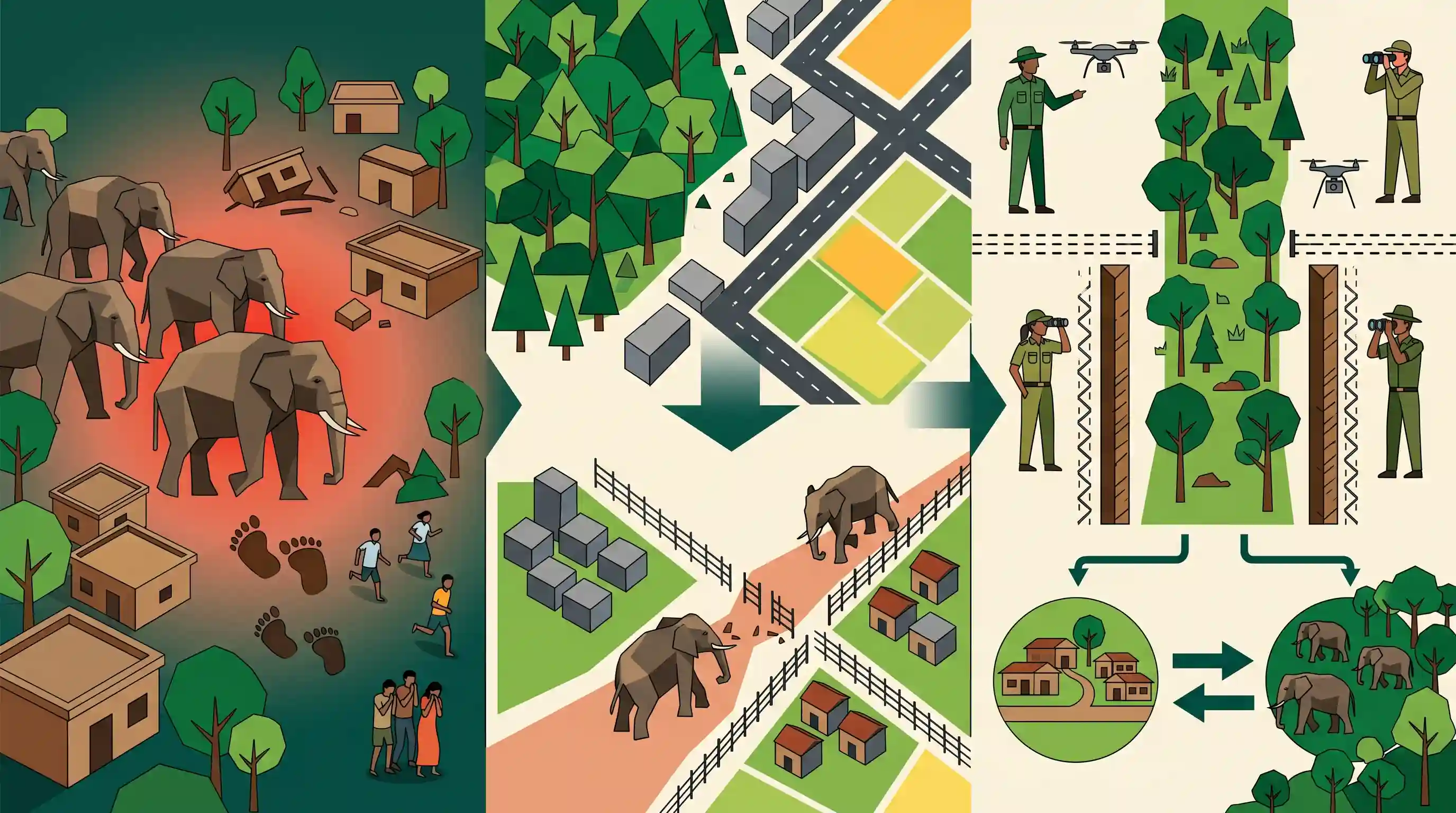
In Jharkhand's Hazaribagh district, a herd of wild elephants has caused the deaths of 12 people within just 10 days, leading to immense panic. The intense human-wildlife conflict has forced many villagers to flee their homes to seek refuge. This tragedy highlights the broader issue of man-animal conflict in India, which is exacerbated by habitat destruction, fragmentation of elephant corridors, and human encroachment into forest areas. The situation underscores the urgent need for robust wildlife management and mitigation strategies by the authorities.
Key Points
- A wild elephant herd has killed 12 people in a span of 10 days in Jharkhand's Hazaribagh district, sparking widespread panic.
- The escalating violence has forced residents of the affected villages to flee their homes in search of safety.
- The incident draws attention to the severe human-elephant conflict in the region, largely driven by habitat fragmentation, mining activities, and encroachment on traditional elephant corridors.
- There is an urgent need for the Forest Department to implement effective mitigation measures such as early warning systems, securing elephant corridors, and rapid response teams.
Important Terms
Human-Wildlife Conflict (HWC)

Interactions between humans and wildlife that lead to negative impacts on social, economic, or cultural life, often resulting from competition for space and resources in fragmented habitats.
UPSC context
GS Paper III: Environment and Biodiversity. Tests understanding of ecological challenges and conflict mitigation strategies.
Project Elephant
A centrally sponsored scheme launched in 1992 (merged with Project Tiger in 2023) to protect elephants, their habitats, and corridors while ensuring the welfare of captive animals.
UPSC context
GS Paper III: Conservation. Focuses on flagship conservation programs and species-specific management frameworks.
Wildlife Protection Act (WPA), 1972
India's primary wildlife legislation providing protection to animals, birds, and plants. The 2022 amendment reduced schedules to four, placing elephants under Schedule I for highest protection.
UPSC context
GS Paper II & III: Environmental Laws. Tests knowledge of statutory frameworks and recent legislative amendments.
Elephant Corridors
Narrow strips of land facilitating the movement of elephants between two larger forest habitats. India has 150 identified corridors crucial for genetic diversity and reducing conflict.
UPSC context
GS Paper III: Biodiversity and Geography. Tests knowledge of habitat connectivity and spatial conservation planning.
Asian Elephant (Elephas maximus)
The species native to mainland Asia, classified as 'Endangered' on the IUCN Red List and recognized as India’s 'National Heritage Animal' with maximum legal protection.
UPSC context
GS Paper III: Species in News. Tests status, distribution, and ecological importance of keystone species.
Prelims Trap
Karnataka, having the highest elephant population, also has the highest number of identified elephant corridors in India.
While Karnataka has the highest elephant population, the 'Elephant Corridors of India 2023' report explicitly states that West Bengal has the highest number of elephant corridors (26).
Static Concepts Connected
What are the key biological traits and legal protections of the Indian Elephant?
- Matriarchal leadership: Elephant herds have a matriarchal social structure, typically led by the oldest and most experienced female.
- Gestation period: Elephants possess the longest gestation period of all mammals, lasting up to 22 months.
- Legal protection: They are listed as Endangered on the IUCN Red List and enjoy the highest legal protection under Schedule I of the Wildlife Protection Act, 1972.
What are the legal provisions regarding ownership and liability for wild animals in India?
- Government property: Under Indian jurisprudence and the WPA 1972, wild animals are considered the "sole property of the government," regardless of whether they are inside or outside protected areas.
- State liability: Because wild animals are state property, the state bears the onus to manage them and compensate citizens for crop damage, injury, or loss of life during wildlife conflicts.
Cross-Topic Patterns
Coal mining vs Elephant Corridors
Jharkhand's Hazaribagh and Dhanbad coalbelts directly overlap with traditional elephant migratory routes. UPSC often links regional economic geography (resource extraction) to localized environmental degradation and wildlife displacement.
Project RE-HAB and Rural Incomes
Using "bee fences" to deter elephants serves a dual purpose: mitigating wildlife conflict while simultaneously boosting rural livelihoods via KVIC's National Honey Mission (the Sweet Revolution).

Expect a 2026 Prelims statement linking 'Elephant Corridors of India 2023' data, Project RE-HAB, and government ownership of wild animals.
Linked PYQs · 2
Linked PYQs · 2
- 2020PrelimsGS1
With reference to Indian elephants, consider the following statements: 1. The leader of an elephant group is a female. 2. The maximum gestation period can be 22 months. 3. An elephant can normally go on calving till the age of 40 years only. 4. Among the States in India, the highest elephant population is in Kerala. Which of the statements given above is/are correct?
- 2022PrelimsGS1
With reference to Indian laws about wildlife protection, consider the following statements : 1. Wild animals are the sole property of the government. 2. When a wild animal is declared protected, such animal is entitled for equal protection whether it is found in protected areas or outside. 3. Apprehension of a protected wild animal becoming a danger to human life is sufficient ground for its capture or killing. Which of the statements given above is/are correct?
