Aravalli FSI report suppression alleges amicus curiae in Supreme Court
Source:Indian Express ↗
Why It Matters
It exposes the institutional challenges and transparency deficits within environmental governance in India. For UPSC aspirants, it provides a contemporary example of policy contradictions, the ongoing debate over the definition of 'forests' post the Godavarman judgment, and the proactive role of the Supreme Court in environmental jurisprudence.
Summary
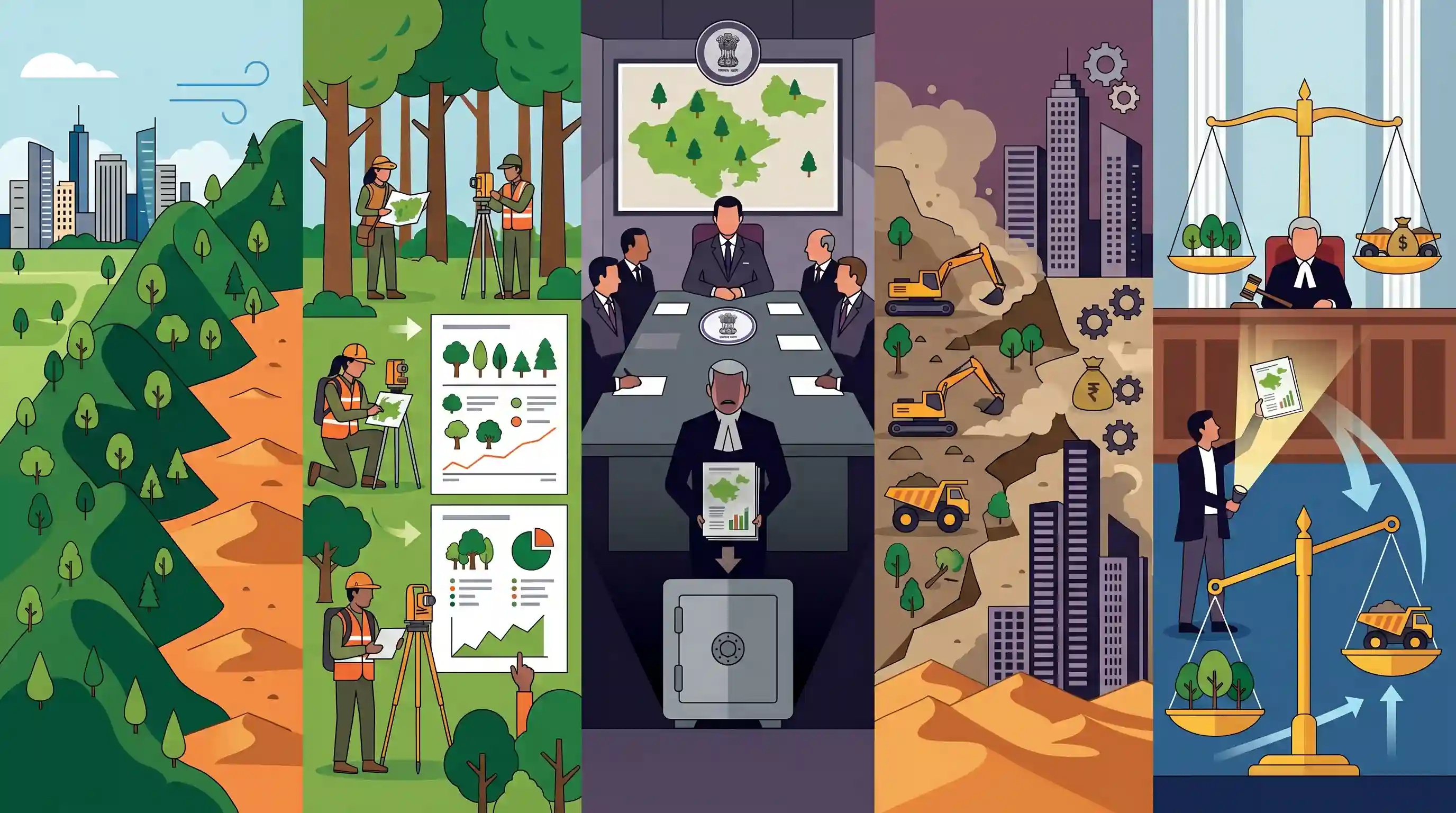
A recent controversy has emerged in the Supreme Court where the Amicus Curiae alleged that a panel headed by the Secretary of the Ministry of Environment, Forest and Climate Change (MoEFCC) suppressed the views of the Forest Survey of India (FSI) regarding the Aravalli range. The FSI's withheld inputs were crucial for defining and identifying 'forests' in the region. This suppression is seen as an attempt to dilute forest conservation norms, potentially opening up the ecologically fragile Aravalli hills—which act as a barrier against desertification for the NCR—to illegal mining and real estate development. The issue underscores the tension between executive developmental priorities and environmental conservation, highlighting the vital role of the judiciary and independent assessments in environmental governance.
Key Points
- The Amicus Curiae informed the Supreme Court that a high-level committee led by the MoEFCC Secretary allegedly suppressed the views of the Forest Survey of India (FSI) regarding the Aravalli range.
- The FSI's withheld perspective reportedly pertained to the identification and definition of 'forests' in the region based on their dictionary meaning, a criteria established by the landmark Godavarman judgment.
- Suppressing the FSI's scientific and technical assessment raises concerns over potential dilution of environmental safeguards to benefit real estate and mining lobbies in the ecologically sensitive Aravalli region.
- The incident highlights significant governance issues, policy contradictions among government bodies, and the crucial role of judicial oversight (and the Amicus Curiae) in ensuring environmental protection.
- The Aravalli hills serve as a critical ecological barrier preventing the eastward expansion of the Thar desert into the NCR, making their conservation vital.
Important Terms
T.N. Godavarman Thirumulpad Judgment

Landmark 1996 Supreme Court ruling that expanded the legal definition of 'forest' beyond notified areas to include lands fitting the 'dictionary meaning,' regardless of ownership or classification.
UPSC context
GS3 Environment/GS2 Judiciary; fundamental to understanding legal conflicts over the 2023 Forest Conservation amendments and forest land identification.
Forest Survey of India (FSI)
A premier national organization under MoEFCC responsible for periodic monitoring of India’s forest resources, best known for publishing the biennial 'India State of Forest Report' (ISFR).
UPSC context
GS3 Environment; the primary source of official data for forest cover, canopy density, and carbon stock assessments in India.
Forest (Conservation) Act, 1980
Legislation governing the diversion of forest land for non-forestry purposes; amended in 2023 to primarily cover lands officially notified or recorded as forests in government records.
UPSC context
GS3 Environment/GS2 Governance; tests knowledge of regulatory frameworks for conservation versus developmental projects and recent legislative shifts.
Aravalli Range
An ancient mountain system in Northwest India serving as a critical ecological barrier against desertification for the NCR and a major groundwater recharge zone.
UPSC context
GS1 Geography/GS3 Environment; essential for questions on regional ecology, resource conservation, and the environmental impact of mining.
Ministry of Environment, Forest and Climate Change (MoEFCC)
The central nodal agency responsible for planning and overseeing India’s environmental, forest, and wildlife policies and the implementation of conservation-related legislation.
UPSC context
GS2 Government Policies/GS3 Environment; relevant for understanding the executive's role in environmental governance and policy formulation.
Amicus Curiae
A 'friend of the court'—an impartial legal professional or expert appointed by the judiciary to provide specialized information or advice on a complex case.
UPSC context
GS2 Judiciary; tests understanding of judicial processes and mechanisms used by the Supreme Court in public interest litigations.
Prelims Trap
Legal protection under the Forest Conservation Act applies only to areas officially notified as 'forests' in government land records.
The 1996 Godavarman judgment ruled that 'forest' must be understood by its dictionary meaning, extending protection to unclassified, private, and deemed forests regardless of official notification.
Static Concepts Connected
What did the Godavarman (1996) judgment establish regarding forests?
- Dictionary Meaning: It expanded the definition of a 'forest' to include its dictionary meaning, irrespective of land ownership, classification, or official notification.
- Expanded Scope: It brought unclassed forests, private forests, and 'deemed' forests under the regulatory purview of the Forest (Conservation) Act, 1980, curbing unchecked deforestation.
- Judicial Oversight: It empowered the Supreme Court to actively monitor forest governance, leading to the creation of instruments like the Central Empowered Committee (CEC).
What is the geographical and ecological significance of the Aravallis?
- Desertification Barrier: They act as a vital ecological buffer (a 'Green Wall') preventing the eastward expansion of the Thar Desert into the fertile NCR and Indo-Gangetic plains.
- Oldest Fold Mountains: They are one of the world's oldest fold mountain systems (relict mountains), spanning Gujarat, Rajasthan, Haryana, and Delhi.
- Groundwater Recharge: The heavily fractured rocks of the Aravallis serve as critical recharge zones for the region's depleted groundwater aquifers.
Cross-Topic Patterns
FCA Amendment 2023 vs. Godavarman
The Aravalli dispute reflects clashes over the Forest (Conservation) Amendment Act 2023, which restricts protection to officially recorded forests, effectively countering the Godavarman 'dictionary meaning' mandate.
UNCCD and the Aravalli Green Wall
Ecological degradation of the Aravallis directly ties into India's UNCCD targets. The Aravalli Green Wall project aims to restore a 1,400km buffer to stop desertification towards the NCR.

FCA Amendment 2023 vs Godavarman 'forest' definition, combined with Aravalli ecology, will likely form a multi-statement Prelims question.
Linked PYQs · 3
Linked PYQs · 3
- 2022MainsGS2
“The most significant achievement of modern law in India is the constitutionalization of environmental problems by the Supreme Court.” Discuss this statement with the help of relevant case laws.
- 2018MainsGS2
“Policy contradictions among various competing sectors and stakeholders have resulted in inadequate 'protection and prevention of degradation' to environment.” Comment with relevant illustrations.
- 2025MainsGS3
Mineral resources are fundamental to the country's economy and these are exploited by mining. Why is mining considered an environmental hazard? Explain the remedial measures required to reduce the environmental hazard due to mining.
