Bihar Assembly Debates Proposed Rural Taxes on Holding and Water
Source:uni-india ↗
Why It Matters
Highlights the financial empowerment of Gram Panchayats and the constitutional requirement for State Legislature approval to levy local taxes, intersecting with BPSC themes on local governance and the rural economy.
Summary
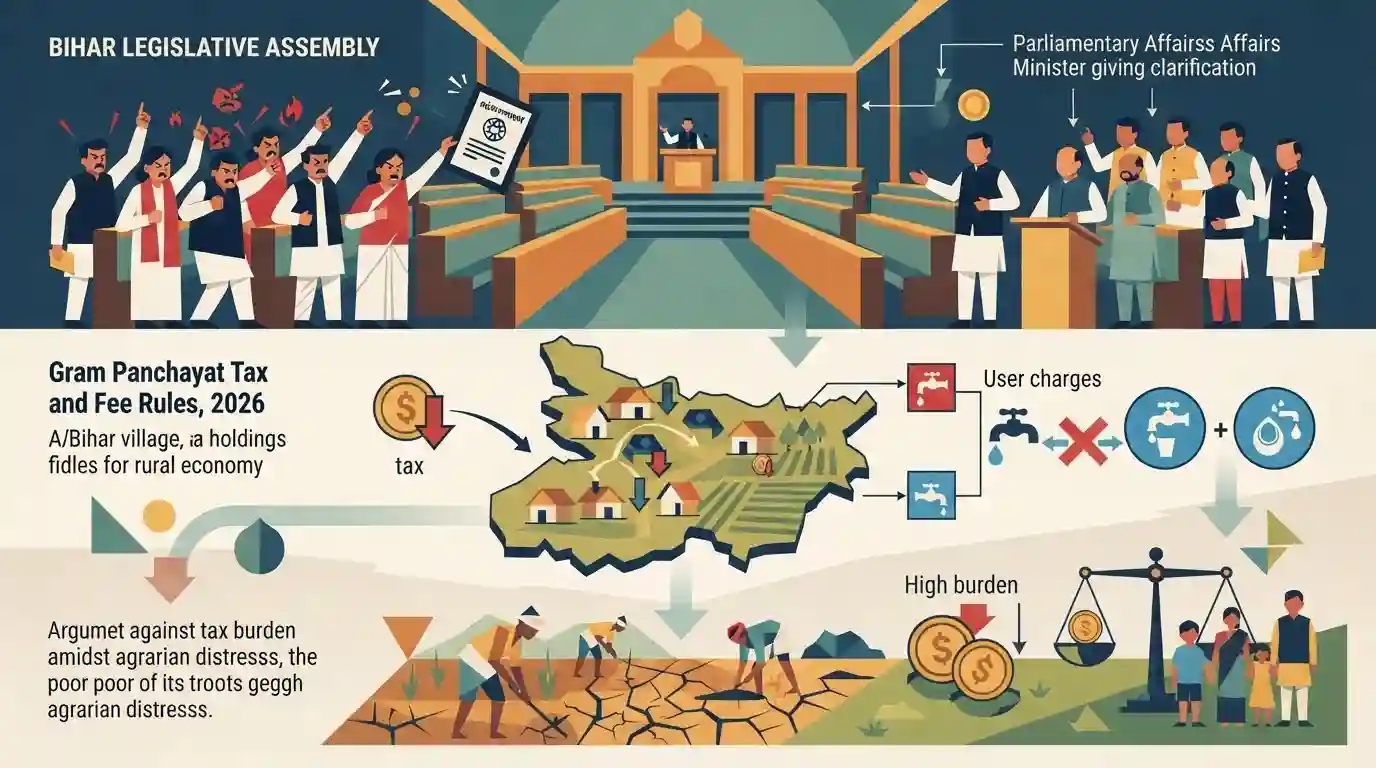
The Bihar Legislative Assembly witnessed protests after the CPI(ML) raised an adjournment motion opposing the government's proposal to impose holding taxes and user charges for water and sanitation in rural areas under the 'Gram Panchayat Tax and Fee Rules, 2026'. The opposition argued the taxes would burden the rural poor amidst agrarian distress. However, the Parliamentary Affairs Minister clarified that no such tax can be implemented without formal approval from the state legislature.
Key Points
- The CPI(ML) moved an adjournment motion in the Bihar assembly to protest a proposed holding tax on rural households and commercial establishments.
- The proposed 'Gram Panchayat Tax and Fee Rules, 2026' aims to empower gram panchayats to levy taxes on structures like houses, shops, brick kilns, and marriage halls, alongside sanitation and water charges.
- The opposition argued that imposing taxes on rural residents is unjust given the prevailing agrarian crisis, inflation, and lack of basic services like health and employment.
- Parliamentary Affairs Minister Vijay Choudhary clarified that local bodies cannot enforce new taxes without the explicit approval and legislative backing of the State Legislature.
Important Terms
Gram Panchayat Tax and Fee Rules, 2026

A framework approved by the Bihar Cabinet authorizing village panchayats to levy holding taxes on properties and user charges for civic services, aiming to boost independent local revenues.
UPSC context
GS Paper 2 (Panchayati Raj). Highlights fiscal decentralization and the devolution of taxation powers to local bodies under Article 243H.
Gram Panchayats
The grassroots tier of rural local self-government in India, tasked with civic administration, local economic development, and the implementation of social justice at the village level.
UPSC context
GS Paper 2 (Local Self-Government). Tests the structural provisions, functioning, and financial empowerment of rural local bodies under the 73rd Amendment.
Bihar Legislative Assembly
The directly elected lower house of Bihar's bicameral state legislature, responsible for debating policies, enacting laws, and holding the state executive accountable for its actions.
UPSC context
GS Paper 2 (State Legislature). Examines legislative procedures, democratic accountability, and the state legislature's role in debating and passing taxation bills.
State Cabinet
The highest executive policy-making body in a state government, consisting of senior ministers led by the Chief Minister, responsible for approving draft rules and legislative proposals.
UPSC context
GS Paper 2 (State Executive). Tests the functioning of the parliamentary system at the state level and the processes of executive decision-making.
CPI(ML)
The Communist Party of India (Marxist-Leninist) Liberation is a left-wing political party in India that actively participates in elections and campaigns primarily on issues of agrarian distress and rural poverty.
UPSC context
GS Paper 2 (Political Parties). Relevant to the study of India's multi-party system, ideological politics, and the role of opposition in highlighting grassroots issues.
Prelims Trap
Panchayati Raj Institutions possess inherent constitutional powers under Part IX to levy and collect local taxes independent of state legislative approval.
Under Article 243H, Panchayats do not have independent or inherent taxation powers; their power to tax is entirely contingent upon explicit enablement by a law passed by the State Legislature.
Static Concepts Connected
What constitutional provisions govern the taxation powers and finances of Panchayati Raj Institutions?
- Article 243H: Empowers the State Legislature to pass laws authorizing Panchayats to levy, collect, and appropriate specified taxes, duties, tolls, and fees.
- Article 243-I: Requires the Governor to constitute a State Finance Commission every five years to review PRI finances and recommend revenue allocation.
- Consolidated Fund Devolution: Enables state laws to provide grants-in-aid to Panchayats from the Consolidated Fund of the State to support developmental activities.
What are the procedural rules governing an Adjournment Motion in Indian legislatures?
- Purpose: An extraordinary device introduced to draw the attention of the House to a definite matter of urgent public importance.
- Censure Element: Because it interrupts normal proceedings and carries an element of censure, it is strictly restricted to the lower house (Lok Sabha/Assembly).
- Admissibility Rules: Must be admitted only with the Speaker's consent and must not deal with any matter that is sub-judice or raise privilege questions.
Cross-Topic Patterns
PRI Fiscal Autonomy and Decentralization
True democratic decentralization is paralyzed without fiscal autonomy; rural taxation disputes highlight why PRIs remain administratively weak and heavily reliant on top-down state grants.
Executive Rule-Making vs. Legislative Supremacy
The friction between executive-formulated rules (Gram Panchayat rules) and the mandatory constitutional requirement for legislative backing illustrates the fine lines of delegated legislation.

Analysis of PRI fiscal distress and the constitutional limits of local body taxation under Article 243H will be a key GS-II theme.
Linked PYQs · 4
Linked PYQs · 4
- 2024-EBPSC_PRELIMSGS1
Under Article “243J” which of the following can make provisions to the maintenance of accounts by Panchayats?
- 2025BPSC_PRELIMSGS1
Who is empowered to review the financial position of the Panchayats?
- 2024-EBPSC_PRELIMSGS1
What is the contribution of agriculture in the Gross Domestic Product (GDP) of Bihar?
- 2023BPSC_PRELIMSGS1
Which one of the following is correct for Bihar economy?
