Himachal Pradesh amends Panchayati Raj Act to include daughter-in-law
Source:theprint ↗
Why It Matters
Important for understanding amendments in grassroots democracy laws, women's inclusion, and legal definitions governing local bodies.
Summary
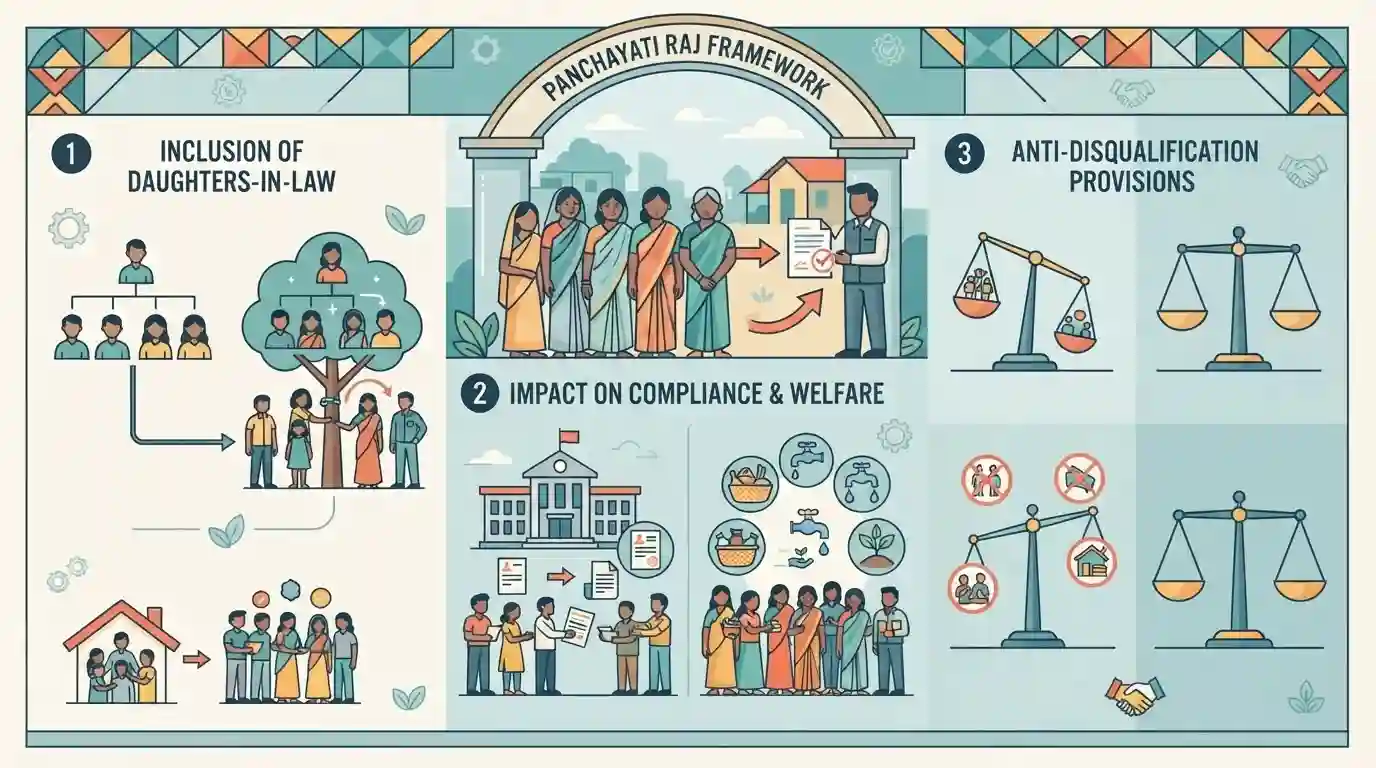
The passage of the Panchayati Raj Amendment Bill brings significant changes to local self-government regulations by modifying the definition of 'family' to incorporate daughters-in-law, affecting compliance, welfare distribution, and anti-disqualification provisions under state panchayati raj frameworks.
Key Points
- The Panchayati Raj Amendment Bill has expanded the legal definition of 'family' in local body governance to explicitly include the daughter-in-law.
- This legislative change impacts eligibility criteria, disqualification clauses, and asset/liability disclosures connected with family members in local bodies.
- Aims to address legal ambiguities regarding dependents and relatives living in joint families under local governance laws.
Important Terms
Panchayati Raj Amendment Bill

A legislative amendment enacted by the Himachal Pradesh Assembly modifying the principal Panchayati Raj Act to include daughters-in-law within the definition of family for local election disqualifications related to land encroachment.
UPSC context
GS Paper II (Polity and Governance - Decentralisation and Local Government). Essential for understanding grassroots democracy, state-level legislation, and electoral disqualifications in Himachal Pradesh.
State Legislature
The elected law-making body of a state in India, empowered under Article 168 to enact laws on matters enumerated in the State List, including local governance and Panchayati Raj institutions.
UPSC context
GS Paper II (Indian Constitution - Structure, Functioning, and Powers of the Executive and Judiciary). Tests the legislative competence of states over local self-government.
Panchayati Raj Department
The administrative department of the state government responsible for policy formulation, implementation, and oversight of rural development schemes and local self-government institutions (Panchayats).
UPSC context
GS Paper II (Governance and Administration). Important for studying grassroots implementation, rural administration, and bureaucratic oversight in Himachal Pradesh.
Prelims Trap
expanded the legal definition of family... to exclusively benefit dependents through welfare distribution
Aspirants may assume the amendment was purely a welfare expansion measure, missing that its core intent was closing an anti-disqualification loophole regarding land encroachment.
Static Concepts Connected
What are the constitutional provisions and disqualification grounds for Panchayati Raj Institutions in India?
- Constitutional Basis: Article 243F specifies disqualifications for membership of Panchayats, mirroring grounds for state legislature elections plus any law made by the state legislature.
- State Legislation: States have enacted specific laws (like HP Panchayati Raj Act) adding local criteria such as minimum educational qualifications, functional toilets, or non-encroachment of government land.
- Proxy Controls: Anti-disqualification rules often extend to family members to curb proxy governance by disqualified individuals, though definition scopes vary across states.
Cross-Topic Patterns
Local Governance Proxy Politics & Transparency
The inclusion of daughters-in-law to prevent proxy representation links state-level decentralization with broader governance transparency and anti-corruption mandates.
Panchayat Disqualification & Women Empowerment
Modifying rural governance disqualification criteria directly intersects with women's empowerment, examining whether equity measures unintentionally restrict female candidacy.

HPAS Mains GS2 may test local body reforms, proxy politics, and whether disqualification rules hinder women's grassroots political participation.
Linked PYQs · 2
Linked PYQs · 2
- 2024HPAS_PRELIMSGS1
Consider the following statements regarding Panchayati Raj system in Himachal Pradesh. Statement I : In 1949, the Punjab Village Panchayat Act of 1939 was enforced and 132 panchayats were established in Himachal. Statement II : By the end of 1956, there were 466 Gram Panchayats and 26 Tehsil Panchayats in Himachal. Choose the correct option from the following :
- 2025HPAS_PRELIMSGS1
Who decides the disqualification of members of State Legislative Assembly, for matters other than those in the Tenth Schedule of the Constitution ?
