Uttar Pradesh Panchayat Elections Postponement and Legal Challenges
Source:uniindia ↗
Why It Matters
This development touches upon fundamental constitutional principles of local self-government under Part IX of the Indian Constitution, specifically Article 243E (five-year tenure of Panchayats) and the legal constraints of appointing interim administrators when elections are delayed. It also showcases the tension between executing state-level legislative elections (under the ECI) and local body elections (under the SEC), along with the judicial scrutiny over OBC reservation methodologies in municipal and panchayat elections.
Summary
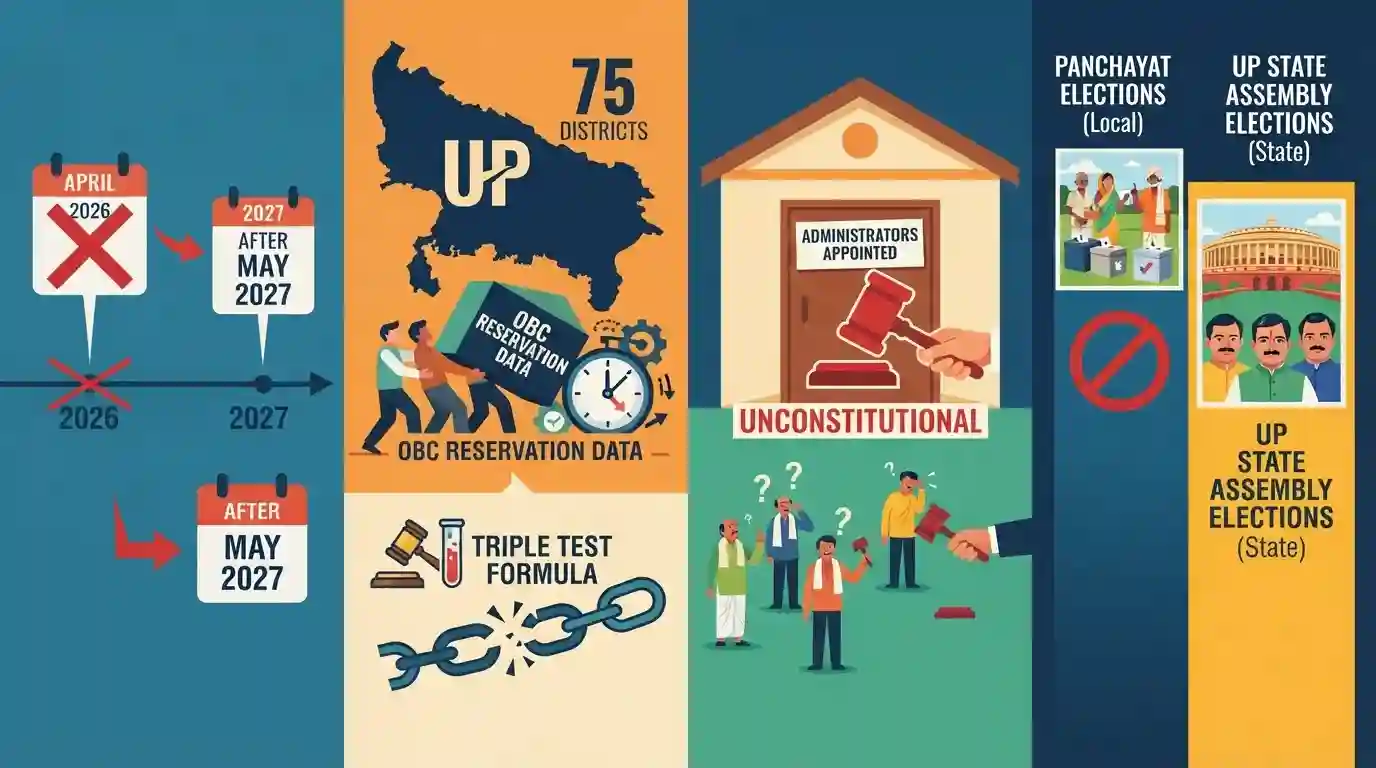
The three-tier Panchayat elections in Uttar Pradesh, originally scheduled for April 2026, are set to be postponed until after the 2027 UP State Assembly elections (expected to be completed by April/May 2027). The postponement stems from delays in the report of the dedicated Uttar Pradesh Backward Classes Commission, which is tasked with recommending OBC reservations across all 75 districts. Furthermore, while the state government appointed outgoing village heads (Pradhans) as administrators after their terms ended in May 2026, the Allahabad High Court declared this appointment unconstitutional, complicating interim governance in the state's rural local bodies.
Key Points
- The three-tier Panchayat elections in Uttar Pradesh (originally slated for April 2026) are highly likely to be delayed and held only after the 2027 UP State Assembly elections.
- The primary reason for the delay is the ongoing work of the dedicated Uttar Pradesh Backward Classes Commission, which was constituted in May 2026 to survey all 75 districts and make recommendations on Other Backward Classes (OBC) reservation.
- The Commission is expected to submit its report only in November or December 2026, having completed surveys in just 22 districts as of August 2026.
- Following the expiration of the village heads' (Pradhans) terms on May 26, 2026, the state government appointed them as interim administrators for a six-month period.
- The Allahabad High Court declared the government's May 2026 order appointing village heads as administrators unconstitutional, adding legal complexity to the administrative transition.
- Chief Election Commissioner Gyanesh Kumar confirmed that the UP Assembly elections are a constitutional obligation and will proceed on schedule in early 2027, further pushing back the local body polls to mid-2027.
Important Terms
73rd Constitutional Amendment Act, 1992

A landmark constitutional amendment that gave constitutional status to Panchayati Raj Institutions (PRIs) in India, establishing a uniform three-tier system of local self-government in rural areas.
UPSC context
GS Paper II (Polity & Governance); tests provisions of local self-government, grassroots decentralisation, and Article 243.
Uttar Pradesh Backward Classes Commission
A state-constituted panel responsible for conducting empirical inquiries into the political backwardness of OBCs to recommend appropriate seat reservations in municipal and panchayat elections.
UPSC context
GS Paper II (Polity/UP Governance); tests OBC reservation rules, local governance disputes, and constitutional compliance of state policies.
State Election Commission (Uttar Pradesh)
An independent constitutional body established under Article 243K to oversee the superintendence, direction, and conduct of all municipal and panchayat elections within Uttar Pradesh.
UPSC context
GS Paper II; tests the difference between state and national election machinery and panchayat election dynamics.
Election Commission of India (ECI)
A permanent constitutional body under Article 324 responsible for conducting and managing elections to Parliament, State Legislatures, and the offices of President and Vice-President.
UPSC context
GS Paper II (Polity); tests federal election administration, comparison with state election commissions, and constitutional powers.
Panchayati Raj Department (Uttar Pradesh)
The state government department responsible for administering, regulating, and monitoring the functioning of Gram, Kshetra, and Zila Panchayats under state-specific laws.
UPSC context
GS Paper II & UP GK Papers; tests state executive structures and the implementation of rural local governance policies.
Allahabad High Court
The highest judicial organ in Uttar Pradesh, having constitutional jurisdiction to review state laws, administrative orders, and ensure compliance with rural self-governance mandates.
UPSC context
GS Paper II & UP GK Papers; tests state judiciary, judicial review, and constitutional rulings on local governance structures.
Prelims Trap
The state legislature can extend the five-year term of a Panchayat under extraordinary circumstances using state-specific amendments.
Article 243E of the Constitution strictly limits the term of every Panchayat to five years from its first meeting and "no longer". State laws cannot override this constitutional ceiling.
Static Concepts Connected
What constitutes the Supreme Court's 'Triple Test' formula for local body OBC reservations?
- Dedicated Commission: State must set up a dedicated commission to conduct a rigorous empirical inquiry into the nature and implications of backwardness in local bodies.
- Proportion Specification: State must specify the proportion of reservation required in light of the Commission's recommendations to avoid aggregate excess.
- The 50% Cap: Under no circumstances can the total reservation for SCs, STs, and OBCs combined exceed an aggregate of 50% of the total seats.
How do Article 243K and Article 324 differ in their election mandates?
- Jurisdiction of SEC: Article 243K vests the superintendence, direction, and control of all Panchayat and Municipal elections exclusively in the State Election Commission.
- Jurisdiction of ECI: Article 324 vests the conduct of elections to Parliament, State Legislatures, and the offices of President and Vice-President in the Election Commission of India.
- Constitutional Autonomy: The State Election Commissioner is an independent constitutional authority and is not subordinate to the Election Commission of India.
Cross-Topic Patterns
Judicial oversight of local administration
The Allahabad HC's intervention illustrates the judiciary's role in preventing state executives from bypassing democratic local elections via administrative appointments.
Empirical data vs political reservation
The Triple Test requirement links local governance with the broader national debate on OBC sub-categorisation and the demand for empirical, caste-based demographic data.

Strict limits of Article 243E combined with the 'Triple Test' formula for local body OBC reservations is likely as a multi-statement question.
Linked PYQs · 5
Linked PYQs · 5
- 2023UPPSC_PRELIMSGS1
All elections to the Panchayats are conducted by -
- 2025UPPSC_PRELIMSGS1
With reference to Panchayati Raj Institutions in India which of the following statements is/are correct ? 1. Tenure of Panchayati Raj Institutions shall be of 5 years. 2. In Panchayati Raj Institutions, out of the seats reserved, 1/4 of the seats shall be reserved for women belonging to Scheduled Caste and Scheduled Tribe. Select the correct answer from the code given below :
- 2022UPPSC_PRELIMSGS1
Given below are two statements, one is labelled as Assertion (A) and the other as Reason (R). Assertion (A) : The 73rd Amendment of the Constitution is considered to be a watershed in the history of local self government in India. Reason (R) : The 73rd Constitution Amendment conferred the much coveted Constitutional status on Panchayats. Select the correct answer from the code given below.
- 2024UPPSC_PRELIMSGS1
Which one of the following is not a level in the three-tier Panchayati Raj recommended by Balwant Rai Mehta Committee ?
- 2020UPPSC_PRELIMSGS1
The superintendence, direction and control of all elections to the Panchayats are vested in
