Himachal Assembly Passes Panchayat Bill Over Daughter In Law Clause
Source:tribuneindia ↗
Why It Matters
Crucial for understanding amendments to local self-governance laws and state-specific legislative developments concerning Panchayati Raj institutions in Himachal Pradesh.
Summary
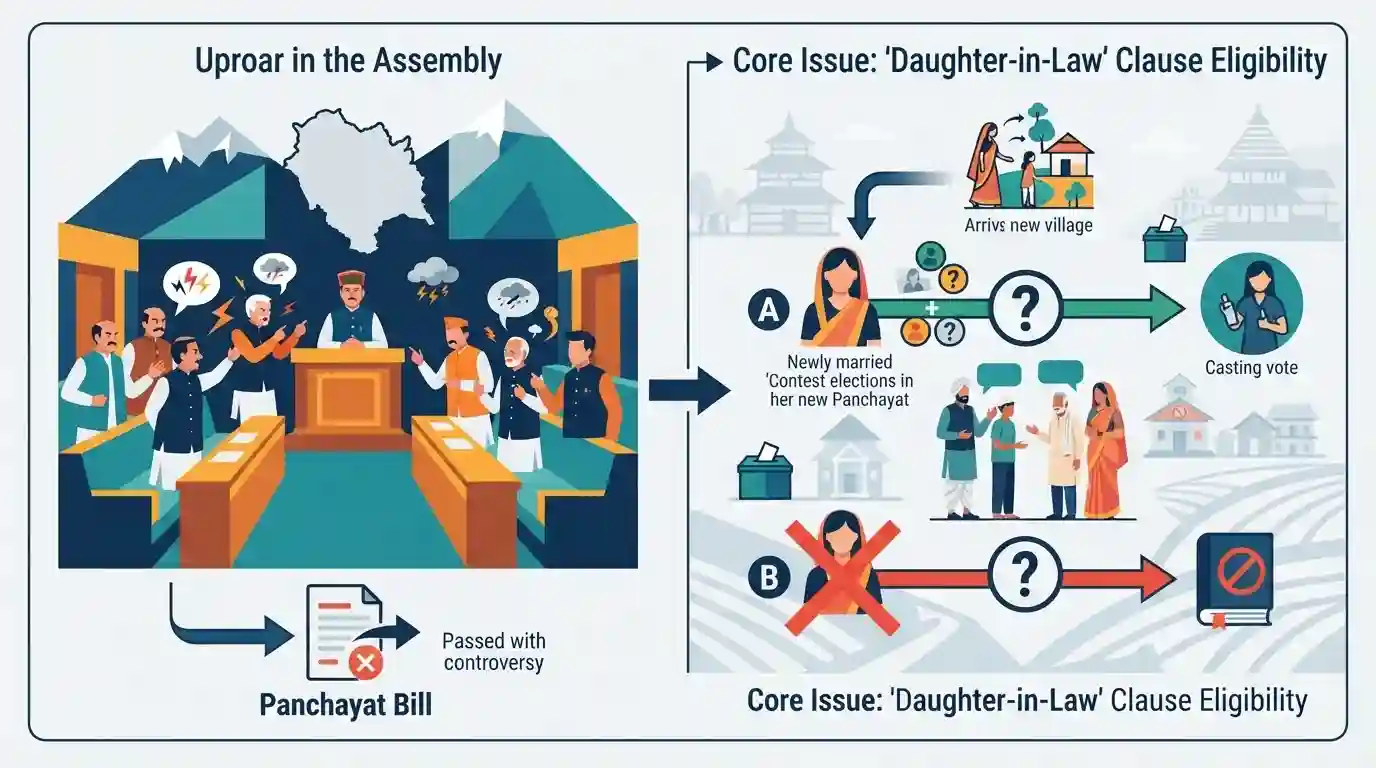
The Himachal Pradesh Assembly passed a Panchayat Bill amid a political row involving the BJP over the 'daughter-in-law' clause, which sparked an uproar in the House regarding local body election eligibility and rules.
Key Points
- The Himachal Pradesh Assembly passed a Panchayat Bill amid uproar from the opposition BJP over the 'daughter-in-law' clause.
- The clause pertains to provisions affecting women married into families in the state regarding local body elections and panchayat governance rules.
- The opposition protested against certain amendments or criteria introduced within the bill concerning residency or eligibility.
Important Terms
Himachal Pradesh Panchayati Raj Act

The primary legislation governing rural local government bodies in Himachal Pradesh, providing for the constitution of Gram Panchayats, Panchayat Samitis, and Zilla Parishads under the Panchayati Raj framework.
UPSC context
HPAS Paper II (Polity and Governance): Important for questions on grassroots democracy, local self-governance, and statutory amendments in Himachal Pradesh.
Panchayat Bill
An amendment bill passed by the Himachal Pradesh Assembly modifying the Panchayati Raj Act to expand the definition of 'family' for election disqualification regarding land encroachment.
UPSC context
HPAS Current Affairs / Governance: Tests knowledge of recent legislative changes impacting local body elections and eligibility criteria in the state.
Prelims Trap
daughter-in-law clause pertains to voting rights in local body elections
Aspirants may assume the 'daughter-in-law' clause allows them to vote, whereas the amendment specifically deals with disqualification from contesting panchayat polls due to family land encroachments.
Static Concepts Connected
What are the constitutional provisions and disqualifications under the HP Panchayati Raj Act?
- Statutory Origin: Constitutional basis is Part IX of the Constitution, operationalized in Himachal via the HP Panchayati Raj Act, 1994.
- Key Disqualifications: Disqualifications include allegiance to a foreign state, unsound mind, disqualification by or under any law made by the state legislature, and unauthorized encroachment on government/shamlat land.
- Women Reservation: The 73rd Constitutional Amendment Act mandates reservation of not less than one-third of total seats for women in Panchayats.
Cross-Topic Patterns
Panchayat Disqualifications & Himachal Land Tenure Laws
HP Panchayati Raj amendments on land encroachment link local body disqualifications directly to Himachal's complex land tenure systems (Shamlat/Government land), echoing broader forest rights and land revenue debates.
Gender Justice vs. Rural Landholding Traditions
The controversy over daughter-in-law liability in local polls bridges gender justice with patriarchal landholding traditions in rural Himachal governance.

HPAS prelims may test specific disqualification criteria under HP Panchayati Raj Act, particularly land encroachment and family definitions.
Linked PYQs · 2
Linked PYQs · 2
- 2024HPAS_PRELIMSGS1
Consider the following statements regarding Panchayati Raj system in Himachal Pradesh. Statement I : In 1949, the Punjab Village Panchayat Act of 1939 was enforced and 132 panchayats were established in Himachal. Statement II : By the end of 1956, there were 466 Gram Panchayats and 26 Tehsil Panchayats in Himachal. Choose the correct option from the following :
- 2024HPAS_PRELIMSGS1
Consider the following statements : (1) Mandi was first state in Shimla Hill States in which Panchayati Raj Act was passed. (2) During freedom movement Lala Lajpat Rai never visited Mandi. (3) Non-cooperation Movement did not start in Himachal Pradesh. (4) Rajkumari Amrit Kaur from Shimla conducted Quit India Movement. Choose the correct answer from the options given below :
