Himachal Panchayati Raj Amendment Bill and local governance norms
Source:tribuneindia ↗
Why It Matters
Important for HPAS aspirants to understand recent amendments to the Himachal Pradesh Panchayati Raj Act and related local governance debates.
Summary
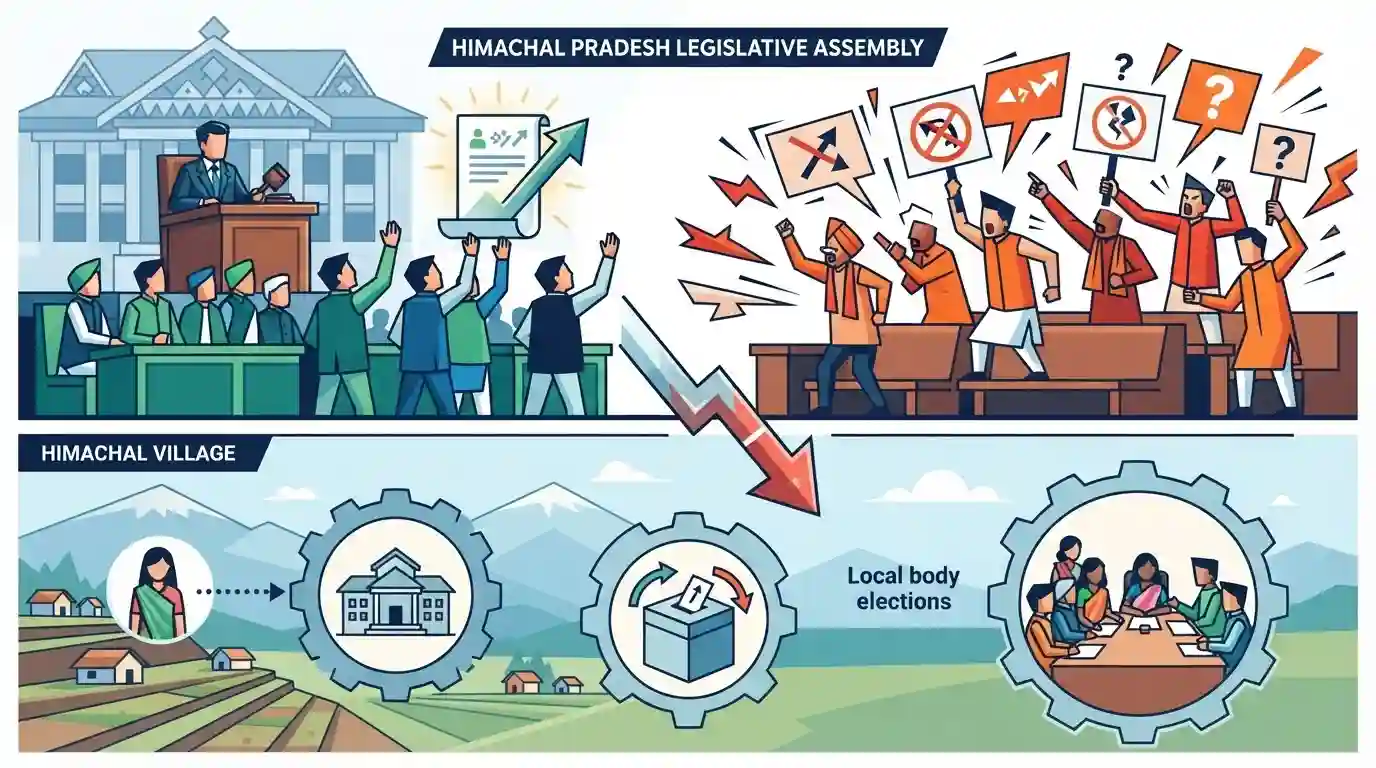
The Himachal Pradesh Legislative Assembly passed the Panchayati Raj Amendment Bill amid a fierce political uproar by the BJP, specifically centered around provisions regarding the 'daughter-in-law' clause affecting local body elections and representation in the state.
Key Points
- The Himachal Pradesh Assembly passed a Panchayati Raj Bill amidst significant opposition uproar from the BJP.
- The controversy primarily centered on the 'daughter-in-law' clause proposed within the amendment provisions.
- The bill relates to local self-government regulations, voter or candidate eligibility criteria, and decentralization norms under the Himachal Pradesh Panchayati Raj framework.
Important Terms
Himachal Pradesh Panchayati Raj Amendment Bill

A legislative enactment modifying the HP Panchayati Raj Act to expand the definition of 'family'—including daughters-in-law—for disqualifying individuals from contesting local polls if family members encroach on public land.
UPSC context
HPAS GS Paper II (Polity and Governance): Tests understanding of grassroots democracy, local self-government, and state-level legislative amendments.
Himachal Pradesh Legislative Assembly
The unicameral state legislature of Himachal Pradesh, responsible for enacting state laws, including amendments to local governance acts and panchayati raj regulations.
UPSC context
HPAS GS Paper II: Tests knowledge of state legislature functioning, legislative procedures, and law-making powers in Himachal Pradesh.
BJP
A major national political party in India that acts as the principal opposition in the Himachal Pradesh Legislative Assembly, playing a key watchdog role in debates.
UPSC context
HPAS GS Paper II: Tests awareness of the Indian party system, opposition dynamics, and parliamentary accountability in state politics.
Prelims Trap
daughter-in-law clause affecting local body elections
Aspirants might assume daughters-in-law are disqualified due to dowry or gender bias, whereas the actual legal expansion links them to joint family accountability on government land encroachments and synthetic drug offenses.
Static Concepts Connected
What are the constitutional provisions and 73rd Amendment mandates regarding Panchayati Raj disqualifications?
- Constitutional Basis: Article 243F provides disqualifications for membership of Panchayats, mirroring MLA disqualifications under Article 191.
- State Legislative Power: State Legislatures are explicitly empowered by the Constitution to enact laws determining disqualifications for panchayat candidates.
- HP Act Framework: HP Panchayati Raj Act governs local bodies in Himachal Pradesh, subject to judicial review regarding arbitrary restrictions on fundamental rights.
Cross-Topic Patterns
Local Self-Government + Anti-Drug Initiatives
The amendment links local governance integrity with public asset protection, mirroring stricter moral and behavioral disqualifications introduced in excise and drug (chitta) legislations across HP.
Panchayati Raj Disqualifications + Civil Property Law
HP Panchayati Raj amendments mirror broader debates on family asset definition and gender-neutral property rights under Hindu Succession laws, influencing local political candidacy.

HP Panchayati Raj Act amendments on land encroachment and family definitions will feature in HPAS polity & local governance questions.
Linked PYQs · 1
Linked PYQs · 1
- 2024HPAS_PRELIMSGS1
Consider the following statements regarding Panchayati Raj system in Himachal Pradesh. Statement I : In 1949, the Punjab Village Panchayat Act of 1939 was enforced and 132 panchayats were established in Himachal. Statement II : By the end of 1956, there were 466 Gram Panchayats and 26 Tehsil Panchayats in Himachal. Choose the correct option from the following :
