Palau Taiwan Diplomatic Ties and Indo-Pacific Geopolitics
Source:The Hindu ↗
Why It Matters
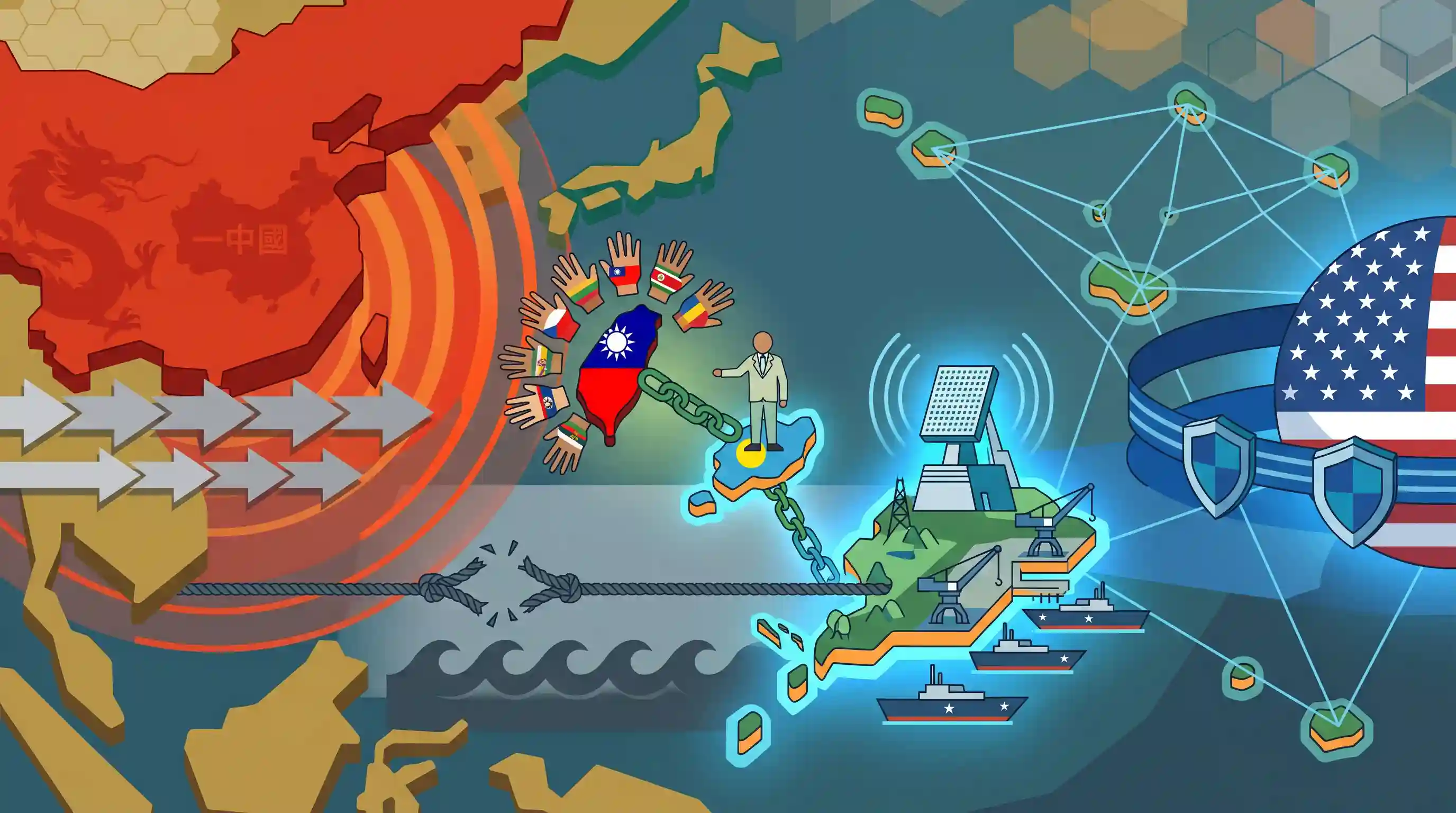
The article highlights the intensifying geopolitical competition between the US and China in the Pacific region. It serves as an excellent case study for UPSC aspirants on "Checkbook Diplomacy," Taiwan's struggle for international recognition, and how small island nations like Palau are becoming critical strategic nodes in the broader Indo-Pacific security architecture.
Summary
Palau's President Surangel Whipps Jr. has strongly reiterated the Pacific island nation's commitment to recognizing Taiwan, rejecting diplomatic pressure from China. As one of merely 12 countries acknowledging Taiwan's statehood, Palau's stance highlights the ongoing diplomatic tug-of-war in the region. To counter Chinese influence, Palau is significantly enhancing its defense and strategic ties with the United States. This includes hosting a US military radar installation and upgrading local port infrastructure to support US naval operations, underscoring the growing geopolitical importance of Pacific island nations in the broader US-China rivalry.
Key Points
- Palau\'s President Surangel Whipps Jr. affirmed the country\'s unwavering diplomatic alliance with Taiwan, vowing to remain allies "until death do us part."
- Palau is one of only 12 nations globally that officially recognize Taiwan\'s statehood over Beijing\'s claims.
- Despite consistent diplomatic pressure from China, Palau has chosen to deepen its ties with the United States to counter regional coercion.
- Due to its strategic location 800 km east of the Philippines, Palau is expanding military cooperation with the US, including hosting a new radar outpost and dredging its commercial port to accommodate US Navy vessels.
Important Terms
One China Policy

A diplomatic stance acknowledging the People's Republic of China (PRC) as the sole legitimate government. India officially follows this while maintaining unofficial economic and cultural ties with Taiwan.
UPSC context
GS-II: International Relations. Crucial for understanding India-China-Taiwan dynamics and the geopolitical balance in the Indo-Pacific.
Compact of Free Association (COFA)
An agreement between the U.S. and three Pacific nations (Palau, Micronesia, Marshall Islands) providing aid and defense in exchange for exclusive U.S. military access and "strategic denial" of other militaries.
UPSC context
GS-II: International Relations. Significant for studying regional security architectures and U.S.-China competition for influence in the Pacific.
Second Island Chain
A U.S. maritime containment concept. The Second Island Chain, including Palau and Guam, serves as a strategic defense line to restrict Chinese power projection into the broader Pacific.
UPSC context
GS-II: Geopolitics and Maritime Security. Tests knowledge of maritime "choke points" and containment strategies in the Pacific.
Pacific Island Nations (PINs)
A group of sovereign states in Oceania (e.g., Palau, Fiji) with vast Exclusive Economic Zones (EEZs), central to global maritime trade and the intensifying U.S.-China rivalry.
UPSC context
GS-II: International Relations. Relevant to India’s "Act East" policy and engagement via FIPIC.
Diplomatic Recognition
The formal acknowledgement by a state that another entity is a sovereign nation. Palau’s continued recognition of Taiwan remains a primary diplomatic flashpoint with China.
UPSC context
GS-II: International Law and Sovereignty. Understanding how major powers use diplomatic status to support territorial claims.
Indo-Pacific Region
A strategic maritime region spanning from Africa’s east coast to the Pacific, serving as the primary theater for global power competition and India’s maritime strategy.
UPSC context
GS-II: Central to maritime security, the Quad, and India’s regional leadership and strategic interests.
Prelims Trap
All Pacific Island nations have severed ties with Taiwan to adhere to Beijing's 'One China Policy'.
Palau, Tuvalu, and the Marshall Islands still officially recognize Taiwan. UPSC often uses absolute terms to trap aspirants on diplomatic alignments.
Static Concepts Connected
How is the Pacific Island region geographically divided?
- Micronesia: Located in the northwest Pacific, comprising small islands including Palau, Nauru, and the Marshall Islands.
- Melanesia: Located in the southwest, consisting of larger islands like Fiji, Papua New Guinea, and the Solomon Islands.
- Polynesia: The easternmost grouping forming a massive geographic triangle, including Tuvalu, Samoa, and Tonga.
What is the Forum for India-Pacific Islands Cooperation (FIPIC)?
- Diplomatic Outreach: Launched in 2014, it groups India with 14 Pacific Island Countries (PICs) to advance economic and strategic ties.
- Large Ocean States: Acknowledges PICs not as small island states but as 'Large Ocean States' with massive, resource-rich Exclusive Economic Zones (EEZs).
- Act East Extension: Acts as a vital maritime extension of India's Act East Policy, prioritizing climate action, renewable energy, and capacity building.
Cross-Topic Patterns
FIPIC vs. superpower militarization
While the US and China militarize the Pacific via radar outposts and security pacts, India uses FIPIC to project non-coercive soft power, focusing on climate action and healthcare.
EEZs and critical mineral security
The massive Exclusive Economic Zones of tiny Pacific nations like Palau make them prime targets for future deep-sea mining of polymetallic nodules and critical minerals.

Expect a Prelims pair-matching question on Pacific Island regions (Micronesia/Melanesia) mapped to their US/China/Taiwan alignments.
Linked PYQs · 3
Linked PYQs · 3
- 2024MainsGS2
‘The West is fostering India as an alternative to reduce dependence on China's supply chain and as a strategic ally to counter China's political and economic dominance.’ Explain this statement with examples.
- 2021MainsGS2
The newly tri-nation partnership AUKUS is aimed at countering China's ambitions in the Indo-Pacific region. Is it going to supersede the existing partnerships in the region? Discuss the strength and impact of AUKUS in the present scenario.
- 2021MainsGS2
“The USA is facing an existential threat in the form of a China, that is much more challenging than the erstwhile Soviet Union.” Explain.
