Tanker attack near Strait of Hormuz involving Indian crew
Source:Indian Express ↗
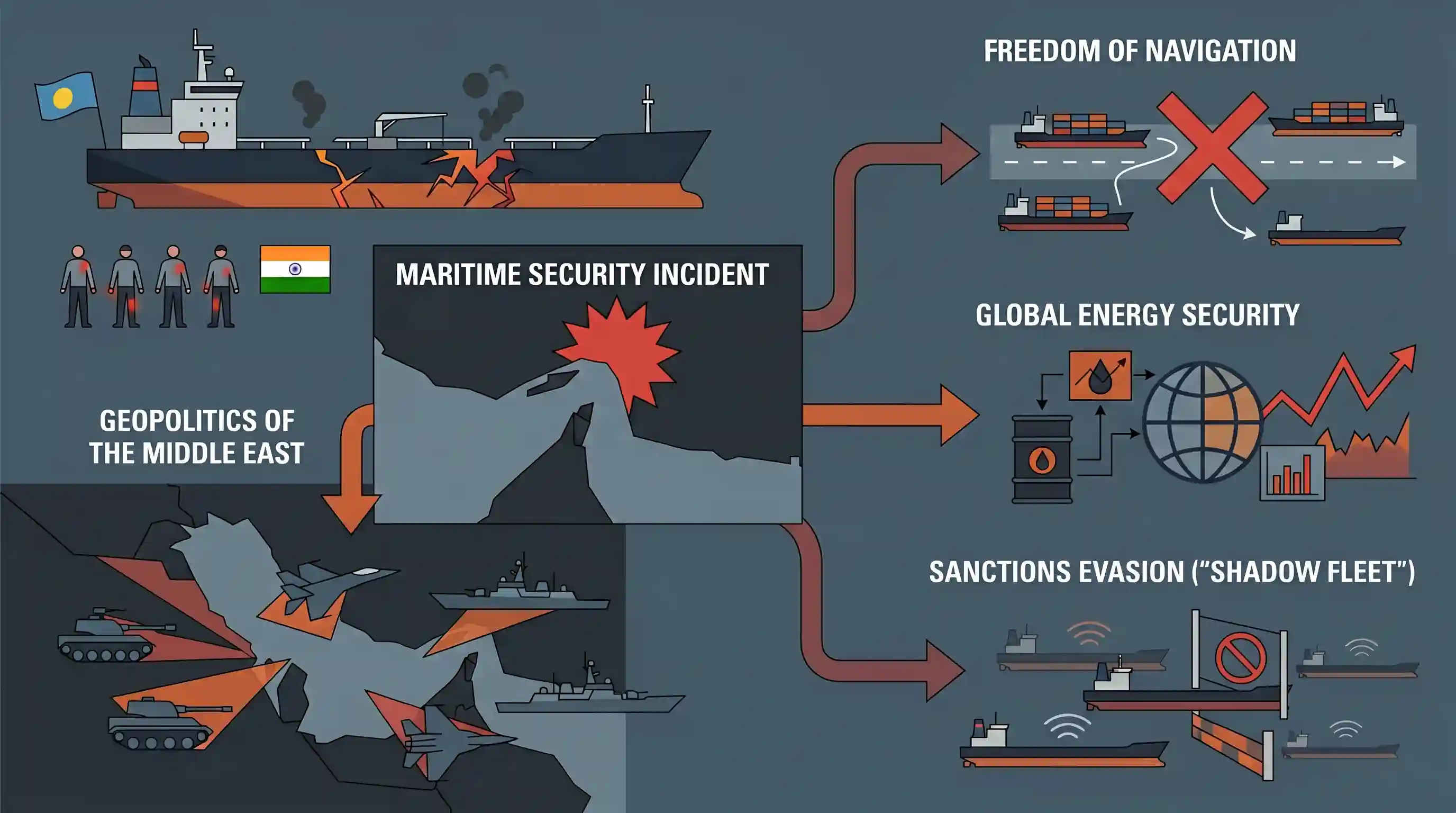
Why It Matters
The Strait of Hormuz is a crucial artery for global oil trade. Attacks in this region directly threaten India's energy security and economic stability. Furthermore, the involvement of Indian seafarers highlights the need for robust diplomatic and security mechanisms to protect citizens operating in volatile international waters.
Summary
An attack on a Palau-flagged 'shadow fleet' tanker near the strategic Strait of Hormuz injured four crew members, including Indians. The vessel is suspected of transporting sanctioned oil, circumventing Western sanctions frameworks. This incident highlights the escalating maritime security threats to commercial shipping in critical geopolitical chokepoints, amplifying concerns over global energy supply chain disruptions and the safety of Indian maritime personnel.
Key Points
- A Palau-flagged tanker, operating as part of the 'shadow fleet', was attacked near the strategically vital Strait of Hormuz and Musandam Peninsula.
- The strike resulted in injuries to four crew members, including Indian nationals, raising concerns about the safety of Indian seafarers in global conflict zones.
- The 'shadow fleet' refers to a network of vessels used to bypass Western sanctions, often transporting restricted crude oil from countries like Iran or Russia.
- This incident underscores the fragility of global energy supply chains and the increasing maritime security threats facing commercial shipping in pivotal maritime chokepoints.
Important Terms
Shadow Fleet

A fleet of aging tankers that uses deceptive shipping practices (like spoofing locations and opaque ownership) to transport sanctioned oil, bypassing Western price caps and regulatory oversight.
UPSC context
Relevant for GS Paper 2 (International Relations) and GS Paper 3 (Energy Security/Economy), testing knowledge of sanctions evasion and maritime risks.
Strait of Hormuz
A critical maritime chokepoint between Iran and Oman connecting the Persian Gulf to the Arabian Sea; it facilitates roughly 20% of global oil and 35% of LNG trade.
UPSC context
Core topic for GS Paper 1 (Geography) and GS Paper 2 (International Relations), focusing on energy security and regional stability.
UNCLOS
The 1982 international treaty (the 'Constitution of the Oceans') that establishes the legal framework for maritime zones, navigation rights, and the protection of the marine environment.
UPSC context
Crucial for GS Paper 2, testing understanding of international law, maritime disputes, and global governance of the high seas.
Maritime Security
The protection of a nation's territorial waters, sea lanes, and economic interests from threats such as piracy, terrorism, smuggling, and maritime accidents.
UPSC context
Relevant for GS Paper 3 (Internal Security), focusing on India's 7,500+ km coastline and the safety of maritime personnel.
Freedom of Navigation
A principle under UNCLOS (Article 87) ensuring that ships of any state can navigate the high seas without interference, balancing coastal sovereignty with global trade mobility.
UPSC context
A recurring theme in GS Paper 2 (International Relations), especially regarding South China Sea and West Asia tensions.
Flag of Convenience
A practice where ships are registered in a country other than the owner's, often to benefit from lower taxes, minimal regulations, and easier anonymity.
UPSC context
Tests knowledge of international maritime regulations and the challenges of tracking illicit trade in GS Paper 3 (Economy).
Prelims Trap
"The Strait of Hormuz is a maritime chokepoint lying entirely between Iran and the UAE."
The southern flank of the Strait of Hormuz is actually controlled by Oman through its Musandam Peninsula exclave, not the UAE.
Static Concepts Connected
What are the defining geographical features of the Strait of Hormuz?
- Maritime Connectivity: It acts as the only sea passage connecting the Persian Gulf to the Gulf of Oman and the wider Arabian Sea.
- Bordering Nations: It is bounded by Iran to the north and Oman's Musandam Peninsula exclave to the south.
- Strategic Value: It is the world's most critical energy chokepoint, handling approximately 20% of global petroleum consumption daily.
What is a 'Flag of Convenience' (FoC) under international maritime law?
- Regulatory Arbitrage: A business practice where a ship is registered in a country different from that of its owners to exploit minimal regulatory oversight.
- Economic Incentives: FoC registries offer lower taxes, cheaper labor costs, and lax environmental regulations, obscuring true ownership.
- UNCLOS Compliance: UNCLOS requires a "genuine link" between a ship and its flag state, a clause widely flouted by shadow fleets using FoCs like Palau or Panama.
Cross-Topic Patterns
Western Sanctions & Shadow Fleets
The rise of 'shadow fleets' directly undermines the G7 price cap mechanism, pushing restricted Russian or Iranian crude through alternative maritime insurance networks and grey-market logistics.
Energy Security meets Diaspora Safety
Maritime disruptions in the Middle East present a dual-threat to India by spiking landed crude oil costs while simultaneously endangering the disproportionately large Indian seafaring workforce.

Expect a 2026 prelims map question pairing strategic straits (Hormuz, Bab-el-Mandeb) with bordering nations like Oman's Musandam exclave.
Linked PYQs · 4
Linked PYQs · 4
- 2025MainsGS3
Why is maritime security vital to protect India's sea trade? Discuss maritime and coastal security challenges and the way forward.
- 2022MainsGS3
What are the maritime security challenges in India ? Discuss the organisational, technical and procedural initiatives taken to improve the maritime security.
- 2025MainsGS2
"Energy security constitutes the dominant kingpin of India's foreign policy, and is linked with India's overarching influence in Middle Eastern countries.” How would you integrate energy security with India's foreign policy trajectories in the coming years?
- 2024MainsGS2
Discuss the geopolitical and geostrategic importance of Maldives for India with a focus on global trade and energy flows. Further also discuss how this relationship affects India's maritime security and regional stability amidst international competition ?
