Technological Supremacy and Hard Power Defense Strategy
Source:Indian Express ↗
Why It Matters
The manifesto reflects a growing fusion between Big Tech and the military-industrial complex. It raises profound ethical questions about corporate power in warfare, AI's role in global security, and a geopolitical shift towards hard power and sovereign nationalism, which are crucial themes for GS2 (IR) and GS4 (Ethics).
Summary
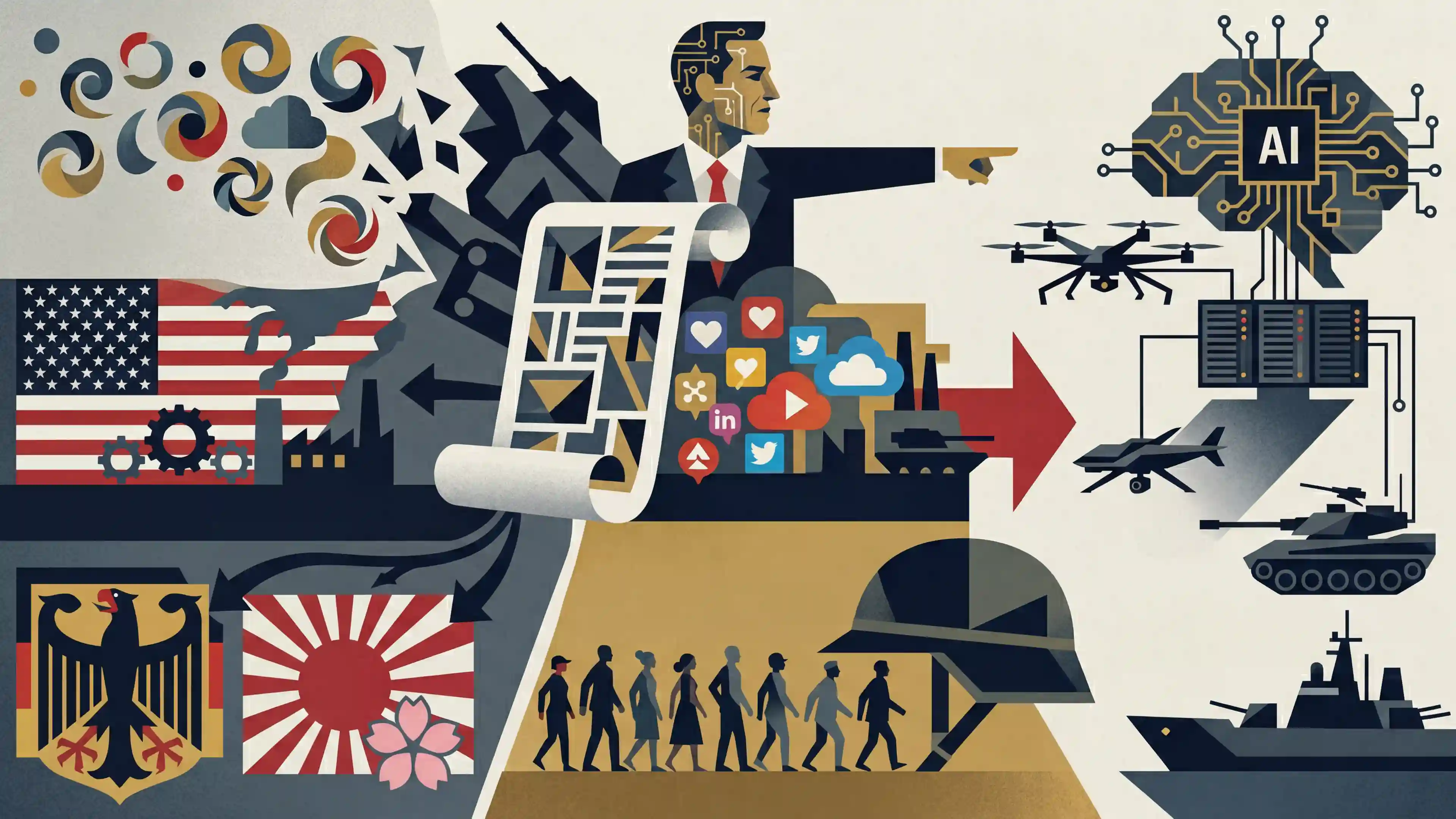
US defense contractor and AI firm Palantir Technologies has sparked controversy with a new manifesto derived from CEO Alex Karp's book, 'The Technological Republic'. The document urges Silicon Valley to pivot toward military technology, arguing that AI weapons are inevitable and a shift toward 'hard power' is necessary for global security. It advocates for the rearmament of Germany and Japan, mandatory US military enlistment, and the rejection of 'hollow pluralism', raising alarm among critics over its 'techno-fascist' ideology.
Key Points
- Palantir Technologies released a 22-point manifesto based on CEO Alex Karp's book 'The Technological Republic', urging Silicon Valley to abandon consumer apps and prioritize US defense tech.
- The manifesto asserts that the era of nuclear deterrence is ending and AI weapons are inevitable due to advancements by adversaries like China, necessitating US technological supremacy.
- It advocates for a shift from soft power to 'hard power', explicitly supporting the rearmament of post-WWII pacifist nations like Germany and Japan to counter global threats.
- Controversially, it calls for mandatory military enlistment in the US, dismisses 'vacant and hollow pluralism', and criticizes cancel culture, drawing scholarly backlash for its 'techno-fascist' undertones.
Important Terms
The Technological Republic

A book/manifesto by Palantir CEO Alex Karp advocating for Western tech firms to lead military rearmament and prioritize "hard power" over consumer-focused innovation.
UPSC context
GS Paper II/IV. Tests understanding of modern geopolitical ideologies and the ethical role of tech corporations in national security.
Hard Power
The use of coercive tools like military force, economic sanctions, and threats to influence international actors, as opposed to persuasion or cultural attraction.
UPSC context
GS Paper II. Essential for analyzing global security shifts and India's evolving balance between "strategic autonomy" and military strength.
Project Maven
A Pentagon initiative (officially the Algorithmic Warfare Cross-Functional Team) using machine learning to automate target identification from massive surveillance data.
UPSC context
GS Paper III. Critical for discussing AI’s impact on modern warfare and the ethics of autonomous targeting.
Gotham
Palantir’s primary software platform for government and defense agencies, designed for data fusion and real-time battlefield visualization to identify threats.
UPSC context
GS Paper III. Relevant to internal security, counter-terrorism technology, and data-driven military operations.
Selective Service System (SSS)
The U.S. agency responsible for military registration; the manifesto calls for it to transition from a voluntary system to mandatory national service.
UPSC context
GS Paper II. Useful for comparing international defense mobilization strategies and the debate over universal military service.
Soft Power
Influence gained through attraction and persuasion, such as cultural values and diplomacy, which Karp’s manifesto argues has proven insufficient for global security.
UPSC context
GS Paper II. Key for contrasting India's traditional diplomatic strengths with the manifesto's call for hard-power dominance.
Hollow Pluralism
A critical term in the manifesto dismissing liberal emphasis on diversity as a weakness that undermines national resolve and industrial ambition.
UPSC context
GS Paper II/IV. Tests analysis of ideological challenges to democratic values within the framework of national security.
Prelims Trap
Palantir's manifesto on AI weaponry reflects the official defense doctrine of the United States.
Aspirants may confuse an influential private defense contractor's corporate manifesto with official US government policy or Pentagon military doctrine.
Static Concepts Connected
What distinguishes Hard, Soft, and Smart Power in geopolitics?
- Hard Power: The use of military and economic means to coerce the behavior of other political bodies.
- Soft Power: The ability to co-opt rather than coerce, relying on cultural, ideological, and diplomatic appeal (coined by Joseph Nye).
- Smart Power: The strategic and balanced combination of both coercive hard power and persuasive soft power.
What is constitutional pacifism in the context of Japan?
- Article 9: A clause in Japan's post-WWII Constitution that formally renounces war as a sovereign right and the threat or use of force to settle disputes.
- Policy Shift: Reinterpreted in 2014 to allow 'collective self-defense', enabling Japan to aid allies and recently leading to significant defense budget increases.
Cross-Topic Patterns
Military-Tech Complex + AI Ethics
The corporate push for algorithmic warfare without human oversight links GS3 defense technology directly with GS4 ethical dilemmas in autonomous decision-making.
End of Post-WWII Pacifism
Advocacy for German and Japanese rearmament mirrors state policy shifts like Germany's 'Zeitenwende', reflecting a transition toward multipolar sovereign nationalism.

The corporatization of warfare and the ethical limits of AI autonomous weapons are prime fodder for a GS3 or GS4 Mains question in 2026.
Linked PYQs · 4
Linked PYQs · 4
- 2025MainsGS2
"With the waning of globalization, post-Cold War world is becoming a site of sovereign nationalism.” Elucidate.
- 2015MainsGS2
Terrorist activities and mutual distrust have clouded India-Pakistan relations. To what extent the use of soft power like sports and cultural exchanges could help generate goodwill between the two countries? Discuss with suitable examples.
- 2023MainsGS3
The use of unmanned aerial vehicles (UAVs) by our adversaries across the borders to ferry arms/ammunitions, drugs, etc., is a serious threat to the internal security. Comment on the measures being taken to tackle this threat.
- 2024MainsGS4
The application of Artificial Intelligence as a dependable source of input for administrative rational decision-making is a debatable issue. Critically examine the statement from the ethical point of view.
