Pakistan western border policy and regional security dynamics
Source:The Hindu ↗
ఇది ఎందుకు ముఖ్యం
Understanding Pakistan's shifting geopolitical dynamics with Afghanistan and the western frontier is crucial for evaluating regional security architecture and threats impacting India's neighborhood.
సారాంశం
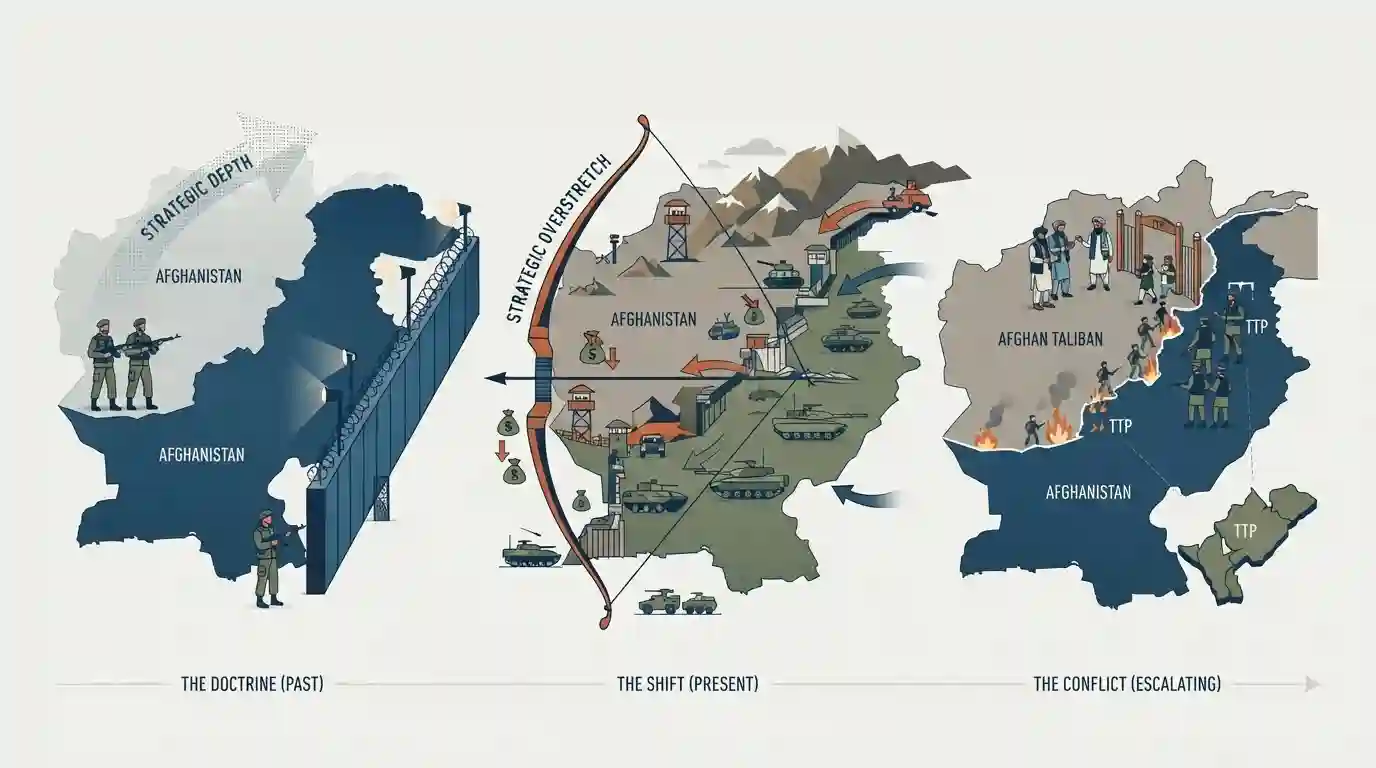
The article analyses Pakistan's strategic pivot toward its western borders with Afghanistan, examining whether its long-held doctrine of 'strategic depth' is turning into a costly overstretch amid escalating tensions with the Afghan Taliban and the TTP.
ముఖ్య అంశాలు
- Pakistan's traditional pursuit of 'strategic depth' in Afghanistan has faced severe friction due to rising cross-border militancy from the Tehreek-e-Taliban Pakistan (TTP).
- The shift in Pakistan's westward policy reflects an overstretch rather than cohesive strategic depth, given internal economic vulnerabilities and deteriorating security on its western border.
- Geopolitical dynamics in South Asia continue to impact regional stability, posing multifaceted security challenges for India's immediate neighborhood.
ముఖ్యమైన పదాలు
Tehreek-e-Taliban Pakistan (TTP)

An umbrella organization of Islamist militant groups operating along the Afghanistan-Pakistan border, aiming to overthrow the Pakistani state and enforce a strict Islamist legal framework.
UPSC context
GS Paper II (International Relations - Neighborhood) and GS Paper III (Security Challenges and Border Management). Tests cross-border terrorism dynamics.
Taliban
An Islamist fundamentalist and militant political movement that regained control of Afghanistan in August 2021 after a two-decade insurgency against foreign and U.S.-backed forces.
UPSC context
GS Paper II (India and its Neighborhood - Relations) and GS Paper III (Security). Important for regional stability and India's security interests.
ప్రిలిమ్స్ ఉచ్చు
The takeover of Kabul by the Afghan Taliban in 2021 permanently secured Pakistan's western border through ideological alignment.
Aspirants often assume the Afghan Taliban acts as a proxy for Pakistan against all militant groups, ignoring that ideological solidarity with the TTP has severely ruptured Islamabad-Kabul relations.
అనుసంధానమైన స్థిర భావనలు
What is the historical origin and geopolitical significance of the Durand Line?
- Origin:: Established in 1893 through an agreement between Sir Mortimer Durand and Afghan Amir Abdur Rahman Khan.
- Status:: Serves as the 2,670-kilometer international border between Pakistan and Afghanistan, which Kabul has historically refused to officially recognize.
- Implication:: Cuts directly through Pashtun tribal homelands, creating persistent cross-border ethnic identity tensions and security friction.
అంతర-అంశ నమూనాలు
Strategic Depth vs. Strategic Overstretch
The concept of strategic depth historically applied to India-Pakistan rivalry now rebounds on Islamabad via TTP and Durand Line disputes.
Economic Vulnerabilities and Frontier Security
Severe balance-of-payments crises directly impair a state's capacity to project power or manage prolonged counter-insurgency operations on rugged frontiers.

Durand Line disputes and TTP resurgence make Pakistan's western border a prime candidate for an analytical mains question on regional stability.
అనుసంధాన PYQలు · 1
అనుసంధాన PYQలు · 1
- 2016MainsGS2
Increasing cross-border terrorist attacks in India and growing interference in the internal affairs of several member-states by Pakistan are not conducive for the future of SAARC (South Asian Association for Regional Cooperation)." Explain with suitable examples.
