Pakistan leadership meets to formulate response to Indian actions
Source:The Hindu ↗
Why It Matters
The suspension of the Indus Water Treaty and the revocation of the SAARC Visa Exemption Scheme represent massive shifts in India's diplomatic posture toward Pakistan. These developments are highly relevant for questions on bilateral relations, water diplomacy, and India's strategy to counter cross-border terrorism.
Summary
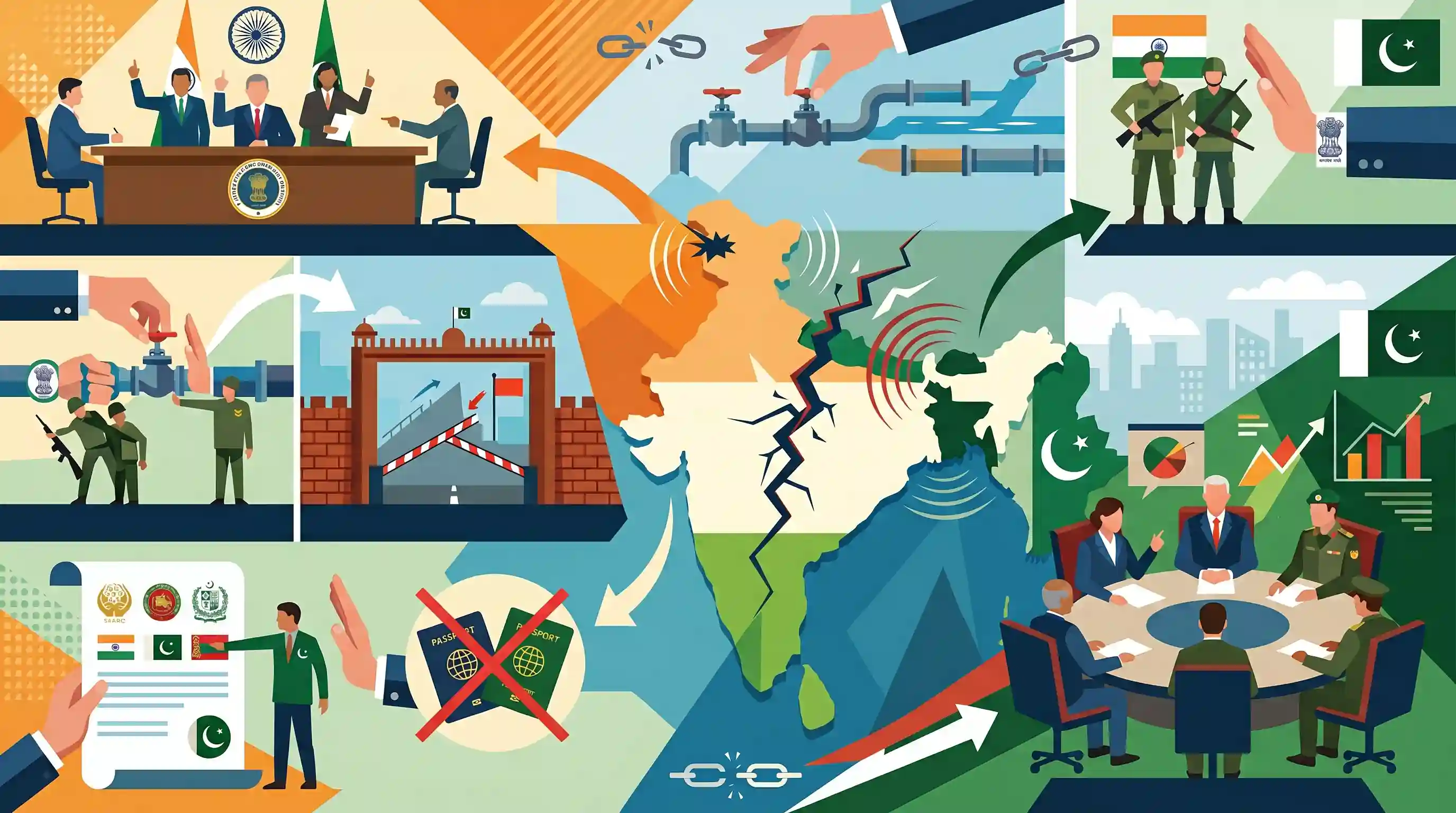
Following the Pahalgam terror attack, India took stringent diplomatic and strategic measures against Pakistan, including the temporary suspension of the Indus Water Treaty of 1960 and the expulsion of Pakistani military attaches. The Indian Cabinet Committee on Security (CCS) further escalated the response by closing the Attari Integrated Check Post and cancelling the SAARC Visa Exemption Scheme (SVES) for Pakistani nationals. In response, Pakistan's top civil and military leadership convened a National Security Committee session to formulate a counter-strategy, highlighting a severe deterioration in bilateral ties.
Key Points
- India temporarily suspended the Indus Water Treaty of 1960 and downgraded diplomatic ties with Pakistan following the Pahalgam terror attack.
- Pakistan's National Security Committee, chaired by PM Shehbaz Sharif, convened to formulate a response to India's unprecedented moves.
- The Indian Cabinet Committee on Security (CCS), led by PM Modi, closed the Integrated Check Post at Attari with immediate effect.
- India revoked the SAARC Visa Exemption Scheme (SVES) for Pakistani nationals, cancelling previously issued visas and barring future travel under the scheme.
Important Terms
Indus Water Treaty of 1960

A 1960 World Bank-brokered water-sharing agreement between India and Pakistan. It allocates the three Eastern Rivers (Ravi, Beas, Sutlej) to India and three Western Rivers (Indus, Jhelum, Chenab) to Pakistan.
UPSC context
GS Paper II (International Relations). Tests knowledge of transboundary water governance and diplomatic leverage in India-Pakistan relations.
Cabinet Committee on Security (CCS)
India's apex decision-making body on national security and defense. Chaired by the Prime Minister, it includes the Ministers of Home Affairs, Defence, Finance, and External Affairs.
UPSC context
GS Paper II (Polity & Governance). Tests understanding of executive decision-making structures and crisis management during national security threats.
SAARC Visa Exemption Scheme (SVES)
A regional travel mechanism launched in 1992, allowing 24 categories of persons (e.g., dignitaries, journalists, businessmen) from SAARC nations to travel within the region visa-free.
UPSC context
GS Paper II (International Relations). Relates to regional integration, people-to-people contact, and India's diplomatic tools in South Asia.
SAARC
An 8-member regional intergovernmental organization established in 1985 to promote economic and social development in South Asia. Members: India, Pakistan, Afghanistan, Bangladesh, Bhutan, Maldives, Nepal, and Sri Lanka.
UPSC context
GS Paper II (International Relations). Tests knowledge of regional groupings, South Asian diplomacy, and challenges to regional cooperation.
National Security Committee (NSC)
Pakistan's highest civil-military coordination forum for national security matters. Chaired by the Prime Minister, it includes top ministers and military leadership to formulate strategic responses.
UPSC context
GS Paper II (International Relations). Relevant for understanding foreign decision-making structures and bilateral counter-strategies in South Asia.
Prelims Trap
The Indus Water Treaty was brokered by the United Nations, and India has absolute rights over all six rivers during a suspension.
The treaty was brokered by the World Bank, not the UN. Additionally, infrastructural limitations prevent India from instantly diverting all Western river waters.
Static Concepts Connected
How are river waters allocated under the Indus Water Treaty of 1960?
- Eastern Rivers: Ravi, Beas, and Sutlej are allocated to India for unrestricted, absolute use.
- Western Rivers: Indus, Jhelum, and Chenab are allocated to Pakistan, though India retains specific non-consumptive usage rights.
- Indian Exceptions: India can build run-of-the-river hydroelectric projects on Western rivers subject to strictly defined design criteria.
- Guarantor Role: The World Bank brokered the treaty and plays a procedural role in appointing neutral experts and court of arbitration members.
What is the composition and mandate of the Cabinet Committee on Security (CCS)?
- Chairperson: The committee is strictly chaired by the Prime Minister of India.
- Core Members: Comprises the Ministers of Home Affairs, Defence, Finance, and External Affairs. The National Security Advisor (NSA) is not a member.
- Mandate: It is the apex executive body for final decisions on defense spending, national security policy, foreign affairs, and strategic deployments.
Cross-Topic Patterns
Hydro-diplomacy as strategic coercion
Suspending the IWT shifts India to active "water weaponization." This sets a crucial precedent relevant to India's concerns over China's upper-riparian dam building on the Brahmaputra.
Geoeconomic isolation & SAARC's decline
Revoking the SVES and closing Attari ICP practically buries remaining SAARC initiatives, reinforcing India's long-term strategic pivot towards BIMSTEC for regional integration minus Pakistan.

A 2026 multi-statement question will likely combine IWT dispute mechanisms (World Bank role) with exact geography of Indus tributaries.
Linked PYQs · 3
Linked PYQs · 3
- 2015MainsGS2
Terrorist activities and mutual distrust have clouded India-Pakistan relations. To what extent the use of soft power like sports and cultural exchanges could help generate goodwill between the two countries? Discuss with suitable examples.
- 2016MainsGS2
Increasing cross-border terrorist attacks in India and growing interference in the internal affairs of several member-states by Pakistan are not conducive for the future of SAARC (South Asian Association for Regional Cooperation)." Explain with suitable examples.
- 2012MainsGS2
The situation today is far different to that prevalent fifty years back when the Indus Water Treaty was signed." Highlight the complexity of the current challenges on both sides of the border in this regard. Do you think that a review of the Treaty is in India's best interests?
