PoJK Civil Unrest Stems From Decades Of Pakistani Administrative Abuse
Source:The Hindu ↗
Why It Matters
This development illustrates India's proactive diplomatic policy regarding PoJK. By highlighting Pakistan's systemic governance failures and humanitarian abuses in occupied territories, India aims to shape the global narrative, reiterate its sovereign claim over the entire state of Jammu and Kashmir, and position the issue as a matter of human rights and administrative failure rather than merely a bilateral border dispute.
Summary
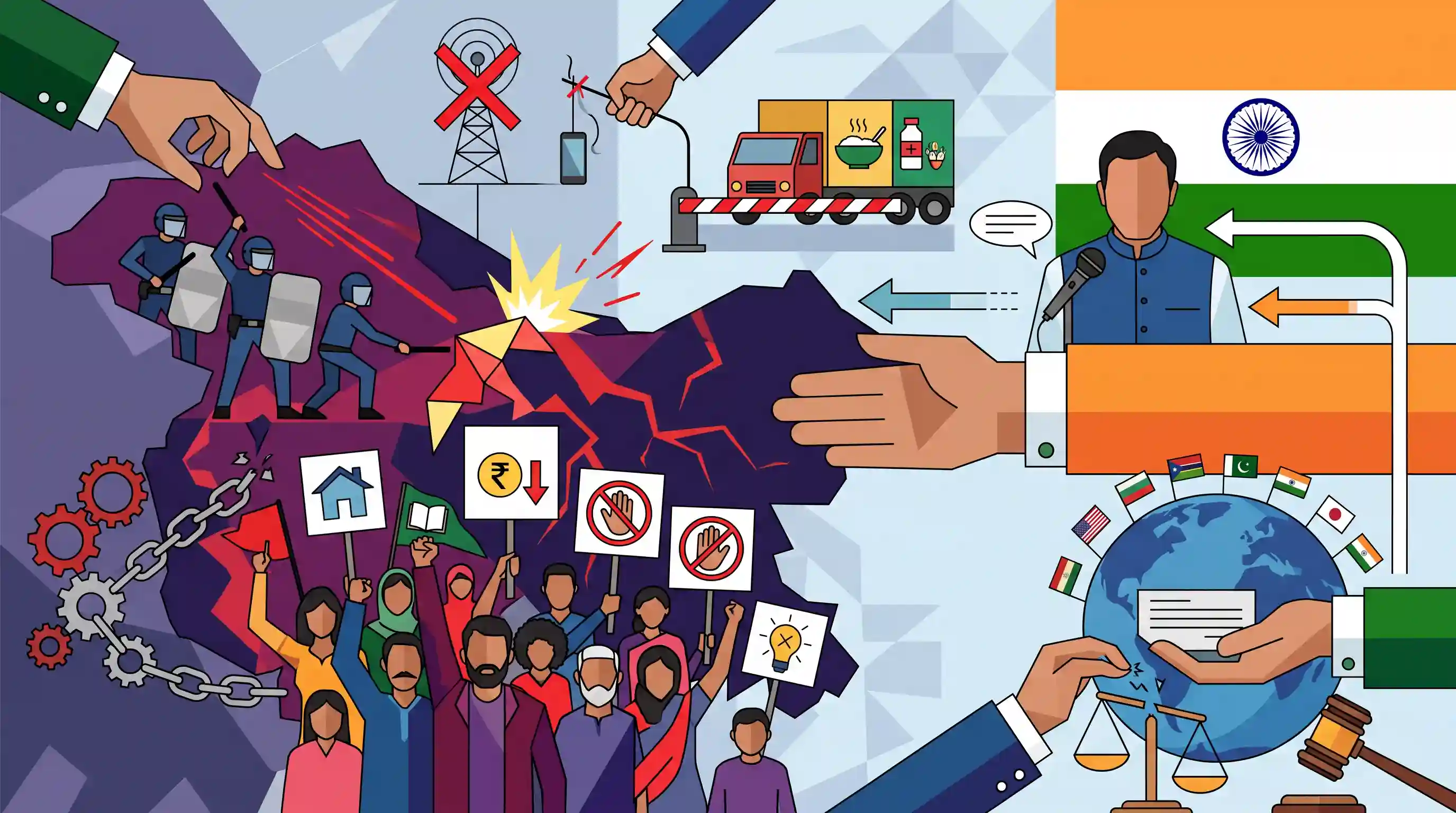
The Ministry of External Affairs (MEA), India, has stated that the escalating civil unrest and protests in Pakistan-occupied Jammu and Kashmir (PoJK) are a consequence of Pakistan's decades-long systemic exploitation and administrative oppression. Led by the Joint Awami Action Committee (JAAC), the local population is protesting against severe economic deprivation, inflation, and a lack of basic rights. Instead of addressing these grievances, the Pakistani state has cracked down with police brutality, internet shutdowns, supply blockades of essential goods like food and medicine, and lethal force. Reaffirming its sovereign claim over the region, India has called upon the international community to hold Pakistan accountable for human rights violations in its illegally occupied territories.
Key Points
- The Ministry of External Affairs (MEA), India, stated that the ongoing widespread protests in Pakistan-occupied Jammu and Kashmir (PoJK) are a direct result of Pakistan's 'decades-long systemic exploitation, denial of fundamental rights, and administrative oppression' under illegal occupation.
- The protests are spearheaded by the Joint Awami Action Committee (JAAC), which called for a long march to Muzaffarabad following the expiry of an ultimatum to the Pakistani government over economic and political grievances.
- JAAC's demands include the implementation of its 38-point charter of demands, the release of detained leaders and activists, and an end to the ongoing 'security crackdown' and high utility tariffs.
- India's MEA spokesperson Randhir Jaiswal condemned Pakistan's response to the protests, highlighting state-led police brutality against civilians, blocking of food and medicine supplies, internet blackouts, and the deployment of lethal force.
- India has urged the international community to hold Pakistan fully accountable for human rights abuses and governance misdeeds in the occupied territories.
Important Terms
Joint Awami Action Committee (JAAC)

A civil society coalition in Pakistan-occupied Jammu and Kashmir (PoJK) formed in 2023, comprising traders, lawyers, and students, leading protests against economic deprivation, high utility costs, and political marginalization.
UPSC context
GS Paper II (India and Neighborhood); tests understanding of regional civil movements and geopolitical friction.
Pakistan-occupied Jammu and Kashmir (PoJK)
A region of the former princely state of Jammu and Kashmir currently under illegal Pakistani administrative and military control, claimed as an integral territory by India.
UPSC context
GS Paper II (Bilateral Relations); tests knowledge of border disputes, historical context, and territorial integrity.
Ministry of External Affairs (MEA)
The central government agency of India responsible for the conduct of foreign relations, formulating foreign policy, and representing the nation on the global stage.
UPSC context
GS Paper II (Foreign Policy & Institutions); tests knowledge of executive bodies managing international relations.
Prelims Trap
The historic 1994 resolution asserting India's sovereignty over the entirety of J&K was passed exclusively by the Lok Sabha.
The landmark 1994 resolution was a unanimous joint declaration passed by BOTH houses of Parliament (Lok Sabha and Rajya Sabha), not just the Lok Sabha.
Static Concepts Connected
What is the significance of the 1994 Parliamentary Resolution on Jammu and Kashmir?
- Unanimous Consensus: Passed unanimously on February 22, 1994, by both Houses of the Indian Parliament to show absolute national consensus.
- Sovereignty Assertion: Declares that the entire State of Jammu and Kashmir is an integral part of the Indian Union.
- Vacation Demand: Demanded that Pakistan must vacate all areas of the Indian State of Jammu and Kashmir which it has occupied through aggression.
What is the 1963 Sino-Pakistan Boundary Agreement and its strategic impact?
- Territorial Cession: Signed on March 2, 1963, Pakistan illegally ceded 5,180 sq km of Shaksgam Valley in Gilgit-Baltistan to China.
- India's Rejection: India rejects the pact, maintaining that the territory is an integral part of Ladakh/J&K and that Pakistan had no legal right to transfer it.
- Strategic Collusion: Deepened China-Pakistan strategic collusion, paving the physical path for the Karakoram Highway and the China-Pakistan Economic Corridor (CPEC).
Cross-Topic Patterns
PoJK protests + CPEC sovereignty
Local unrest in Gilgit-Baltistan and PoJK directly impacts the security of the China-Pakistan Economic Corridor (CPEC), reinforcing India's sovereignty objections to the trans-boundary project.
Human rights + Neighborhood Policy
India leverages human rights violations in PoJK at international forums to counter Pakistan's narrative, highlighting its failure to maintain basic governance under the Shimla Agreement.

The legal status of PoJK, the 1994 Resolution, and the 1963 Shaksgam Pact's impact on CPEC are prime targets for GS-2/Prelims 2026.
Linked PYQs · 3
Linked PYQs · 3
- 2015MainsGS2
Terrorist activities and mutual distrust have clouded India-Pakistan relations. To what extent the use of soft power like sports and cultural exchanges could help generate goodwill between the two countries? Discuss with suitable examples.
- 2020MainsGS3
Analyze internal security threats and transborder crimes along Myanmar, Bangladesh and Pakistan borders including Line of Control (LoC). Also discuss the role played by various security forces in this regard.
- 2016MainsGS3
Border management is a complex task due to difficult terrain and hostile relations with some countries. Elucidate the challenges and strategies for effective border management.
