इस्लामाबाद बम विस्फोट और उग्रवाद का पुनरुत्थान
स्रोत:द हिंदू ↗
क्यों मायने रखता है
दक्षिण एशिया को अस्थिर करने में सीमा पार आतंकवाद और उग्रवादी पनाहगाहों के निरंतर खतरे को दर्शाता है, जो GS2 (भारत और इसके पड़ोसी संबंध) और GS3 (आंतरिक सुरक्षा चुनौतियां और आतंकवाद) के लिए एक समकालीन केस स्टडी प्रदान करता है।
सारांश
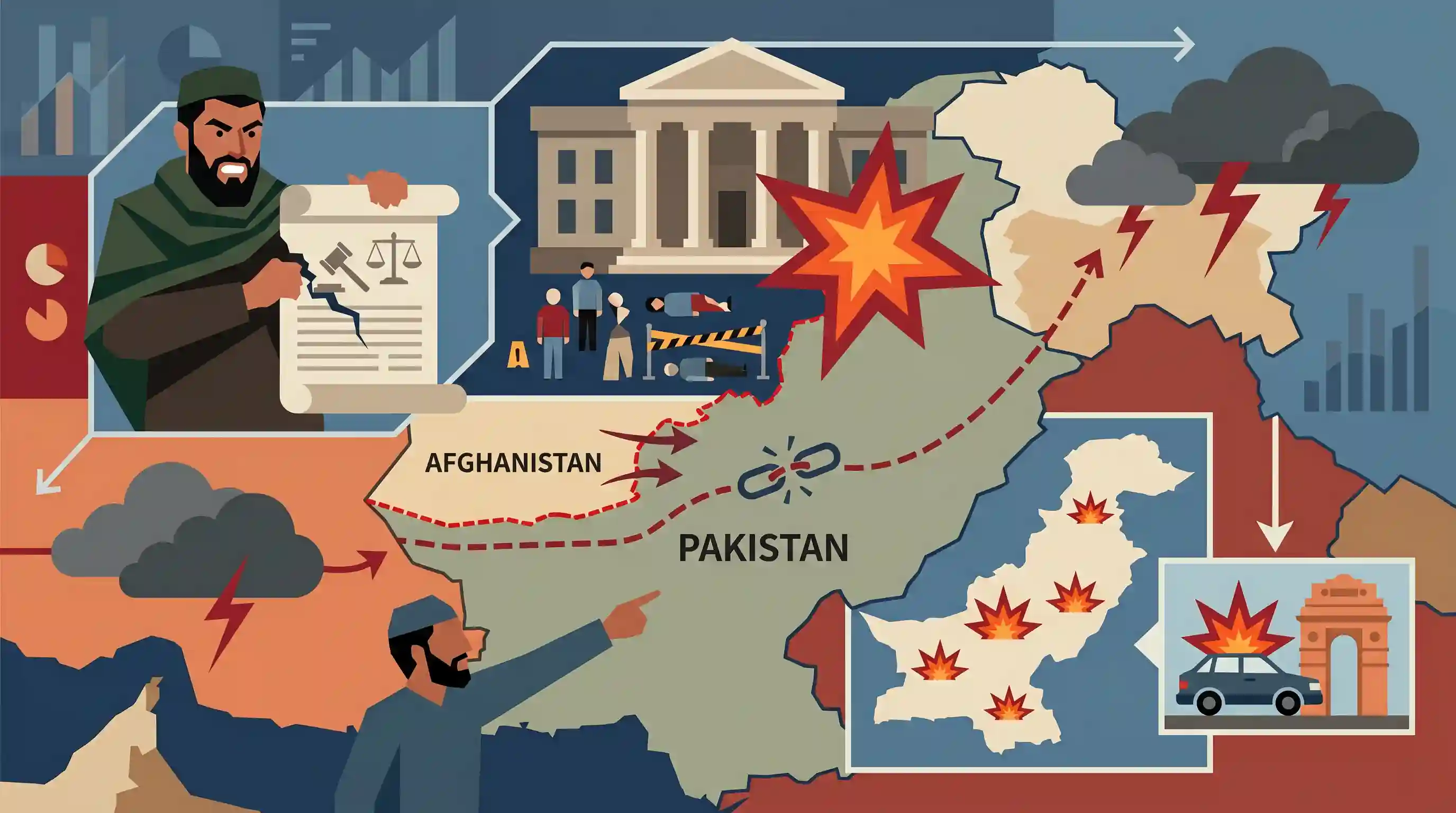
The Pakistani Taliban (TTP) claimed responsibility for a deadly suicide bombing outside district court buildings in Islamabad that killed at least 12 people. The militant group explicitly targeted the judiciary for enforcing laws they deem "un-Islamic". The incident occurs amid a broader resurgence of terrorist violence in Pakistan, with government officials accusing Afghanistan of harbouring TTP fighters and other militant factions. The recent wave of cross-border attacks has severely strained Pakistan-Afghanistan relations, derailed border ceasefire negotiations, and raised regional security concerns in South Asia following a similar car explosion in Delhi just a day prior.
मुख्य बिंदु
- The Pakistani Taliban (TTP) claimed responsibility for a rare and deadly suicide car bomb attack in Islamabad, targeting members of the judiciary over the enforcement of "un-Islamic laws".
- The blast resulted in at least 12 fatalities and numerous injuries, marking a major resurgence of militant violence in the Pakistani capital.
- Pakistani officials attributed the attacks to militant groups taking shelter in Afghanistan, which has stalled recent border negotiations and severely strained diplomatic relations between Islamabad and Kabul.
- The bombing occurred shortly after another deadly car explosion in Delhi, underscoring broader volatility and persistent cross-border terrorism challenges across the South Asian region.
महत्वपूर्ण शब्द
Tehrik-i-Taliban Pakistan (TTP)

An umbrella organization of various militant groups formed in 2007 seeking to overthrow the Pakistani state and establish an 'Islamic Emirate' through Sharia-based governance.
UPSC context
GS Paper 3 (Internal Security) and GS Paper 2 (International Relations); critical for understanding regional terrorism and India's neighborhood.
Cross-border Terrorism
Terrorism where one country's territory is used to plan or launch attacks against another, often as a 'grey zone' conflict or undeclared proxy war.
UPSC context
GS Paper 3 (Internal Security); core concept for analyzing challenges to national integrity and state-sponsored militancy.
Durand Line
The 2,640 km border established in 1893 between British India and Afghanistan; recognized by Pakistan as an international boundary but rejected by successive Afghan regimes.
UPSC context
GS Paper 2 (International Relations); essential for territorial disputes and geopolitical stability in South Asia.
Strategic Depth
A military strategy used by Pakistan to influence Afghanistan to prevent Indian encirclement and secure a friendly buffer during potential conflicts.
UPSC context
GS Paper 2 (International Relations); analyzes Pakistan’s foreign policy and its long-term impact on regional peace.
Non-State Actors
Individuals or groups that hold significant political or social influence but are not allied with any particular country or state (e.g., TTP, NGOs, or MNCs).
UPSC context
GS Paper 3 (Internal Security); tests understanding of asymmetrical threats to a state's sovereign authority.
Internal Security
The preservation of peace, law and order within a nation's borders, involving the protection of citizens and institutions from internal threats.
UPSC context
GS Paper 3 (Syllabus head); tests strategies to manage domestic radicalization, insurgency, and organized crime.
प्रारंभिक ट्रैप
The TTP and Afghan Taliban are a unified entity under a single leadership aiming to establish an Islamic Emirate across the Af-Pak region.
They are distinct entities. The Afghan Taliban governs Afghanistan, while the TTP is a separate umbrella militant organization specifically seeking to overthrow the Pakistani state.
संबंधित अवधारणाएँ
What is Pakistan's 'Strategic Depth' doctrine regarding Afghanistan?
- Military Origin: Formulated in the 1980s to use Afghanistan as a friendly fallback territory in the event of an invasion by India.
- Proxy Method: It relied on cultivating pro-Pakistan militant regimes in Kabul to ensure a pliant western border.
- Blowback Effect: The current TTP resurgence from Afghan safe havens against the Pakistani state demonstrates the failure and unintended consequences of this doctrine.
Why is the Durand Line a persistent source of Af-Pak conflict?
- Colonial Legacy: The 2,640-km border was drawn by the British in 1893, arbitrarily dividing ethnic Pashtun and Baloch tribal areas.
- Non-recognition: Successive Afghan governments, including the Taliban, refuse to recognize it as a legitimate international boundary.
- Militancy Facilitator: The disputed, porous nature of the border facilitates trans-border militant movement, smuggling, and cross-border terrorism.
अंतर-विषय पैटर्न
Regional terror spikes & FATF scrutiny
The resurgence of TTP and overlapping regional blasts could re-trigger global scrutiny on terror-financing frameworks, increasing the risk of returning Pakistan to the FATF Grey List.
Contagion effect in South Asian security
Consecutive blasts in Delhi and Islamabad highlight how porous borders and historical proxy policies create a volatile, uncontainable regional security environment impacting India's internal security.

Expect a 2026 Mains question linking the collapse of Pakistan's 'Strategic Depth' doctrine to rising regional cross-border terrorism.
संबद्ध PYQ · 3
संबद्ध PYQ · 3
- 2021MainsGS3
Analyse the complexity and intensity of terrorism, its causes, linkages and obnoxious nexus. Also suggest measures required to be taken to eradicate the menace of terrorism.
- 2020MainsGS3
Analyze internal security threats and transborder crimes along Myanmar, Bangladesh and Pakistan borders including Line of Control (LoC). Also discuss the role played by various security forces in this regard.
- 2016MainsGS2
Increasing cross-border terrorist attacks in India and growing interference in the internal affairs of several member-states by Pakistan are not conducive for the future of SAARC (South Asian Association for Regional Cooperation)." Explain with suitable examples.
