Balochistan Insurgency and Military Counter Terrorism Operations
Source:The Hindu ↗
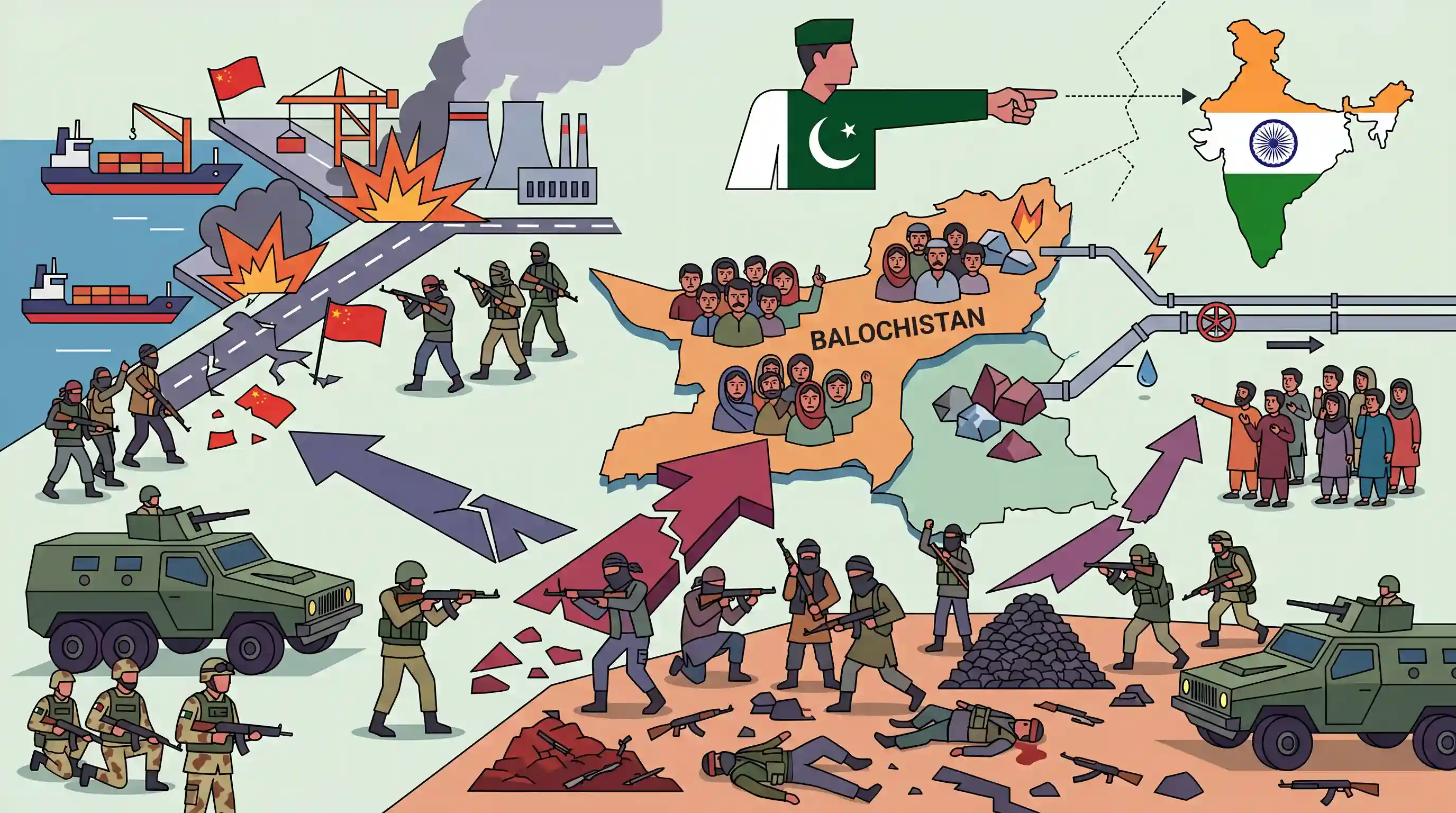
Why It Matters
The Balochistan insurgency impacts regional stability in South Asia and directly affects India-Pakistan relations due to Islamabad's frequent, unsubstantiated allegations of Indian involvement. Furthermore, the targeting of Chinese infrastructure (CPEC) in Balochistan and cross-border militant networks (TTP, Afghan Taliban) are critical for understanding the geopolitical security architecture of India's immediate neighborhood.
Summary
Pakistani security forces neutralized 177 Baloch Liberation Army (BLA) militants in a 48-hour counter-insurgency operation in Balochistan, marking the highest toll in decades. The clashes followed coordinated BLA attacks on civilian and security infrastructure. The conflict highlights regional instability fueled by the ethnic Baluch minority's grievances over state exploitation and discrimination. Complicating the geopolitical landscape, Pakistan accused India of backing the militants without evidence, while the BLA continues to target Chinese infrastructure projects, allegedly with operational support from the Tehrik-e-Taliban Pakistan (TTP).
Key Points
- Pakistani security forces killed 177 militants from the Baloch Liberation Army (BLA) in Balochistan within 48 hours following coordinated insurgent attacks.
- The insurgency is rooted in long-standing grievances of the ethnic Baluch minority regarding political discrimination and economic exploitation by the central government.
- Pakistan's Interior Minister labeled the killed insurgents as 'Indian-backed terrorists,' a claim made without evidence that attempts to internationalize a domestic conflict.
- The BLA frequently targets Chinese interests and infrastructure projects in the region and is reportedly supported by the Tehrik-e-Taliban Pakistan (TTP), highlighting complex regional security dynamics.
Important Terms
Baloch Liberation Army (BLA)

An ethno-nationalist militant organization seeking independence for Balochistan. It targets Pakistani security forces and Chinese infrastructure, alleging state exploitation. It is designated a terrorist group by Pakistan, the US, and UK.
UPSC context
GS-III (Security). Tests understanding of regional insurgencies, non-state actors, and their impact on South Asian stability.
Tehrik-e-Taliban Pakistan (TTP)
An umbrella group of Islamist militants operating along the Afghan-Pakistan border. It seeks to overthrow the Pakistani state to impose Sharia law and often collaborates with other regional insurgent factions.
UPSC context
GS-III (Internal Security). Relates to cross-border terrorism and challenges posed by religious extremism in India’s neighborhood.
China-Pakistan Economic Corridor (CPEC)
A flagship multi-billion dollar project of China’s Belt and Road Initiative (BRI) connecting Gwadar Port to Xinjiang. It is a major target for Baloch militants and a sovereignty concern for India.
UPSC context
GS-II (International Relations). Vital for topics on India-China-Pakistan dynamics and sovereignty issues regarding Pakistan-occupied Kashmir (PoK).
Balochistan
Pakistan’s largest, resource-rich province that remains economically marginalized. It is the site of a long-running separatist insurgency fueled by grievances over political exclusion and resource exploitation by the central government.
UPSC context
GS-I (Regionalism) and GS-III (Security). Evaluates knowledge of ethnic conflicts and the geostrategic importance of the Arabian Sea.
Non-State Actors
Individuals or groups independent of state governments that hold significant influence or use force to achieve political goals, such as the BLA or TTP in regional insurgencies.
UPSC context
GS-III (Security). Core concept for questions on internal security challenges and the impact of proxy warfare on national interests.
Prelims Trap
The Baloch Liberation Army is an Islamist militant organization aligned ideologically with the Afghan Taliban.
Aspirants often confuse the BLA with Islamist groups. The BLA is explicitly secular and ethno-nationalist, driven by resource and territorial grievances, not religious fundamentalism.
Static Concepts Connected
What is the geographical and strategic significance of Balochistan?
- Strategic Borders: Shares international borders with Iran to the west, Afghanistan to the north, and a strategic coastline along the Arabian Sea to the south.
- Resource Wealth: Highly rich in natural gas, copper, and gold (e.g., Reko Diq), yet remains Pakistan's most impoverished province due to systemic exploitation.
- CPEC Hub: Hosts the Gwadar Port, the crucial southern anchor of the China-Pakistan Economic Corridor (CPEC), providing China direct access to the Indian Ocean.
How do ethno-nationalist and religious insurgencies differ?
- Ethno-nationalist: Driven by ethnic identity, territory, and resource control. They are often secular and seek political autonomy or outright independence (e.g., BLA).
- Religious Extremist: Driven by fundamentalist interpretations of religion, aiming to overthrow the government to establish a theocratic state system (e.g., TTP).
- Tactical Alliances: Despite deep ideological differences, these disparate groups sometimes forge temporary tactical alliances based on shared animosity toward the state.
Cross-Topic Patterns
Gwadar instability vs. Chabahar's value
Instability in Balochistan threatens China's Gwadar port, indirectly elevating the strategic value of India's Chabahar port investments in neighboring Iran as a stable regional alternative.
Ideological convergence in militancy
The tactical alliance between the secular BLA and Islamist TTP illustrates how modern non-state actors bypass ideological friction to achieve operational leverage against state machinery.

Mains 2026: Assess the implications of the BLA-TTP tactical nexus and Baloch insurgency on CPEC's viability and India's security calculus.
Linked PYQs · 4
Linked PYQs · 4
- 2024MainsGS2
‘Terrorism has become a significant threat to global peace and security.’ Evaluate the effectiveness of the United Nations Security Council's Counter Terrorism Committee (CTC) and its associated bodies in addressing and mitigating this threat at the international level.
- 2016MainsGS2
Increasing cross-border terrorist attacks in India and growing interference in the internal affairs of several member-states by Pakistan are not conducive for the future of SAARC (South Asian Association for Regional Cooperation)." Explain with suitable examples.
- 2024MainsGS3
India has a long and troubled border with China and Pakistan fraught with contentious issues. Examine the conflicting issues and security challenges along the border. Also give out the development being undertaken in these areas under the Border Area Development Programme (BADP) and Border Infrastructure and Management (BIM) Scheme.
- 2025MainsGS3
Terrorism is a global scourge. How has it manifested in India? Elaborate with contemporary examples. What are the counter measures adopted by the State? Explain.
