Pakistan Offers Mediation Between United States and Iran
Source:The Hindu ↗
Why It Matters
This article connects several critical UPSC themes: the geopolitics of West Asia, the strategic importance of maritime chokepoints like the Strait of Hormuz for energy security, and the diplomatic competition between India and Pakistan. It highlights the challenges India faces in maintaining strategic influence in the Middle East amidst Pakistan's diplomatic outreach.
Summary
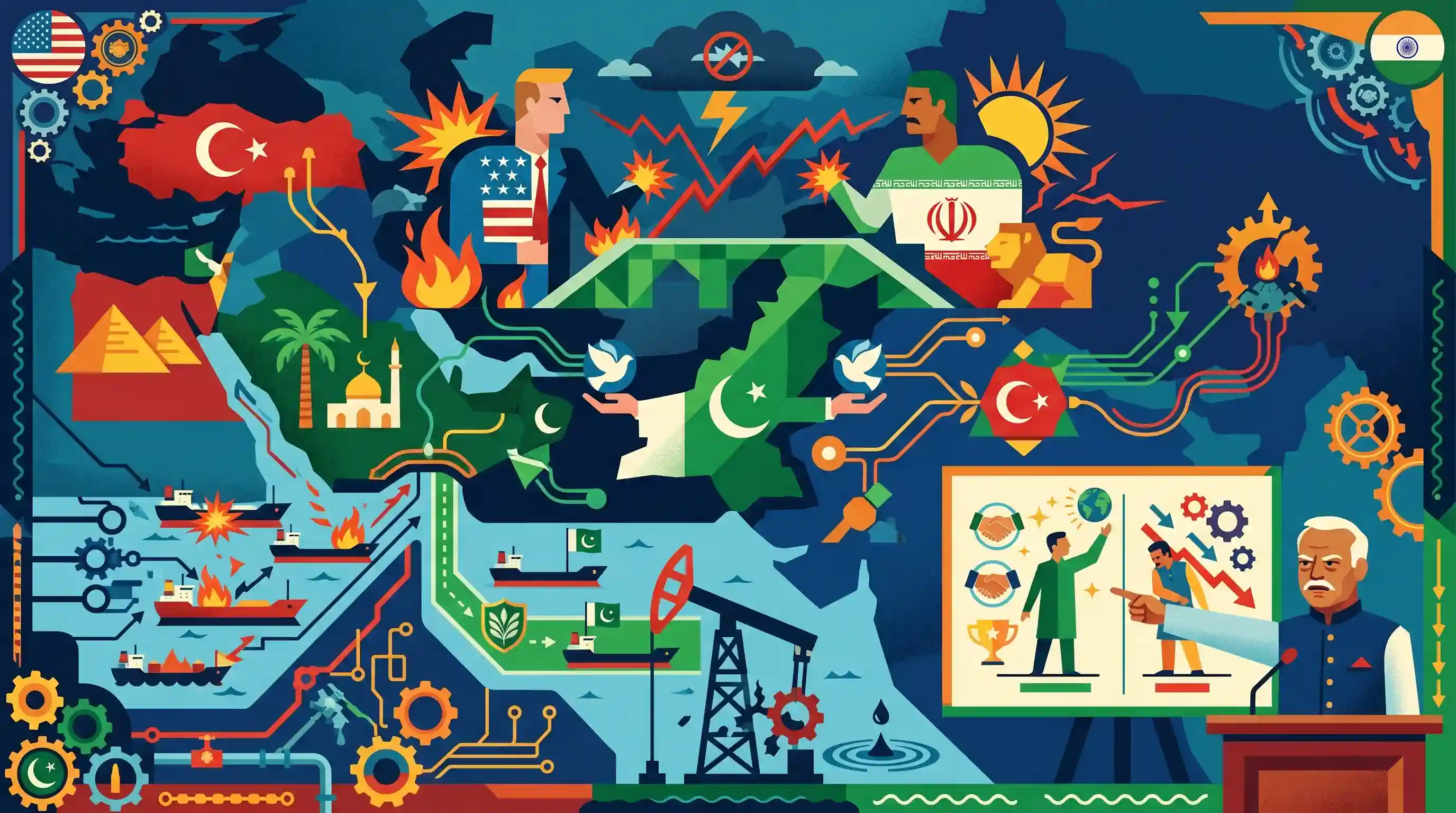
Pakistan has expressed its readiness to mediate peace talks between the United States and Iran to ease escalating tensions in the Middle East. Foreign Minister Ishaq Dar emphasized Pakistan's active diplomatic role, evidenced by recent engagements with Saudi Arabia, Egypt, and Turkey. The conflict poses a severe risk to maritime traffic in the Strait of Hormuz, which is vital for Pakistan's oil and gas imports, although Iran recently allowed Pakistani vessels safe passage. Meanwhile, in India, Congress leader Jairam Ramesh framed Pakistan's diplomatic maneuvering and global acceptance as a significant failure of India's current foreign policy. The development highlights complex regional geopolitics, the vulnerability of energy supply chains, and the ongoing diplomatic contest between India and Pakistan.
Key Points
- Pakistan's Foreign Minister Ishaq Dar announced that Pakistan would be honored to facilitate peace talks between the US and Iran to de-escalate regional conflict.
- The statement follows Pakistan hosting senior officials from Saudi Arabia, Egypt, and Turkey, showcasing its active diplomatic outreach in the Middle East.
- Regional tensions have threatened maritime traffic through the Strait of Hormuz, a crucial choke point for Pakistan's heavily import-dependent energy sector.
- Despite the broader conflict, Iran permitted 20 Pakistani-flagged vessels to pass through the Strait, highlighting their bilateral understanding.
- Congress leader Jairam Ramesh criticized India's foreign policy, arguing that Pakistan's global diplomatic acceptance signals a strategic failure for India.
Important Terms
Strait of Hormuz

A strategic maritime chokepoint between the Persian Gulf and the Gulf of Oman; it facilitates approximately 20% of global oil and liquefied natural gas (LNG) trade.
UPSC context
GS Paper II/III (Geography/IR/Energy); vital for understanding West Asian geopolitics and India's maritime supply chain vulnerabilities.
Energy Security
The continuous availability of energy sources at an affordable price; for India, this involves mitigating risks of supply disruptions in the Middle East.
UPSC context
GS Paper III (Economy/Security); addresses India's high crude oil import dependency and the impact of regional wars on inflation.
Strategic Autonomy
A state's capacity to pursue its national interests and preferred foreign policy independently, without being forced to take sides in great-power rivalries.
UPSC context
GS Paper II (International Relations); key to debates on India's "non-alignment 2.0" versus its recent "strategic reticence" in regional conflicts.
Neighbourhood First Policy
India’s primary foreign policy framework prioritizing proactive engagement, connectivity, and development cooperation with its immediate neighbors to ensure regional stability.
UPSC context
GS Paper II (IR/Neighbourhood Relations); tests India's ability to maintain regional leadership amid diplomatic competition from Pakistan and China.
Diplomatic Mediation
A diplomatic process where a third party (neutral or mutually accepted) assists conflicting nations in reaching a peaceful settlement through dialogue.
UPSC context
GS Paper II (International Relations); examines the roles and credibility of various states (like Pakistan) as regional peace facilitators.
Indian National Congress
India's principal opposition party; in the context of foreign policy, it critiques the government's perceived failure to maintain regional diplomatic dominance.
UPSC context
GS Paper II (Polity/Governance); relates to the role of the opposition in scrutinizing executive decisions on international and regional affairs.
Prelims Trap
The Strait of Hormuz is a vital chokepoint bordered by Iran and Saudi Arabia.
It is bordered by Iran and Oman (via the Musandam Peninsula). Saudi Arabia has coastlines on the Persian Gulf and Red Sea, but NOT the Strait itself.
Static Concepts Connected
What are the vital maritime chokepoints in the Middle East?
- Strait of Hormuz: Connects the Persian Gulf to the Gulf of Oman. Bordered by Iran to the north and Oman to the south.
- Bab el-Mandeb: Connects the Red Sea to the Gulf of Aden. Bordered by Yemen on the Arabian Peninsula, and Djibouti and Eritrea in Africa.
- Suez Canal: Artificial waterway connecting the Mediterranean Sea to the Red Sea, controlled entirely by Egypt.
What drives India's 'Think West' policy in the Middle East?
- Energy Security: Securing crude oil and LNG imports, as the Gulf region traditionally supplies over 50% of India's energy needs.
- Diaspora Welfare: Protecting and facilitating massive inbound remittances from the roughly 8.5 million Indian expatriates residing in the Gulf.
- Strategic Balancing: Maintaining balanced, de-hyphenated relationships across the deeply fractured Saudi, Iranian, and Israeli geopolitical divides.
Cross-Topic Patterns
Maritime Chokepoints & Macroeconomics
Geopolitical tensions in the Strait of Hormuz can trigger global oil price shocks, directly widening India's Current Account Deficit and spurring imported inflation.
Diplomatic Isolation vs. Global Mediation
Pakistan's attempt to mediate US-Iran talks is a direct counter-strategy to India's post-2016 diplomatic efforts to isolate Islamabad on global forums like the UN and FATF.

Map questions pairing Middle East chokepoints like Hormuz with bordering nations and current regional conflicts are highly likely in 2026.
Linked PYQs · 4
Linked PYQs · 4
- 2025MainsGS2
"Energy security constitutes the dominant kingpin of India's foreign policy, and is linked with India's overarching influence in Middle Eastern countries.” How would you integrate energy security with India's foreign policy trajectories in the coming years?
- 2017MainsGS2
The question of India's Energy Security constitutes the most important part of India's economic progress. Analyze India's energy policy cooperation with West Asian countries.
- 2025MainsGS3
Why is maritime security vital to protect India's sea trade? Discuss maritime and coastal security challenges and the way forward.
- 2016MainsGS2
Increasing cross-border terrorist attacks in India and growing interference in the internal affairs of several member-states by Pakistan are not conducive for the future of SAARC (South Asian Association for Regional Cooperation)." Explain with suitable examples.
