Pakistan and Turkiye Agree to Deepen Defence and Trade
Source:The Hindu ↗
Why It Matters
The emerging Pakistan-Turkiye axis involves direct defence cooperation and mutual support on issues detrimental to India's interests (such as Kashmir and actions in PoK). Furthermore, non-Indian regional connectivity initiatives like the ITI train and ECO platforms reflect shifting geopolitical realignments in India's extended neighborhood that civil servants must analyze.
Summary
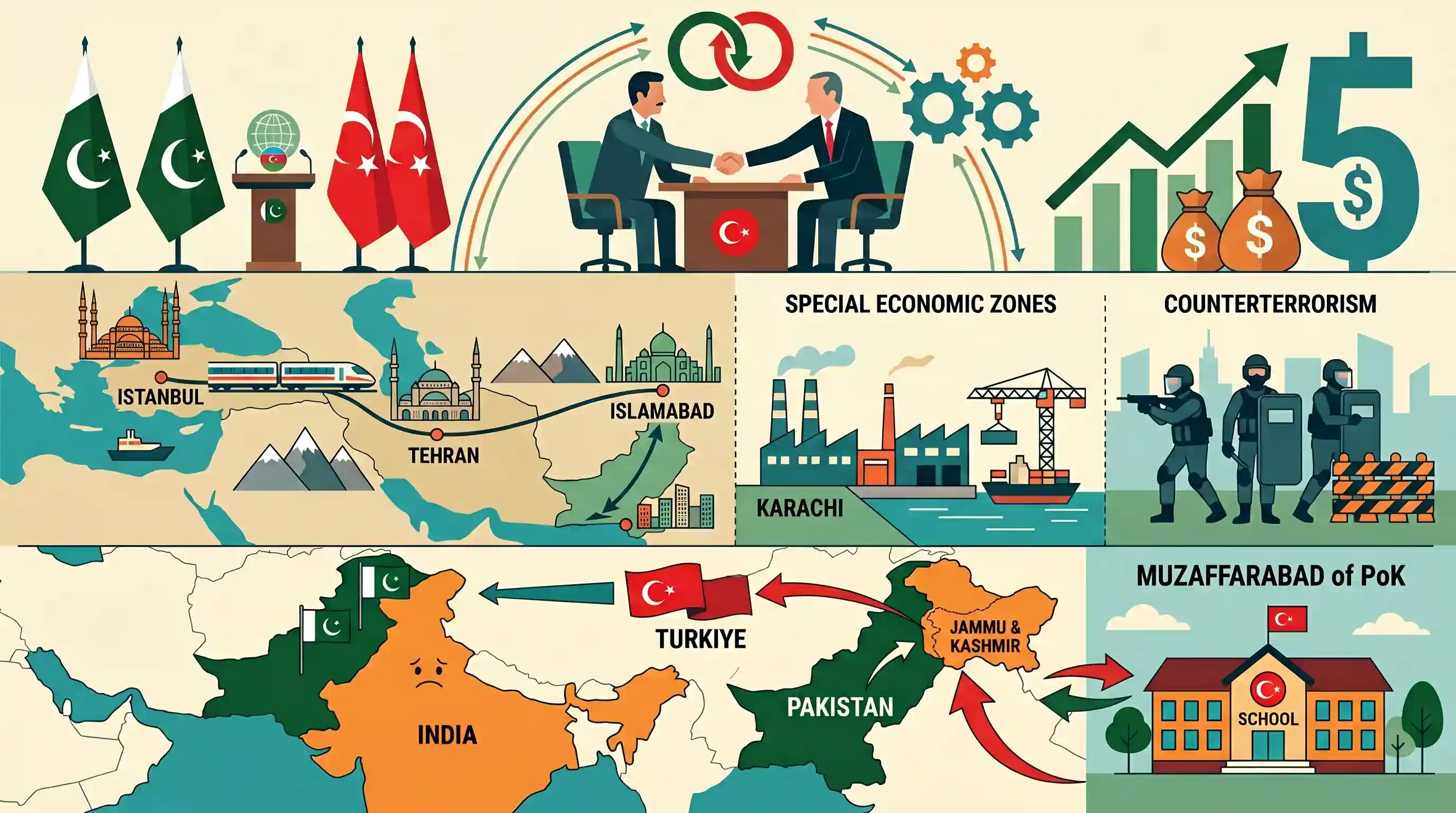
Pakistan and Turkiye have pledged to significantly deepen their defence and economic cooperation, setting a bilateral trade target of $5 billion. Meeting on the sidelines of the Economic Cooperation Organisation (ECO) summit in Azerbaijan, Pakistani President Asif Ali Zardari and Turkish President Recep Tayyip Erdogan discussed capacity building, counterterrorism, and regional connectivity. Key initiatives include establishing a dedicated Special Economic Zone for Turkish investors in Karachi and reviving the Istanbul-Tehran-Islamabad (ITI) train. Geopolitically, Turkiye reaffirmed its diplomatic support for Pakistan's stance regarding its conflict with India, underscored by the operationalization of a Turkish-funded school in Muzaffarabad (PoK).
Key Points
- Pakistan and Turkiye have set a bilateral trade target of $5 billion, focusing heavily on deepening defence and economic ties.
- The leaders met on the sidelines of the Economic Cooperation Organisation (ECO) summit in Khankendi, Azerbaijan.
- Pakistan offered dedicated space for Turkish entrepreneurs in a Special Economic Zone (SEZ) in Karachi.
- Both sides emphasized the revival of the Istanbul-Tehran-Islamabad (ITI) train to boost regional connectivity.
- Turkiye reaffirmed its support for Pakistan regarding conflicts with India, and inaugurated a Turkish Maarif Foundation school in Muzaffarabad (PoK).
Important Terms
Istanbul-Tehran-Islamabad (ITI) train corridor

A 6,500 km freight rail link connecting Pakistan, Iran, and Turkey. It aims to provide an overland trade route between South Asia and Europe, bypassing maritime bottlenecks.
UPSC context
GS Paper II: Regional connectivity projects. Vital for understanding trans-regional trade routes that bypass India or affect its 'Connect Central Asia' policy.
Economic Cooperation Organisation (ECO)
An intergovernmental organization established in 1985 by Iran, Pakistan, and Turkiye to promote socio-economic development and trade among its 10 member states in West and Central Asia.
UPSC context
GS Paper II: Regional groupings involving India’s neighbors. Important for analyzing regional integration and its impact on India's strategic interests.
Turkish Maarif Foundation
A state-funded Turkish foundation authorized to provide educational services abroad. It serves as a key instrument for Turkiye's cultural diplomacy and "soft power" outreach in foreign nations.
UPSC context
GS Paper II: Bilateral relations and sovereignty. Its presence in Pakistan-occupied Kashmir (Muzaffarabad) impacts India’s territorial integrity and diplomatic stance.
Special Economic Zone (SEZ)
A designated area within a country that has different economic regulations and tax incentives than the rest of the nation, specifically designed to attract foreign investment and boost exports.
UPSC context
GS Paper III: Indian Economy and Investment Models. Relevant for comparing trade infrastructure and foreign investment strategies in the neighborhood.
Prelims Trap
India is an observer state in the Economic Cooperation Organisation (ECO).
India is neither a member nor an observer of ECO. It is a 10-member bloc founded by Iran, Pakistan, and Turkey, later expanding to Central Asia.
Static Concepts Connected
What are the core parameters of the Economic Cooperation Organisation (ECO)?
- Origins & Founders: Established in 1985 by Iran, Pakistan, and Turkey, it succeeded the earlier Regional Cooperation for Development (RCD).
- Expansion & Membership: Expanded in 1992 to 10 members, absorbing Afghanistan, Azerbaijan, and five Central Asian Republics.
How does the ITI train corridor contrast with the INSTC?
- ITI Train Corridor: An East-West rail route linking Istanbul, Tehran, and Islamabad, driving ECO trade while explicitly bypassing India.
- INSTC Network: A South-North multi-modal route connecting India to Russia and Europe via Iran, bypassing Pakistan entirely.
Cross-Topic Patterns
Rise of the Non-Arab Islamic Axis
Pakistan leverages ties with Turkiye and Malaysia to counterbalance India’s deepening strategic, economic, and energy partnerships with traditional Arab Gulf powers like the UAE and Saudi Arabia.
Drone Diplomacy & Defense Exports
Turkiye becoming Pakistan’s second-largest arms supplier (Bayraktar drones, MILGEM corvettes) alters the regional security calculus and mirrors its broader drone diplomacy seen in Azerbaijan and Ukraine.

Expect a map-based question matching connectivity corridors (ITI, INSTC, IMEC) with their terminal nodes or bypassing countries in 2026.
Linked PYQs · 2
Linked PYQs · 2
- 2015MainsGS2
Terrorist activities and mutual distrust have clouded India-Pakistan relations. To what extent the use of soft power like sports and cultural exchanges could help generate goodwill between the two countries? Discuss with suitable examples.
- 2016MainsGS2
Increasing cross-border terrorist attacks in India and growing interference in the internal affairs of several member-states by Pakistan are not conducive for the future of SAARC (South Asian Association for Regional Cooperation)." Explain with suitable examples.
