Ceasefire Violations and Border Management Challenges Along LoC
Source:Indian Express ↗
Why It Matters
Border skirmishes and ceasefire violations along the LoC directly link to the GS Paper 3 syllabus on 'Security challenges and their management in border areas.' It also contextualizes the strained India-Pakistan bilateral relations relevant to GS Paper 2.
Summary
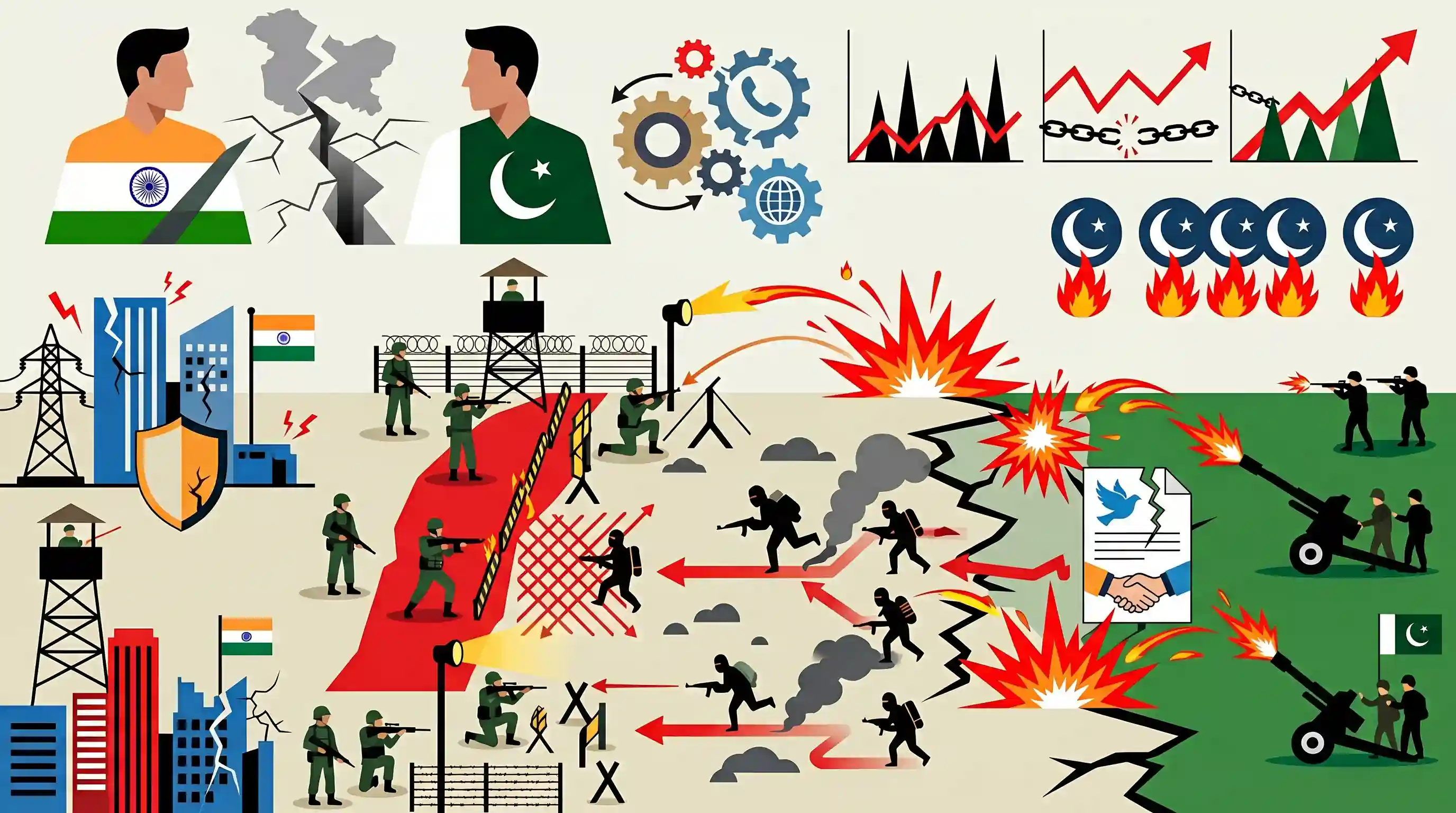
The Indian Army has reported that Pakistani troops continued unprovoked firing across the Line of Control (LoC) in Jammu & Kashmir for a fifth consecutive night. This sustained escalation represents a severe violation of the existing ceasefire understandings between the two nations, notably the renewed 2021 DGMO agreement. Such repeated border skirmishes present serious internal security challenges, as unprovoked firing is historically used as covering fire to facilitate cross-border terrorist infiltration. The incident underscores the fragility of peace along the LoC and highlights the complex challenges in border management. Furthermore, it aggravates the trust deficit and volatility in India-Pakistan bilateral relations.
Key Points
- Pakistani troops have engaged in unprovoked firing across the Line of Control (LoC) for a fifth consecutive night, according to the Indian Army.
- These military actions represent a significant breach of the 2021 reiterated ceasefire understanding between the DGMOs of India and Pakistan.
- Repeated ceasefire violations create severe security challenges, often serving as cover for cross-border infiltration and terrorism in Jammu & Kashmir.
- Such border skirmishes escalate military tensions, deepen mutual distrust, and pose a severe hindrance to the normalization of bilateral ties.
Important Terms
Line of Control (LoC)

The 740 km de facto military boundary dividing Jammu & Kashmir between India and Pakistan, redesignated from the 1949 Ceasefire Line following the 1972 Simla Agreement.
UPSC context
GS Paper 3 (Internal Security) and GS Paper 2 (International Relations); central to border management and territorial disputes.
2021 Ceasefire Understanding
A military commitment by the Directors General of Military Operations (DGMOs) to strictly observe the 2003 ceasefire and maintain peace along the LoC.
UPSC context
GS Paper 2 (India-Pakistan relations); tests knowledge of military-level diplomacy and its role in de-escalating border tensions.
2003 Ceasefire Agreement
A milestone agreement reached in November 2003 to stop cross-border firing, which significantly reduced hostilities and facilitated local trade for several years.
UPSC context
GS Paper 2; historical context for bilateral peace efforts and the foundation for subsequent ceasefire reaffirmations.
Director General of Military Operations (DGMO)
A high-ranking military officer responsible for planning and overseeing army operations, serving as the primary channel for military-to-military communication via border hotlines.
UPSC context
GS Paper 3 (Defence/Internal Security); relates to crisis management mechanisms and institutional frameworks for border communication.
Cross-border Terrorism
The use of one country's territory to launch or support terrorist attacks in another, often serving as a 'grey zone' conflict strategy.
UPSC context
GS Paper 3 (Internal Security); fundamental to understanding external state/non-state actor threats and national security challenges.
Border Management
A national security strategy involving infrastructure, technology (like CIBMS), and coordinated patrolling to secure frontiers against infiltration, smuggling, and territorial incursions.
UPSC context
GS Paper 3 syllabus topic; tests integrated approaches to maintaining territorial integrity and addressing unconventional security threats.
Prelims Trap
"The Border Security Force (BSF) is primarily responsible for securing the Line of Control (LoC)."
The Indian Army secures the active Line of Control (LoC), whereas the BSF guards the International Boundary (IB) with Pakistan.
Static Concepts Connected
Who guards what? India's Multi-agency border guarding architecture
- Army & AR: The Indian Army manages the highly volatile LoC with Pakistan. Assam Rifles guards the Indo-Myanmar border.
- BSF: Guards the legally recognized International Boundary (IB) with Pakistan and the Indo-Bangladesh border.
- ITBP & SSB: ITBP guards the LAC with China, while the SSB is responsible for the peaceful borders with Nepal and Bhutan.
What distinguishes the LoC from an International Boundary (IB)?
- Military Control Line: The LoC is a de facto boundary defining military control, not a legally recognized international border like the IB.
- Simla Agreement 1972: The 1972 Simla Agreement formally established the LoC, renaming the older UN-monitored 1949 ceasefire line.
Cross-Topic Patterns
Tech-border management & CIBMS
Unprovoked firing is used to mask infiltration. This connects directly to India's push for the Comprehensive Integrated Border Management System (CIBMS) to plug vulnerable, unfenced stretches using thermal and AI sensors.
FATF Grey List & Terror Financing
Pakistan's cross-border infiltration tactics are frequently studied alongside international pressure mechanisms like FATF evaluations and state-sponsored terror financing in GS-2 and GS-3.

Expect a multi-statement question in Prelims 2026 contrasting the jurisdictions of BSF, ITBP, and the Army, paired with CIBMS components.
Linked PYQs · 3
Linked PYQs · 3
- 2020MainsGS3
Analyze internal security threats and transborder crimes along Myanmar, Bangladesh and Pakistan borders including Line of Control (LoC). Also discuss the role played by various security forces in this regard.
- 2024MainsGS3
India has a long and troubled border with China and Pakistan fraught with contentious issues. Examine the conflicting issues and security challenges along the border. Also give out the development being undertaken in these areas under the Border Area Development Programme (BADP) and Border Infrastructure and Management (BIM) Scheme.
- 2015MainsGS2
Terrorist activities and mutual distrust have clouded India-Pakistan relations. To what extent the use of soft power like sports and cultural exchanges could help generate goodwill between the two countries? Discuss with suitable examples.
