Indus Waters Treaty Suspension and Parliamentary Diplomacy
Source:The Hindu ↗
Why It Matters
The article provides critical context on the contemporary dynamics of India-Pakistan relations, specifically focusing on the suspension of the Indus Waters Treaty and the strategic use of 'parliamentary diplomacy' to influence international public opinion regarding cross-border terrorism.
Summary
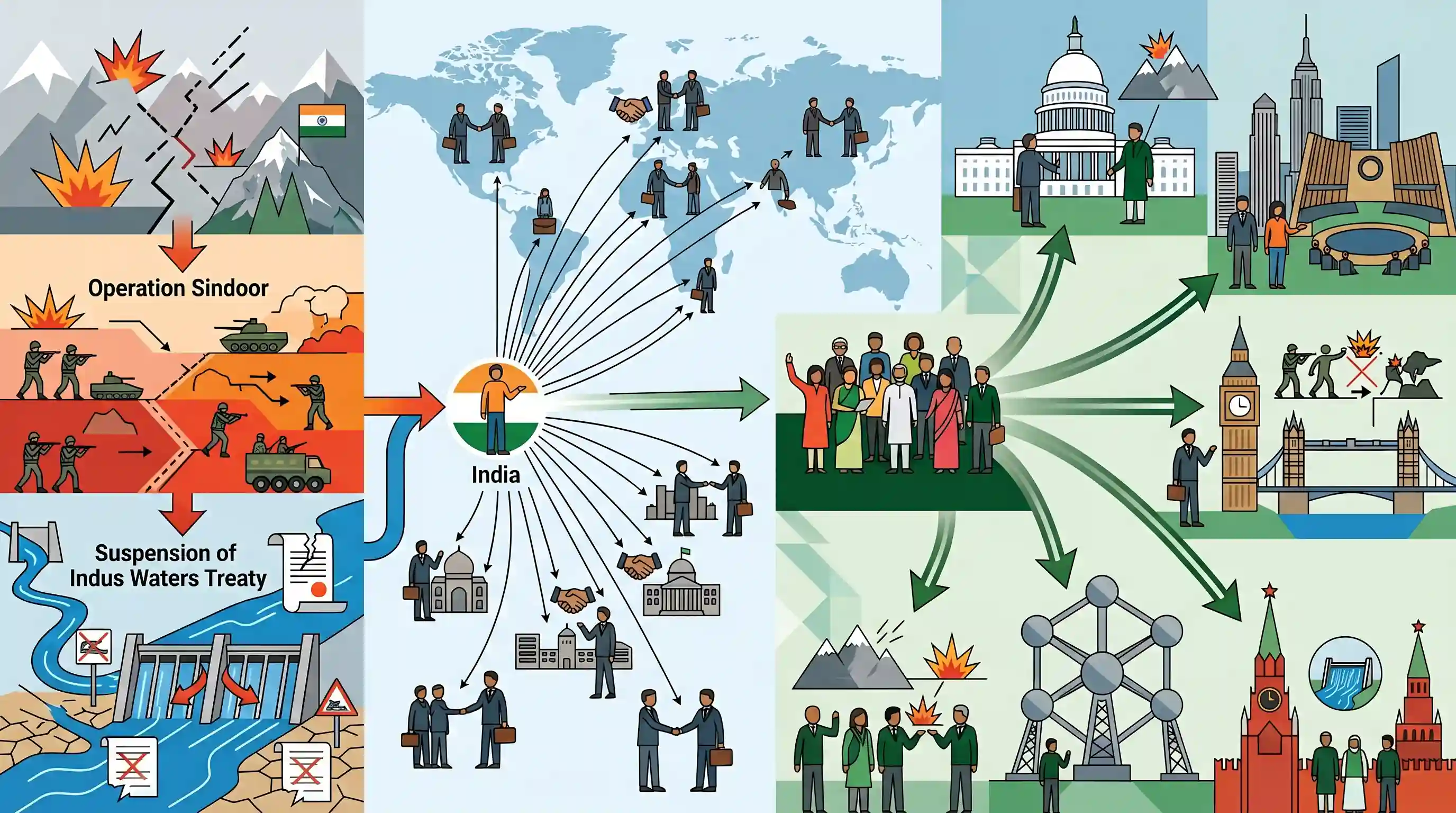
Pakistan is sending all-party parliamentary delegations to major global capitals to counter India's extensive diplomatic outreach following recent bilateral escalations. The diplomatic standoff was triggered by the Pahalgam terror attack in April 2025, which led India to launch "Operation Sindoor" and suspend the Indus Waters Treaty. In response, India dispatched 59 MPs to 33 countries to present its case. Pakistan's retaliatory diplomatic campaign will see senior leaders like Bilawal Bhutto and Syed Tariq Fatemi visit New York, Washington DC, London, Brussels, and Moscow to present Pakistan's narrative on Kashmir, cross-border terrorism, and the Indus Waters Treaty.
Key Points
- Pakistan has constituted special parliamentary delegations to visit five major global capitals to counter India's recent diplomatic outreach.
- The diplomatic maneuvering follows the Pahalgam terror attack in April 2025, India's military response (Operation Sindoor), and its decision to hold the Indus Waters Treaty in abeyance.
- India previously sent 59 Members of Parliament to 33 countries to present its stance on terrorism and the suspension of the water-sharing treaty.
- Pakistan's delegations, involving leaders from various political parties, aim to internationalize the Kashmir issue and challenge India's narrative in the UN, US, UK, EU, and Russia.
- The developments highlight the increasing use of parliamentary diplomacy by both nations to shape global opinion during bilateral crises.
Important Terms
Indus Waters Treaty

A 1960 World Bank-brokered water-sharing agreement between India (Eastern rivers: Ravi, Beas, Sutlej) and Pakistan (Western rivers: Indus, Jhelum, Chenab). It includes a dispute resolution mechanism.
UPSC context
GS Paper 2 (International Relations); critical for understanding India-Pakistan hydro-diplomacy and transboundary water governance.
Parliamentary Diplomacy
International outreach conducted by elected representatives (MPs) to supplement official state diplomacy, build global consensus, and present a national narrative to foreign legislatures and publics.
UPSC context
GS Paper 2 (Indian Constitution/Diplomacy); tests the role of the legislature in foreign policy and soft power.
Track II Diplomacy
Unofficial, non-governmental dialogues involving academic experts, retired diplomats, or civil society members to explore conflict resolution and improve mutual understanding outside formal state channels.
UPSC context
GS Paper 2 (International Relations); relevant for non-state actor roles in resolving bilateral deadlocks.
Cross-border Terrorism
Terrorism where the soil of one country is used to launch attacks against a neighboring nation, often characterized as a "proxy war" or "grey zone" conflict.
UPSC context
GS Paper 3 (Internal Security); core challenge in India-Pakistan relations and national security policy.
Permanent Indus Commission
A bilateral body established under the 1960 Treaty to manage river data exchange, conduct inspections, and serve as the first tier of dispute resolution.
UPSC context
GS Paper 2 (International Relations); functional mechanism of the IWT often affected by bilateral tensions.
Prelims Trap
India has absolutely no usage rights over the Western Rivers (Indus, Jhelum, Chenab) under the Indus Waters Treaty.
While allocated to Pakistan, India is permitted restricted, non-consumptive use of the Western Rivers for domestic needs, agriculture, and run-of-the-river (RoR) hydroelectric projects.
Static Concepts Connected
What is the resource allocation and dispute resolution framework of the IWT?
- River Allocation: Eastern Rivers (Ravi, Beas, Sutlej) allocated for India's unrestricted use. Western Rivers (Indus, Jhelum, Chenab) allocated to Pakistan.
- India's Western Rights: India is allowed non-consumptive use, limited agricultural use, and run-of-the-river hydroelectric power generation on the Western rivers.
- Dispute Mechanism: A 3-tier mechanism: Permanent Indus Commission (administrative), Neutral Expert appointed by World Bank (technical differences), and Court of Arbitration (formal disputes).
What is Parliamentary Diplomacy in the context of India's foreign policy?
- Definition: The deployment of elected MPs to engage with foreign legislatures, serving as Track-1.5 envoys to build global consensus on national narratives.
- Institutional Frameworks: Often executed via bilateral visits (as seen here) or multilateral forums like the Inter-Parliamentary Union (IPU) and Commonwealth Parliamentary Association (CPA).
Cross-Topic Patterns
Water treaties as coercive diplomacy
Suspending the IWT shifts India's strategic posture, merging transboundary water rights (GS1 Geography) with bilateral relations (GS2 IR) to penalize state-sponsored terrorism without relying solely on kinetic escalation.
Kinetic action + Diplomatic isolation
The dual approach of Operation Sindoor and dispatching 59 MPs mirrors the post-Uri/Pulwama doctrine: coupling decisive military retaliation with an intense international diplomatic blitz to isolate Pakistan.

Expect a 2026 Prelims question on the IWT's 3-tier dispute mechanism (Neutral Expert vs Court of Arbitration) and India's river rights.
Linked PYQs · 3
Linked PYQs · 3
- 2012MainsGS2
The situation today is far different to that prevalent fifty years back when the Indus Water Treaty was signed." Highlight the complexity of the current challenges on both sides of the border in this regard. Do you think that a review of the Treaty is in India's best interests?
- 2015MainsGS2
Terrorist activities and mutual distrust have clouded India-Pakistan relations. To what extent the use of soft power like sports and cultural exchanges could help generate goodwill between the two countries? Discuss with suitable examples.
- 2016MainsGS2
Increasing cross-border terrorist attacks in India and growing interference in the internal affairs of several member-states by Pakistan are not conducive for the future of SAARC (South Asian Association for Regional Cooperation)." Explain with suitable examples.
