Pakistan Appointment to Head UNSC Taliban Sanctions Committee
Source:The Hindu ↗
Why It Matters
The paradoxical appointment of a state accused of harboring terrorists to head key UN sanctions and counter-terrorism committees underscores the structural challenges and geopolitical complexities within the UN Security Council. It is highly relevant for answers on UN reforms, global counter-terrorism strategies, and India-Pakistan relations.
Summary
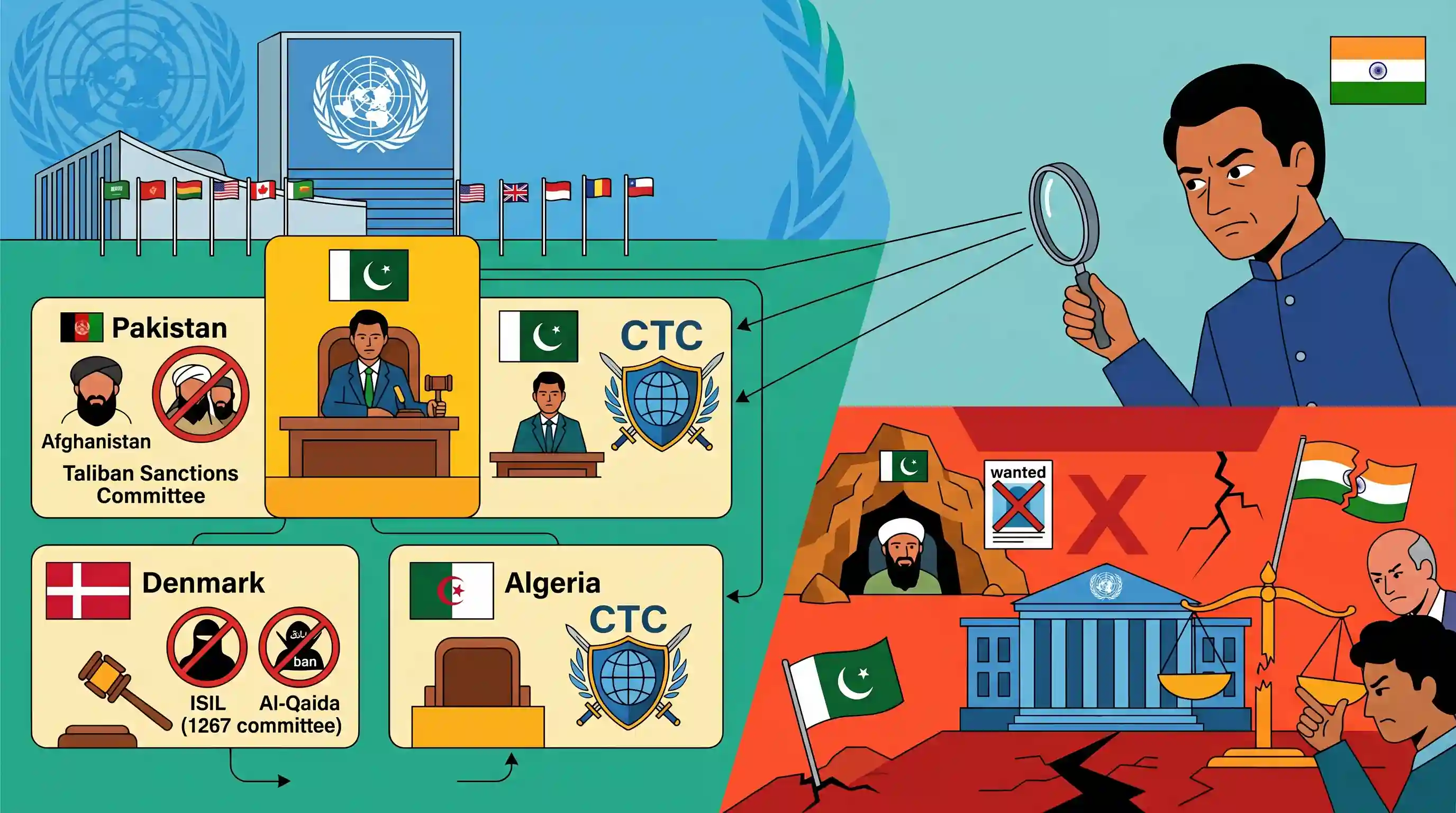
Pakistan has been appointed to chair the UN Security Council's Taliban Sanctions Committee in 2025, while also serving as vice-chair of the UNSC Counter-Terrorism Committee. This move comes as part of its responsibilities as a non-permanent member of the UNSC for the 2025-2026 term. Additionally, Denmark will head the 1267 ISIL and Al-Qaida Sanctions Committee, and Algeria will chair the Counter-Terrorism Committee. Pakistan's new counter-terrorism role is heavily scrutinized, particularly by India, given Pakistan's track record of harboring internationally proscribed terrorists such as Osama bin Laden. The dynamic raises significant concerns about the credibility and effectiveness of the UN's institutional mechanisms to counter terrorism.
Key Points
- Pakistan will chair the UNSC 1988 Taliban Sanctions Committee in 2025 and serve as vice-chair of the 1373 Counter-Terrorism Committee.
- Denmark will chair the 1267 ISIL and Al-Qaida Sanctions Committee, while Algeria will chair the Counter-Terrorism Committee.
- Pakistan is currently serving as a non-permanent member of the UNSC for the 2025-26 term.
- The Taliban Sanctions Committee implements asset freezes, travel bans, and arms embargoes against Taliban-associated entities threatening peace in Afghanistan.
- India, which chaired the Counter-Terrorism Committee in 2022, has consistently highlighted Pakistan's role in harboring UN-proscribed terrorists.
- Bahrain, DRC, Liberia, Latvia, and Colombia have been newly elected as non-permanent members for the 2026-2027 term.
Important Terms
United Nations Security Council (UNSC)

One of six principal UN organs, the 15-member Council holds primary responsibility for maintaining international peace and security, with the power to issue binding resolutions and impose sanctions.
UPSC context
GS Paper II (International Relations): Essential for understanding global governance and India's long-standing quest for a permanent seat.
Taliban Sanctions Committee
Formally the 1988 Sanctions Committee, it monitors and enforces assets freezes, travel bans, and arms embargoes specifically against individuals and entities associated with the Taliban.
UPSC context
GS Paper II & III: Relevant for security challenges in India's neighborhood and international institutional responses to terrorism.
Counter-Terrorism Committee (CTC)
A UNSC body established by Resolution 1373 (2001) to monitor member states' implementation of counter-terrorism measures, such as criminalizing terror financing and suppressing safe havens.
UPSC context
GS Paper III (Internal Security): Tests knowledge of international cooperation and institutional frameworks to combat cross-border terrorism.
1267 ISIL and Al-Qaida Sanctions Committee
A UNSC body overseeing targeted sanctions (assets freeze, travel ban, arms embargo) against individuals and groups associated with ISIL (Da’esh) and Al-Qaida globally.
UPSC context
GS Paper II: Important for understanding the 'Listing' and 'Delisting' processes of global terrorists and India's diplomatic efforts.
Non-permanent members of UNSC
Ten countries elected by the General Assembly for two-year terms to the UNSC. They participate in decision-making but lack the veto power held by the five permanent members.
UPSC context
GS Paper II: Focuses on the structure of the UN and the periodic roles countries like India and Pakistan play.
Prelims Trap
The UNSC 1267 Committee designates both Al-Qaida and Taliban entities for global sanctions.
In 2011, the UN split its sanctions framework. The 1267 Committee strictly targets ISIL/Al-Qaida, while the separate 1988 Committee exclusively handles Taliban sanctions.
Static Concepts Connected
How are non-permanent members of the UNSC elected?
- Electorate: Elected by a two-thirds majority of the UN General Assembly in a secret ballot.
- Term Limits: They serve two-year terms. A retiring member is not eligible for immediate re-election.
- Regional Quotas: Seats are distributed geographically (e.g., 5 for Africa/Asia, 1 for Eastern Europe, 2 for Latin America, 2 for Western Europe/Others).
What differentiates the UNSC CTC (1373) from Sanctions Committees?
- CTC (Resolution 1373): Focuses on broad state capacity building and enforcing legal frameworks to prevent terror financing. It operates by consensus and does not maintain a terrorist list.
- Sanctions Committees: Maintain specific lists of designated individuals/entities and enforce targeted asset freezes, travel bans, and arms embargoes (e.g., 1267 for Al-Qaida).
Cross-Topic Patterns
UN Structural Flaws & CCIT push
Pakistan chairing a terror-sanctions committee exposes the mechanical rotational system's blindness to state-sponsored terrorism, reinforcing India's push for the delayed Comprehensive Convention on International Terrorism (CCIT).
FATF enforcement vs UNSC symbolism
While UNSC 1267 listings are repeatedly delayed by geopolitical vetoes (e.g., China's technical holds), the FATF has proven a far more effective economic deterrent against states harboring terrorists.

Expect a pair-matching Prelims question on UNSC Committees (1267, 1988, 1373) and their specific mandates or targets in 2026.
Linked PYQs · 4
Linked PYQs · 4
- 2024MainsGS2
‘Terrorism has become a significant threat to global peace and security.’ Evaluate the effectiveness of the United Nations Security Council's Counter Terrorism Committee (CTC) and its associated bodies in addressing and mitigating this threat at the international level.
- 2025MainsGS3
Terrorism is a global scourge. How has it manifested in India? Elaborate with contemporary examples. What are the counter measures adopted by the State? Explain.
- 2021MainsGS3
Analyse the complexity and intensity of terrorism, its causes, linkages and obnoxious nexus. Also suggest measures required to be taken to eradicate the menace of terrorism.
- 2016MainsGS2
Increasing cross-border terrorist attacks in India and growing interference in the internal affairs of several member-states by Pakistan are not conducive for the future of SAARC (South Asian Association for Regional Cooperation)." Explain with suitable examples.
