Pakistan Afghan Border Clashes Militant Safe Havens Security Crisis
Source:Indian Express ↗
Why It Matters
The escalating conflict between Pakistan and Afghanistan highlights the persistent threat of cross-border terrorism and the role of non-state actors in regional instability. For India, understanding the Af-Pak security dynamics is crucial for evaluating the broader geopolitical stability of the neighborhood and anticipating challenges related to state-sponsored and non-state militancy.
Summary
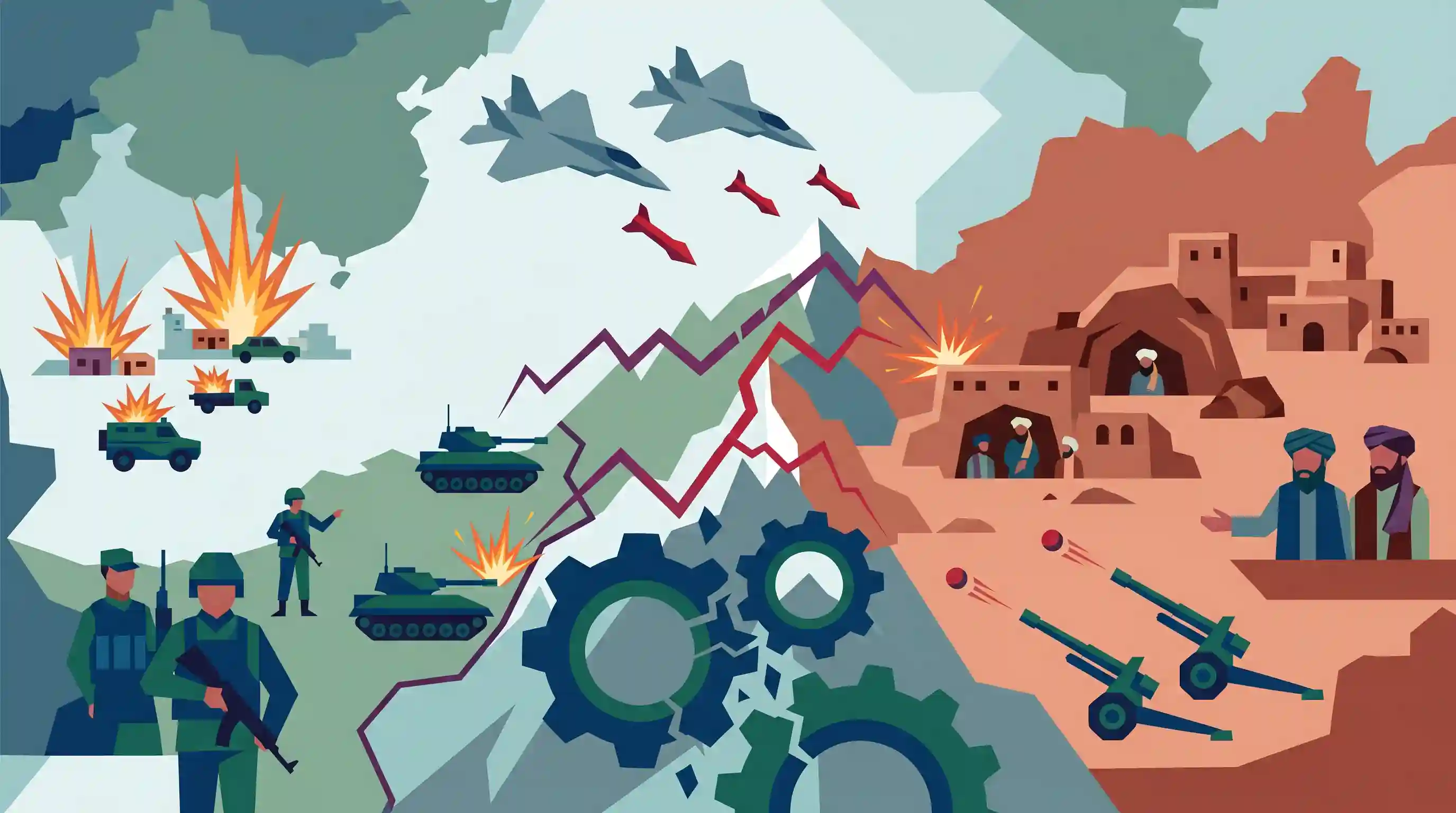
Pakistan's military executed cross-border airstrikes targeting suspected Tehrik-e-Taliban Pakistan (TTP) hideouts in Afghanistan, following a surge in deadly militant attacks on Pakistani forces. The operation targeted the Hafiz Gul Bahadur group, which Islamabad accuses of orchestrating terror activities from Afghan soil with the backing of elements within the Afghan Taliban. In response, the Taliban government strongly condemned the strikes as a violation of Afghan sovereignty and retaliated by shelling Pakistani military outposts along the disputed border. The escalating clashes underscore the deteriorating security relationship between Pakistan and the Taliban regime, highlighting ongoing challenges with cross-border terrorism and regional instability.
Key Points
- Pakistan conducted airstrikes in Afghanistan's border regions, targeting the Hafiz Gul Bahadur faction of the Tehrik-e-Taliban Pakistan (TTP).
- The strikes were launched in retaliation for a surge in deadly attacks on Pakistani security forces, notably an attack in North Waziristan.
- Afghanistan's Taliban government condemned the airstrikes as a violation of sovereignty and retaliated by firing heavy weapons at Pakistani military posts.
- Pakistan accused certain factions of the Afghan Taliban of providing safe havens and patronage to militant groups, violating commitments to prevent Afghan soil from being used for terrorism.
- Escalating border clashes highlight the deteriorating relationship between Islamabad and Kabul since the Taliban's return to power.
Important Terms
Doha Agreement

A 2020 peace treaty between the U.S. and Taliban, mandating U.S. troop withdrawal and a Taliban pledge to prevent terrorist groups from using Afghan soil to threaten international security.
UPSC context
GS II: International Relations. Crucial for understanding regional security obligations and the shift in South Asian geopolitics post-U.S. withdrawal.
Tehrik-e-Taliban Pakistan (TTP)
An umbrella organization of various militant groups formed in 2007, aiming to overthrow the Pakistani state and enforce a strict interpretation of Sharia law through violent insurgency.
UPSC context
GS III: Internal Security. Represents a major cross-border terrorism challenge and threat to India's western neighborhood stability.
Afghan Taliban
A Sunni Islamic movement that has served as the de facto government of Afghanistan since 2021; currently accused by Pakistan of harboring TTP militants.
UPSC context
GS II: India and its Neighborhood. Essential for analyzing bilateral relations and the security vacuum in the Af-Pak region.
Hafiz Gul Bahadur Group
A prominent militant faction based in North Waziristan, currently operating from Afghan sanctuaries; it frequently targets Pakistani security forces through suicide bombings and guerrilla attacks.
UPSC context
GS III: Security Challenges. Illustrates the complexity of "good" vs "bad" Taliban dynamics and border management failures.
Islamic State
Specifically the Khorasan Province (ISKP) affiliate; a transnational terror group active in the region that opposes both the Afghan Taliban and the Pakistani state.
UPSC context
GS III: Terrorism. Highlights the transnational nature of radicalization and the multi-actor conflict destabilizing India's extended neighborhood.
Prelims Trap
Afghanistan officially recognizes the Durand Line as the permanent international boundary with Pakistan.
Afghanistan has consistently rejected the 1893 Durand Line, arguing it was a colonial imposition that arbitrarily divided the Pashtun and Baloch ethnic communities.
Static Concepts Connected
What is the historical and geopolitical context of the Durand Line dispute?
- 1893 Demarcation: Established in 1893 by British diplomat Sir Mortimer Durand and Afghan Amir Abdur Rahman Khan to delineate spheres of influence.
- Ethnic division: The line arbitrarily split Pashtun and Baloch tribal territories, leading to persistent ethno-nationalist grievances and border friction.
- Afghan non-recognition: No Afghan government, including the current Taliban regime, has ever formally recognized it as a legitimate international boundary.
What are the strategic dimensions of the TAPI gas pipeline?
- Route mapping: Originates in Turkmenistan (Galkynysh field), passes through Herat and Kandahar (Afghanistan), Quetta and Multan (Pakistan), ending in Fazilka (India).
- Security bottleneck: Vital for India's energy diversification, but its viability is severely undermined by terrorism and instability along the Afghan-Pakistan border.
Cross-Topic Patterns
Strategic Depth doctrine's collapse
Pakistan's long-standing military policy of cultivating a pliant Afghan regime for "strategic depth" against India has fundamentally backfired, resulting in a volatile two-front security crisis for Islamabad.
TAPI and Regional Connectivity linkages
Escalating cross-border terrorism between the Taliban and Pakistan jeopardizes the TAPI pipeline, linking regional counter-terrorism directly to India's energy security and Central Asian integration initiatives.

Durand Line geography, TAPI routing, and the collapse of Pakistan's 'Strategic Depth' are high-probability multi-statement items for 2026.
Linked PYQs · 3
Linked PYQs · 3
- 2021MainsGS3
Analyse the multidimensional challenges posed by external state and non-state actors, to the internal security of India. Also discuss measures required to be taken to combat these threats.
- 2020MainsGS3
Analyze internal security threats and transborder crimes along Myanmar, Bangladesh and Pakistan borders including Line of Control (LoC). Also discuss the role played by various security forces in this regard.
- 2016MainsGS2
Increasing cross-border terrorist attacks in India and growing interference in the internal affairs of several member-states by Pakistan are not conducive for the future of SAARC (South Asian Association for Regional Cooperation)." Explain with suitable examples.
