Pakistan constitutional amendment and judicial independence debate
Source:The Hindu ↗
Why It Matters
Understanding constitutional developments in India's neighborhood (Pakistan) provides valuable insights into civil-military relations, the doctrine of separation of powers, and the ongoing global debate around national sovereignty versus international human rights oversight.
Summary
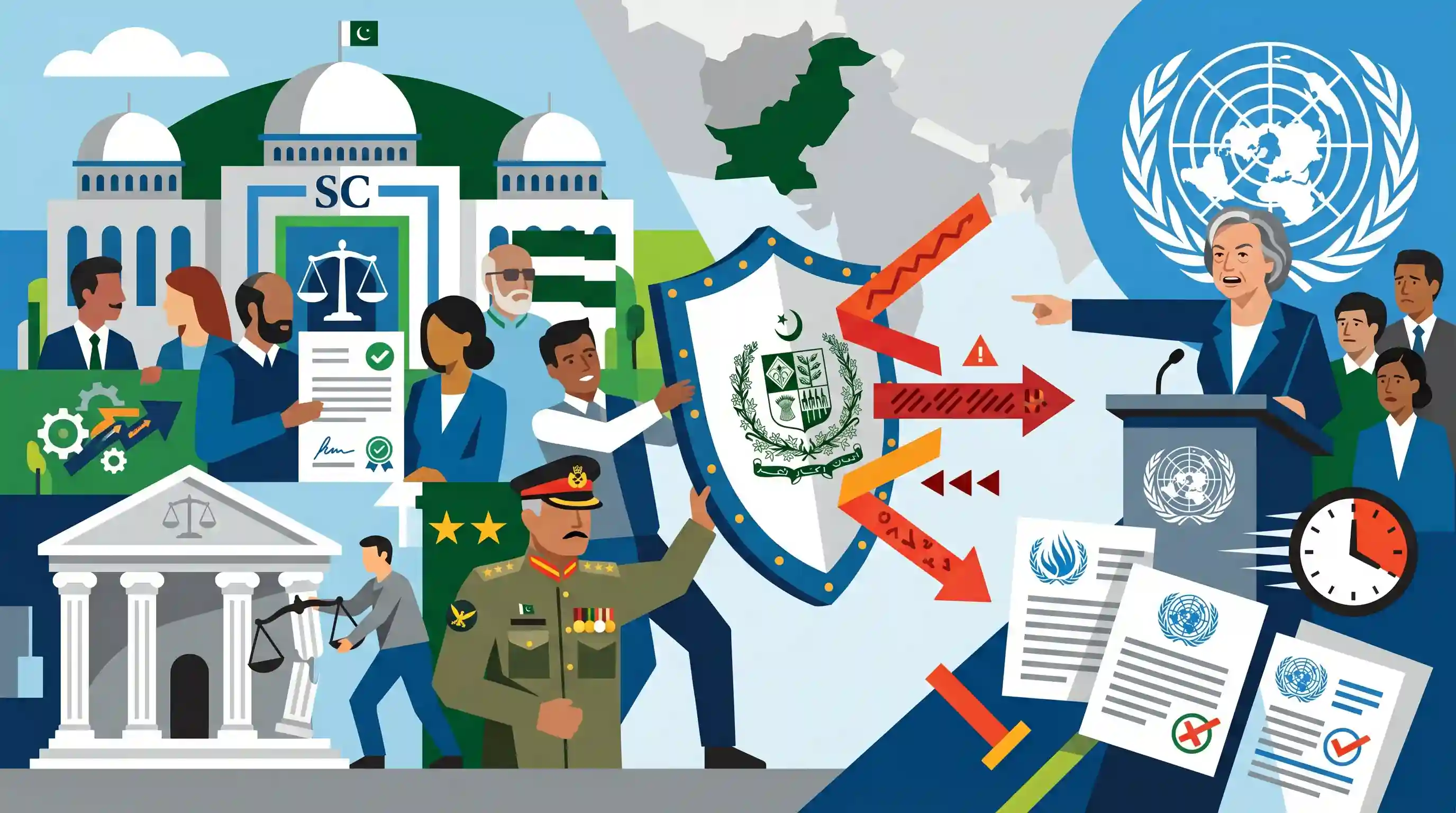
Pakistan has firmly rejected concerns expressed by UN High Commissioner for Human Rights Volker Turk regarding its 27th Constitutional Amendment. The UN rights chief warned that the "hastily adopted" amendment undermines judicial independence and structural accountability by establishing a parallel Federal Constitutional Court that dilutes the Supreme Court's powers. Furthermore, it alters Article 243 to introduce a new 'Chief of Defence Forces', potentially institutionalizing greater military power. The Pakistan Foreign Office dismissed the UN's critique as "misplaced apprehensions," asserting that the constitutional amendments are a sovereign prerogative enacted by democratically elected representatives, and urged international bodies to respect domestic parliamentary decisions.
Key Points
- Pakistan rejected concerns raised by the UN High Commissioner for Human Rights regarding its 27th Constitutional Amendment, terming them as an infringement on parliamentary sovereignty.
- The controversial 27th Amendment alters military leadership structures by abolishing the 'Chairman, Joint Chiefs of Staff Committee' to introduce a 'Chief of Defence Forces'.
- The amendment also establishes a Federal Constitutional Court, drawing criticism for systematically reducing the powers and jurisdiction of the regular Supreme Court.
- UN rights chief Volker Turk warned that the amendment, allegedly passed hastily, severely undermines judicial independence and bolsters the military's institutional power at the cost of democratic accountability.
Important Terms
27th Constitutional Amendment (Pakistan)

A 2025 amendment to Pakistan's Constitution that established a Federal Constitutional Court and created the 'Chief of Defence Forces' post, centralizing executive and military power.
UPSC context
GS Paper II (Neighborhood Relations); tests understanding of constitutional shifts in neighboring states and their impact on regional democratic stability.
Federal Constitutional Court (FCC)
A specialized apex court created in Pakistan to adjudicate constitutional matters, effectively stripping the Supreme Court of its jurisdiction over fundamental rights and federal-provincial disputes.
UPSC context
GS Paper II (Comparative Constitution); tests knowledge of judicial structures and the "separation of powers" principle in parliamentary democracies.
Chief of Defence Forces (CDF)
A unified military command position established by the 27th Amendment, held concurrently by the Army Chief, granting him operational authority over the Navy and Air Force.
UPSC context
GS Paper II (International Relations); relevant for analyzing civil-military dynamics and the institutionalization of military power in the South Asian region.
UN High Commissioner for Human Rights
The principal UN official responsible for global human rights promotion; the current officeholder (Volker Turk) monitors state compliance with international democratic and legal standards.
UPSC context
GS Paper II (International Organizations); tests the role of global bodies in upholding human rights and intervening in domestic constitutional crises.
Independence of Judiciary
The constitutional principle that the judiciary should remain independent from executive or legislative control to ensure impartial justice and uphold the rule of law.
UPSC context
GS Paper II (Polity); a "basic structure" concept often tested through comparative analysis of judicial appointments and executive interference.
Prelims Trap
India possesses a separate Federal Constitutional Court distinct from the regular Supreme Court.
India has an integrated judiciary. The Supreme Court acts as a Constitutional Court via Article 145(3) (minimum 5 judges); it is not a structurally separate entity.
Static Concepts Connected
How does India's constitutional adjudication differ from the dual-court model?
- Integrated judiciary: India's Supreme Court serves as both the highest appellate court and the constitutional court, unlike countries with distinct specialized constitutional courts.
- Article 145(3): Mandates a minimum of five SC judges (Constitution Bench) to decide cases involving substantial questions of constitutional law.
- Basic Structure limit: Parliament cannot structurally diminish the Supreme Court's core judicial review powers by creating parallel apex tribunals.
What is the mandate and authority of the UN OHCHR?
- UNGA Origin: Established in 1993 by the UN General Assembly to promote and protect international human rights obligations.
- Non-binding authority: It acts as an advisory and monitoring body. Its critiques of domestic constitutional changes are persuasive, not legally binding on sovereign states.
Cross-Topic Patterns
India's CDS vs. Pakistan's CDF
While Pakistan's amendment institutionalizes military power, India's Chief of Defence Staff (CDS) strictly maintains civilian supremacy under the President (Article 53) and the Ministry of Defence.
Basic Structure vs Parliamentary Sovereignty
Pakistan justifies judicial dilution via parliamentary sovereignty. India prevents this through the Basic Structure doctrine, ensuring constitutional morality trumps brute legislative majorities.

Mains 2026 GS2 will likely feature a comparative constitution question contrasting India's Basic Structure with amendments by its neighbors.
Linked PYQs · 2
Linked PYQs · 2
- 2023MainsGS2
“Constitutionally guaranteed judicial independence is a prerequisite of democracy.” Comment.
- 2025MainsGS2
"Constitutional morality is the fulcrum which acts as an essential check upon the high functionaries and citizens alike...." In view of the above observation of the Supreme Court, explain the concept of constitutional morality and its application to ensure balance between judicial independence and judicial accountability in India.
