Pakistan Punjab Floods Triggered by Overflowing Indus Tributary Rivers
Source:Indian Express ↗
Why It Matters
The event serves as a critical case study of regional climate vulnerabilities, extreme weather events, and riverine flooding in the subcontinent. It underscores the hydrological dynamics of the Indus river system's major tributaries (Ravi, Chenab, Sutlej) and highlights the severe socio-economic impact of monsoon anomalies traversing across borders.
Summary
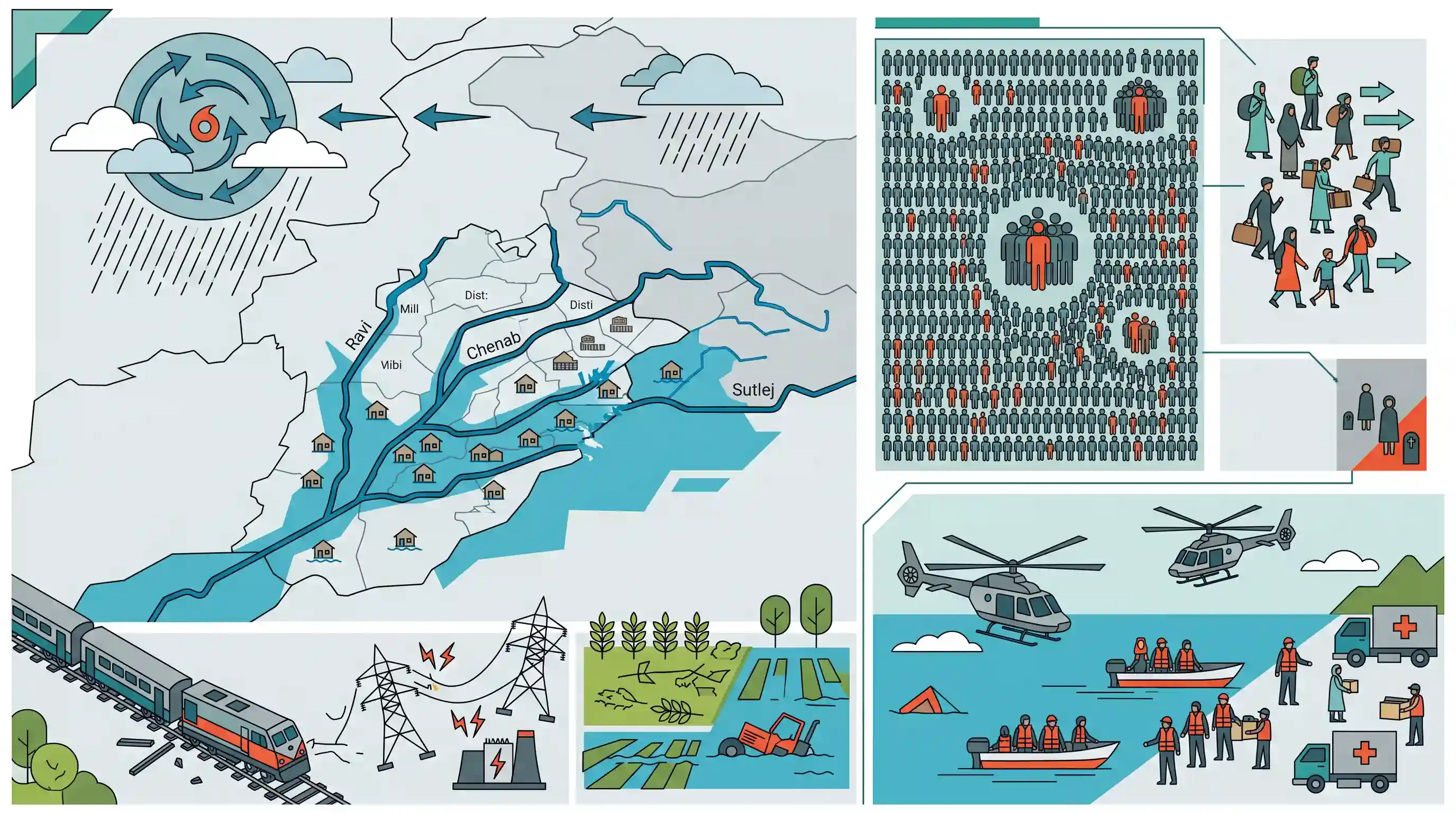
Torrential monsoon rains have triggered severe flooding in Pakistan's Punjab province, as major Indus tributaries including the Ravi, Chenab, and Sutlej breached their banks. The floods have impacted over 4 million people, caused at least 50 deaths, and displaced roughly 2 million individuals across 14 districts. The extreme weather, linked by the NDMA to a westward-moving low-pressure system originating over Madhya Pradesh, led to the inundation of nearly 3,900 villages, widespread destruction of agricultural assets, and significant disruptions to rail and power infrastructure.
Key Points
- Torrential monsoon rainfall triggered severe floods in Pakistan's Punjab province due to the overflow of the Ravi, Chenab, and Sutlej rivers.
- The disaster has impacted over 4 million people, resulted in 50 fatalities, and displaced approximately 2 million individuals.
- Nearly 3,900 villages across 14 districts were submerged, devastating crops, livestock, and critical infrastructure, including railways and power networks.
- The intense rainfall was attributed by the NDMA to a low-pressure system that originated over Madhya Pradesh, India, and moved westwards.
Important Terms
National Disaster Management Authority (NDMA)

The apex statutory body for disaster management, responsible for framing policies, plans, and guidelines to ensure a timely and effective response to disasters.
UPSC context
Relevant for GS Paper III (Disaster Management). Tests understanding of institutional frameworks and the shift from relief-centric to proactive resilience.
Indus Waters Treaty (IWT)
A 1960 water-sharing agreement mediated by the World Bank, dividing the Indus system's six rivers between India (Eastern Rivers) and Pakistan (Western Rivers).
UPSC context
Crucial for GS Paper II (International Relations) and transboundary water governance between India and Pakistan.
Provincial Disaster Management Authority (PDMA)
A regional disaster management entity (the Pakistani equivalent of India's State Disaster Management Authority) responsible for implementing relief and rescue operations within a specific province.
UPSC context
Relevant for GS Paper III (Disaster Management) and comparative studies of federal disaster response structures in South Asia.
Eastern Rivers (Indus System)
The three rivers (Ravi, Beas, and Sutlej) of the Indus system allocated to India for unrestricted use under the Indus Waters Treaty 1960.
UPSC context
Important for GS Paper I (Geography) regarding river drainage systems and Paper II (International Relations).
Low-Pressure System
An atmospheric region where the pressure is lower than the surrounding areas, causing air to rise, condense, and often result in heavy monsoon rainfall.
UPSC context
Core concept in GS Paper I (Geography: Climatology). Tests understanding of monsoon dynamics and weather-related disasters.
Prelims Trap
The Indus Water Treaty grants Pakistan rights over the Ravi, Chenab, and Sutlej rivers since they predominantly flood Pakistan's Punjab.
The IWT allocates the Eastern rivers (Ravi, Beas, Sutlej) unrestricted to India, while the Western rivers (Indus, Jhelum, Chenab) go to Pakistan. Downstream flood geography does not alter treaty rights.
Static Concepts Connected
What are the geographic origins of the Ravi, Chenab, and Sutlej rivers?
- Chenab river: The largest Indus tributary, formed by the confluence of the Chandra and Bhaga streams near the Bara Lacha Pass in Himachal Pradesh.
- Sutlej river: An antecedent transboundary river originating from Rakastal (Tibet) near Lake Mansarovar, entering India via the Shipki La pass.
- Ravi river: Rises near the Rohtang Pass in the Kullu hills of Himachal Pradesh, draining the area between the Pir Panjal and Dhauladhar ranges.
How do low-pressure systems trigger extreme rainfall in Pakistan?
- Monsoon Depressions: They typically originate over the Bay of Bengal during the southwest monsoon and travel west-northwest along the axis of the monsoon trough.
- Westward Trajectory: Traversing through Central India (like Madhya Pradesh), they carry massive moisture over Rajasthan and Gujarat, ultimately dumping heavy rainfall into neighboring Pakistan.
- Climate Anomaly: Warming seas and altered atmospheric circulation are pushing these weather systems further west, causing anomalous extreme floods in usually arid downstream regions.
Cross-Topic Patterns
IWT hydro-diplomacy & flood data sharing
India's management of Eastern rivers (Ravi, Sutlej) necessitates timely hydrological data sharing with Pakistan during peak monsoon depressions, linking disaster mitigation directly to the Indus Water Treaty's mandate.
Climate shifts in the monsoon trough
The westward progression of deep low-pressure systems into Pakistan highlights climate-induced shifts in the monsoon trough, expanding flood vulnerability in historically arid zones of the subcontinent.

Indus tributaries' origin points (glaciers/passes) paired with their IWT allocation is a highly probable match-the-following Prelims Q.
Linked PYQs · 4
Linked PYQs · 4
- 2021PrelimsGS1
With reference to the Indus river system, of the following four rivers, three of them pour into one of them which joins the Indus direct. Among the following, which one is such river that joins the Indus direct?
- 2009PrelimsGS1
The Dul Hasti Power Station is based on which one of the following rivers?
- 2009PrelimsGS1
Which one of the following rivers does not originate in India?
- 2024MainsGS3
Flooding in urban areas is an emerging climate-induced disaster. Discuss the causes of this disaster. Mention the features of two such major floods in the last two decades in India. Describe the policies and frameworks in India that aim at tackling such floods.
