Pakistan Internal Crisis and the Geopolitical Role of China
Source:Indian Express ↗
Why It Matters
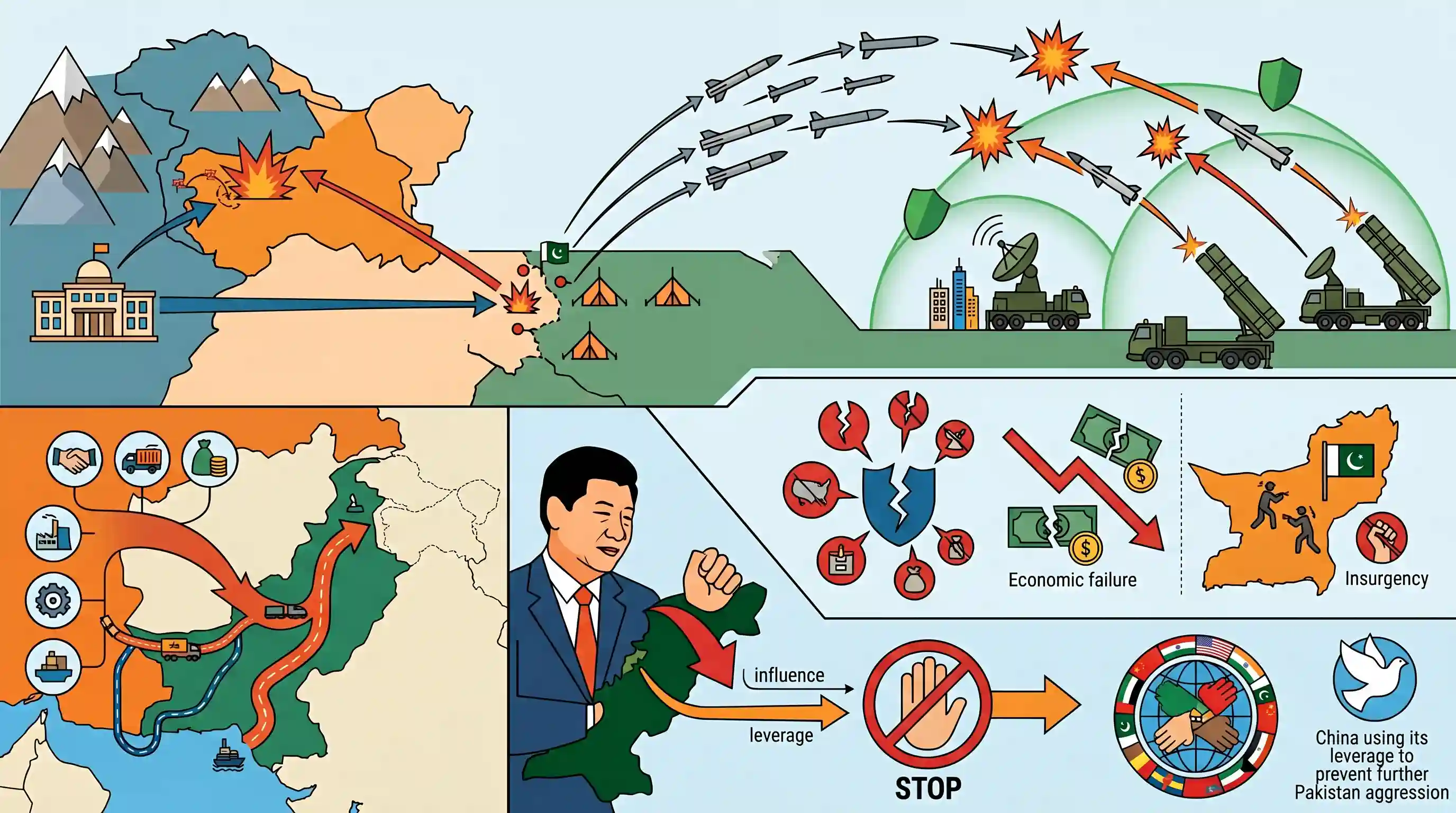
The article highlights key elements of India's evolving deterrence strategy (calibrated cross-border strikes and strong air defence) and the changing geopolitical realities in the subcontinent, focusing on the role of external actors like China in managing India-Pakistan tensions.
Summary
Following the Pahalgam terror attack, India responded with a calibrated strike, 'Operation Sindoor', targeting terrorist camps in Pakistan and PoK while avoiding military or civilian escalation. Pakistan's subsequent retaliatory attacks on Indian cities were intercepted by India's advanced air defence systems, including the S-400 and Akash. Amidst Pakistan's severe internal crises—ranging from economic failure to insurgencies in Balochistan—the article argues that its primary backer, China, which has significant stakes in the region through the CPEC, must exercise its leverage to prevent further unreasonable aggression by Pakistan.
Key Points
- India carried out 'Operation Sindoor', a calibrated cross-border strike targeting terror infrastructure in PoK and Pakistan, as a response to the Pahalgam terrorist attack without crossing escalatory thresholds.
- Pakistan's retaliatory drone and missile attacks on Indian civilian centres were completely thwarted by India's robust air defence shield, consisting of systems like the S-400 and Akash.
- Pakistan continues to face profound domestic instability, marked by a shattered economy, political dysfunction, and widespread insurgencies (such as those in Balochistan).
- The article underscores the critical role of the international community, specifically China—which holds significant leverage due to CPEC investments—in pressuring Pakistan to halt its cross-border aggression.
Important Terms
Operation Sindoor

A 2025 Indian military operation involving precision strikes on terror camps in Pakistan/PoK after the Pahalgam attack. It utilized "non-contact" warfare with advanced missiles and drones.
UPSC context
GS Paper III: Internal Security; tests understanding of India's response doctrine and military strategy against cross-border terrorism.
S-400 Air Defence System
A Russian-made long-range surface-to-air missile (SAM) system, named "Sudarshan Chakra" by India. It engages multiple aerial threats at ranges up to 400 km.
UPSC context
GS Paper III: Defense Technology; covers India's air defense capabilities and strategic autonomy in defense procurement.
Akash Missile System
An indigenous, mobile, medium-range SAM system developed by DRDO. It is designed to neutralize diverse aerial threats like drones and cruise missiles with high precision.
UPSC context
GS Paper III: Science & Tech; emphasizes indigenization of technology (Atmanirbhar Bharat) in the defense sector.
China-Pakistan Economic Corridor (CPEC)
A flagship $60bn+ project of China’s Belt and Road Initiative (BRI) linking Xinjiang to Gwadar Port. It passes through PoK, challenging Indian sovereignty.
UPSC context
GS Paper II: International Relations; tests knowledge of India-China-Pakistan dynamics and territorial integrity issues.
Pahalgam Terror Attack
The April 2025 Islamist terror strike on tourists in J&K that killed 26 people. It served as the casus belli for India's Operation Sindoor.
UPSC context
GS Paper III: Security; relates to cross-border terrorism, communal harmony, and its impact on regional stability.
Prelims Trap
"Akash is an offensive ballistic missile, and the S-400 is an indigenously developed long-range air defence system."
UPSC frequently swaps origins and functions of defence tech. Akash is an indigenous Surface-to-Air Missile (SAM), while S-400 is imported from Russia. Neither are offensive ballistic missiles.
Static Concepts Connected
How do the S-400 and Akash Air Defence Systems differ?
- Origin: S-400 is imported from Russia, whereas Akash is indigenously developed by DRDO under the Integrated Guided Missile Development Programme (IGMDP).
- Range capability: S-400 is a long-range system capable of neutralizing threats up to 400 km. Akash is a short-to-medium-range system targeting threats up to Mach 2.5.
- Core function: Both are Surface-to-Air Missiles (SAMs) acting as defensive shields against incoming aircraft, drones, and cruise missiles.
Why does India vehemently oppose the China-Pakistan Economic Corridor (CPEC)?
- Sovereignty violation: The flagship BRI project passes through Gilgit-Baltistan in Pakistan-Occupied Kashmir (PoK), violating India's territorial sovereignty.
- Strategic encirclement: CPEC connects Xinjiang to Gwadar Port in Balochistan, advancing Beijing's 'String of Pearls' strategy and establishing a dual-use Chinese footprint in the Arabian Sea.
Cross-Topic Patterns
Gwadar vs Chabahar Geoeconomics
China's strategic control over Gwadar under CPEC is countered by India's investment in Iran's Chabahar Port, securing direct trade access to Afghanistan and Central Asia while completely bypassing Pakistan.
Shift in Counter-Terrorism Doctrine
'Operation Sindoor' exemplifies India's evolving security doctrine from 'deterrence by denial' to 'deterrence by punishment'—a kinetic shift vital for GS-3 Mains border management questions.

Prelims 2026 will likely test S-400 vs Akash tech specs. Mains could ask to evaluate India's shift to 'deterrence by punishment'.
Linked PYQs · 5
Linked PYQs · 5
- 2025MainsGS3
Terrorism is a global scourge. How has it manifested in India? Elaborate with contemporary examples. What are the counter measures adopted by the State? Explain.
- 2019MainsGS3
Cross-border movement of insurgents is only one of the several security challenges facing the policing of the border in North-East India. Examine the various challenges currently emanating across the India-Myanmar border. Also, discuss the steps to counter the challenges.
- 2018PrelimsGS1
What is "Terminal High Altitude Area Defense (THAAD)", sometimes seen in the news?
- 2015MainsGS2
Terrorist activities and mutual distrust have clouded India-Pakistan relations. To what extent the use of soft power like sports and cultural exchanges could help generate goodwill between the two countries? Discuss with suitable examples.
- 2016MainsGS2
Increasing cross-border terrorist attacks in India and growing interference in the internal affairs of several member-states by Pakistan are not conducive for the future of SAARC (South Asian Association for Regional Cooperation)." Explain with suitable examples.
