Bilateral diplomatic coordination on Middle East conflict mediation
Source:The Hindu ↗
Why It Matters
The growing diplomatic footprint of China and Pakistan in West Asian conflicts reflects a changing global order. This is highly relevant for UPSC GS2 (International Relations) as candidates need to analyze how external powers' interventions in the Middle East affect regional stability, global energy security (Strait of Hormuz), and India's strategic and diplomatic interests in West Asia.
Summary
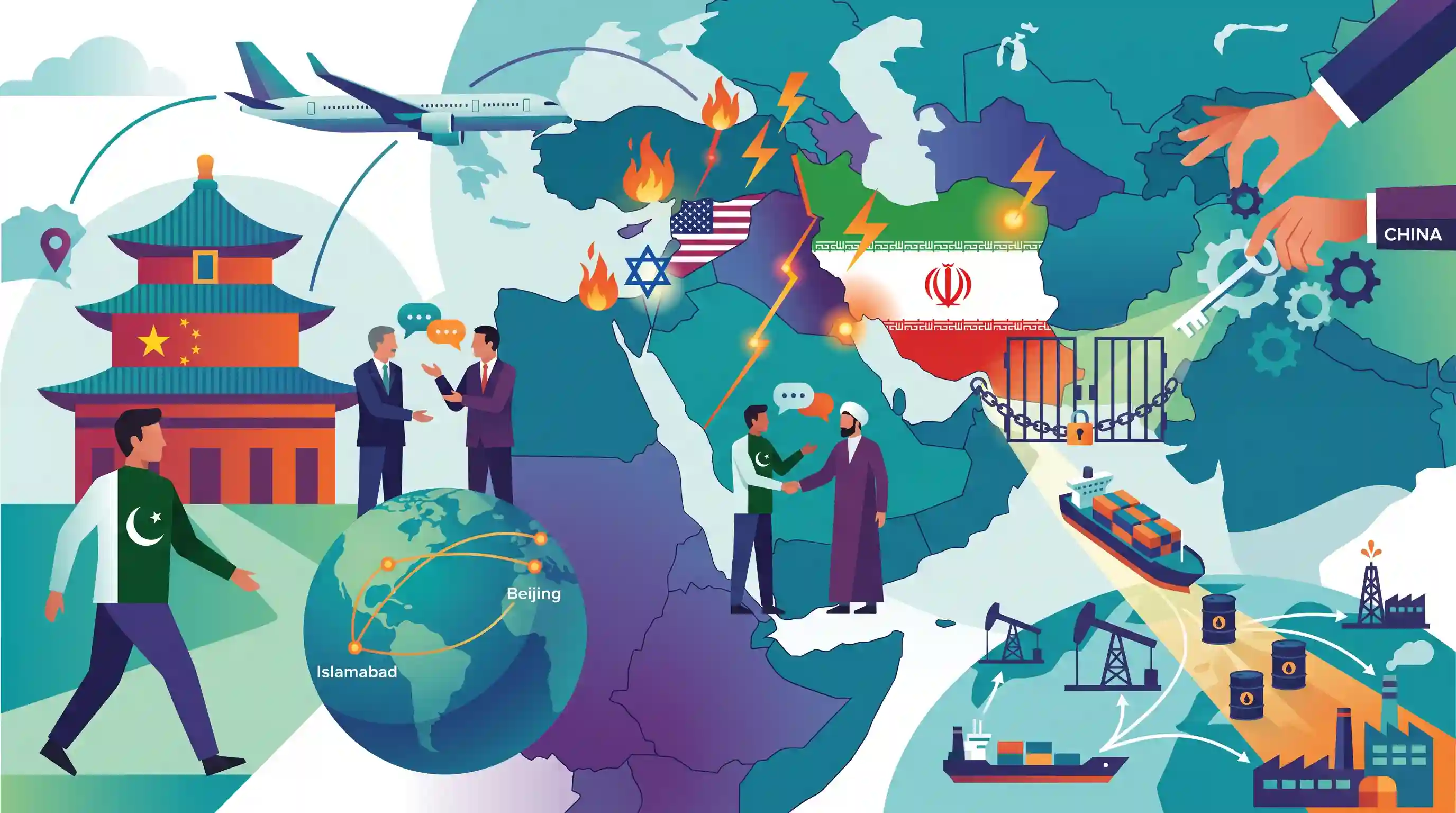
Pakistan Prime Minister Shehbaz Sharif is scheduled to visit China to coordinate diplomatic mediation efforts concerning the ongoing conflict in West Asia, specifically the tensions involving the US, Israel, and Iran. While Pakistan actively engages with Tehran as a central mediator, China assumes a quieter role by facilitating dialogue and offering strategic assistance to reopen the Strait of Hormuz. The joint diplomatic strategy underscores China and Pakistan's growing geopolitical footprint in the Middle East and highlights concerns regarding global energy security amid regional instability.
Key Points
- Pakistan PM Shehbaz Sharif will visit China from May 23-26 to coordinate mediation efforts regarding the ongoing conflict in West Asia.
- Pakistan is acting as an active central mediator between conflicting parties, particularly holding discussions with Iranian officials.
- China is playing a quieter diplomatic role, engaging in dialogue and offering assistance to reopen the strategically critical Strait of Hormuz.
- The collaborative China-Pakistan mediation efforts underscore the evolving geopolitical landscape in the Middle East and its implications for global energy security.
Prelims Trap
The Strait of Hormuz is a critical maritime chokepoint connecting the Red Sea to the Gulf of Aden.
The Strait of Hormuz connects the Persian Gulf to the Gulf of Oman. The waterway connecting the Red Sea to the Gulf of Aden is the Bab-el-Mandeb.
Static Concepts Connected
What is the geographical and economic significance of the Strait of Hormuz?
- Strategic location: It connects the Persian Gulf to the Gulf of Oman and the Arabian Sea, acting as a narrow 33-km-wide maritime chokepoint.
- Global oil transit: It facilitates nearly 20% of the world's global oil trade, making it highly sensitive to geopolitical disruptions and essential for global energy security.
What are the key pillars of India's 'Look West' policy?
- Energy security: Ensuring stable oil and natural gas supplies from Gulf nations to meet domestic energy demands.
- Strategic connectivity: Developing alternative trade routes, such as the Chabahar Port in Iran and the India-Middle East-Europe Economic Corridor (IMEC), to bypass Pakistan.
- Diaspora protection: Safeguarding the welfare and economic interests of millions of Indian expatriates working across the Middle East.
Cross-Topic Patterns
China's evolving regional security role
China is transitioning from a purely economic actor via the BRI to an alternative global security arbiter, building on its successful 2023 brokering of the Saudi-Iran détente.
Pakistan's diplomatic rent-seeking strategy
Pakistan utilizes 'dual-alignment', leveraging its mediation role with Iran to extract strategic capital from Washington while simultaneously deepening its geopolitical coordination with Beijing.
Challenges to India's Look West policy
The deepening China-Pakistan strategic coordination in West Asia poses direct challenges to India's autonomous investments in regional connectivity, such as the Chabahar Port and IMEC.

Mapping West Asian straits (Hormuz, Bab-el-Mandeb) or a mains query on how the China-Pakistan axis counters India's Look West is expected.
Linked PYQs · 3
Linked PYQs · 3
- 2025MainsGS2
"Energy security constitutes the dominant kingpin of India's foreign policy, and is linked with India's overarching influence in Middle Eastern countries.” How would you integrate energy security with India's foreign policy trajectories in the coming years?
- 2017MainsGS2
The question of India's Energy Security constitutes the most important part of India's economic progress. Analyze India's energy policy cooperation with West Asian countries.
- 2024MainsGS2
‘The West is fostering India as an alternative to reduce dependence on China's supply chain and as a strategic ally to counter China's political and economic dominance.’ Explain this statement with examples.
