Pakistan Raises Indus Waters Treaty Abeyance Globally
Source:The Hindu ↗
Why It Matters
The Indus Waters Treaty is a fundamental component of India-Pakistan bilateral relations and a frequent topic in UPSC exams. Understanding the geopolitical implications of transboundary water sharing, often termed 'hydro-diplomacy' or the 'weaponisation of water,' is critical for GS2. Additionally, the article connects geopolitics with climate change by addressing glacial melt and climate vulnerability, which are important themes in GS1 Geography and GS3 Environment.
Summary
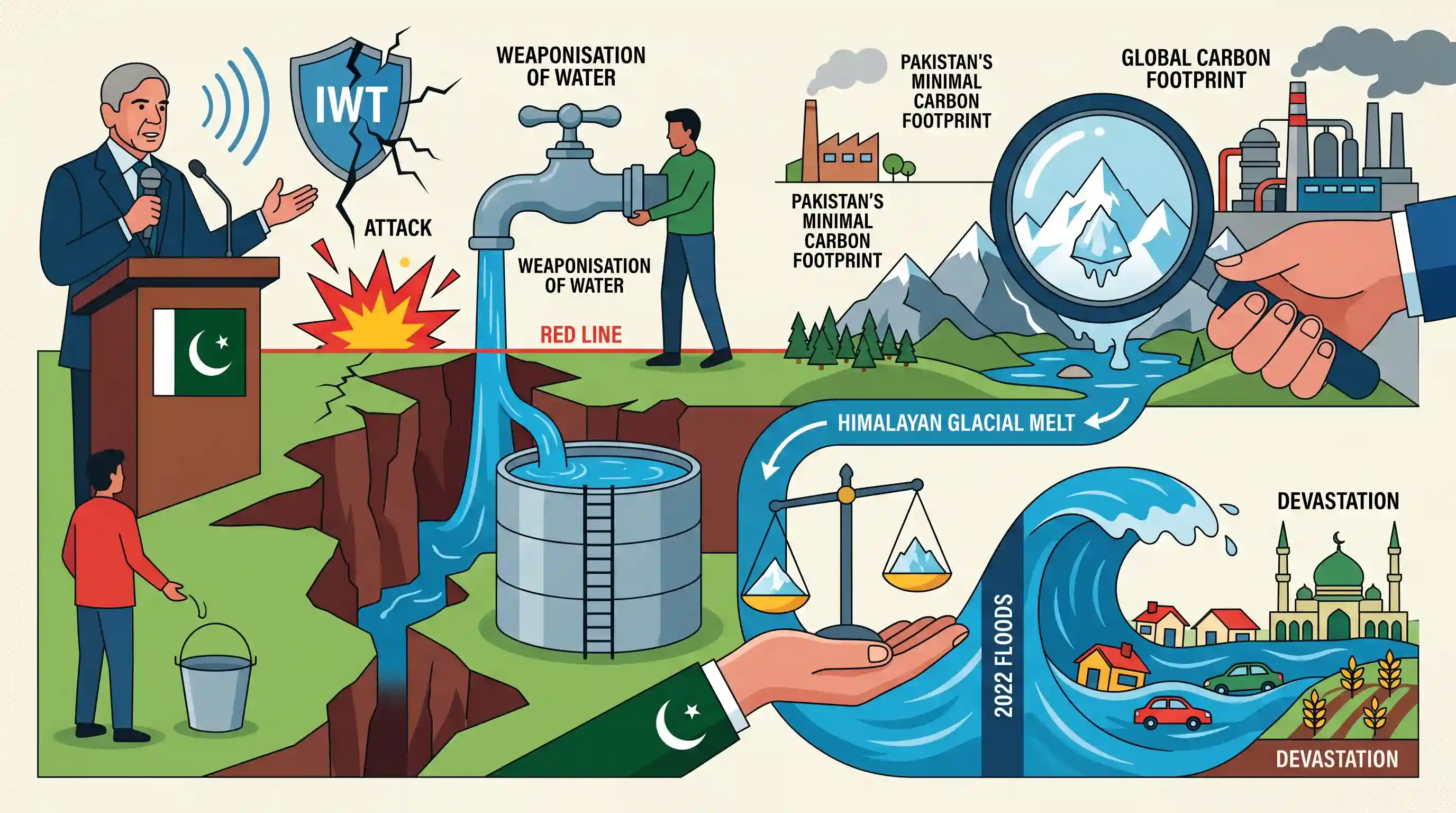
Speaking at the International Conference on Glaciers' Preservation in Tajikistan, Pakistan Prime Minister Shehbaz Sharif accused India of keeping the Indus Waters Treaty in 'abeyance' following a terrorist attack. He strongly opposed the 'weaponisation of water' and cautioned that Pakistan would not permit India to cross this red line regarding transboundary water sharing. Sharif also used the platform to underscore Pakistan's severe vulnerability to climate-induced disasters, highlighting the accelerated melting of Himalayan glaciers and the devastating 2022 floods, despite the country's negligible carbon footprint.
Key Points
- Pakistan PM Shehbaz Sharif accused India of holding the Indus Waters Treaty (IWT) in abeyance following the Pahalgam terrorist attack, warning that Pakistan would not allow India to cross the red line.
- He rejected the weaponisation of water, asserting that uninterrupted flow and water sharing are essential for regional peace and sustainable development.
- Sharif made these remarks at the International Conference on Glaciers Preservation in Dushanbe, Tajikistan.
- He highlighted Pakistan's acute vulnerability to climate change, noting the devastating 2022 floods and accelerated glacial melt, despite the nation contributing less than 1% to global greenhouse gas emissions.
Important Terms
Indus Waters Treaty (IWT)

A 1960 water-sharing agreement brokered by the World Bank, allocating the Eastern rivers (Ravi, Beas, Sutlej) to India and Western rivers (Indus, Jhelum, Chenab) to Pakistan, with specific provisions for non-consumptive use.
UPSC context
GS-II: India and its Neighborhood; International Relations. Key for understanding transboundary water management and bilateral conflict resolution between nuclear-armed neighbors.
World Bank
The international financial institution that brokered and remains a signatory to the Indus Waters Treaty. It facilitates dispute resolution through mechanisms such as the appointment of Neutral Experts and Courts of Arbitration.
UPSC context
GS-II: Important International Institutions. Tests knowledge of the Bank's unique legal role as a facilitator and guarantor in the Indus basin.
Weaponisation of Water
The strategic use of control over water resources or hydrological infrastructure (such as dams) as a tool for political coercion or military advantage against downstream riparian states.
UPSC context
GS-II & III: Security Challenges and IR. Important for analyzing non-traditional security threats and the shifting nature of geopolitical leverage.
Permanent Indus Commission (PIC)
A bilateral technical body established by the 1960 Treaty, consisting of commissioners from India and Pakistan, responsible for data exchange, project inspections, and the first stage of dispute resolution.
UPSC context
GS-II: Bilateral Institutional Frameworks. Tests understanding of the specialized mechanisms required to maintain technical cooperation despite political hostility.
Cryosphere
The portion of Earth's surface where water is in solid form, including glaciers and snowpack. Its degradation affects the perennial flow of the Indus system and increases disaster vulnerability.
UPSC context
GS-I & III: Physical Geography and Environment. Essential for studying climate change impacts on water security and mountain ecosystems.
Hydro-diplomacy
The use of diplomatic tools to manage and negotiate the sharing of transboundary water resources, aiming to ensure regional stability and prevent resource-based conflicts between riparian nations.
UPSC context
GS-II: International Relations. A key concept in transboundary cooperation and the peaceful management of shared natural resources.
Prelims Trap
India formally abrogated and withdrew from the Indus Waters Treaty in 2025.
India has placed the treaty in 'abeyance' (suspension) in response to terror attacks, but has not formally abrogated or legally withdrawn from the agreement yet.
Static Concepts Connected
What is the water-sharing formula under the Indus Waters Treaty (1960)?
- Eastern Rivers: Ravi, Beas, and Sutlej are allocated exclusively to India for unrestricted use (approx. 33 million acre-feet).
- Western Rivers: Indus, Jhelum, and Chenab are allocated to Pakistan. India is permitted limited agricultural use and non-consumptive uses like run-of-the-river hydroelectric projects.
- World Bank Role: Brokered the treaty and serves as a signatory for specific dispute resolution provisions, acting as a neutral fact-finder or arbitrator when required.
Why is the Hindu Kush Himalayan region termed the Water Tower of Asia?
- Massive Ice Reserve: It contains the largest volume of ice and snow outside the polar regions, acting as a critical freshwater reservoir.
- River Origins: Its glaciers feed 10 major Asian river systems, including the Indus, Ganges, and Brahmaputra, sustaining nearly 2 billion people downstream.
- Climate Threat: Accelerated melting due to black carbon and global warming threatens base river flows, creating severe existential risks for lower-riparian agricultural economies.
Cross-Topic Patterns
Climate vulnerability vs. Carbon footprint
Pakistan's <1% emission share juxtaposed with its 2022 mega-floods perfectly illustrates the necessity of the Loss and Damage fund and the principle of Common But Differentiated Responsibilities (CBDR).
Hydro-diplomacy and upstream leverage
India's IWT abeyance mirrors concerns over China's upstream dam constructions on the Brahmaputra, reflecting a regional shift where transboundary water data and flows are used as geopolitical leverage.

Expect a 2026 multi-statement question blending IWT river allocations (Eastern vs Western) with the World Bank's specific signatory role.
Linked PYQs · 4
Linked PYQs · 4
- 2012MainsGS2
The situation today is far different to that prevalent fifty years back when the Indus Water Treaty was signed." Highlight the complexity of the current challenges on both sides of the border in this regard. Do you think that a review of the Treaty is in India's best interests?
- 2020MainsGS1
How will the melting of Himalayan glaciers have a far-reaching impact on the water resources of India?
- 2014MainsGS1
Bring out the relationship between the shrinking Himalayan glaciers and the symptoms of climate change in the Indian sub-continent.
- 2021PrelimsGS1
With reference to the Indus river system, of the following four rivers, three of them pour into one of them which joins the Indus direct. Among the following, which one is such river that joins the Indus direct?
