Four Day Work Week Policy in Asian Nations
Source:Indian Express ↗
Why It Matters
It provides excellent comparative case studies for Mains answers. Candidates can cite Pakistan for energy/forex crisis management and the Philippines for urban traffic solutions, linking both to India's own debates around the new Labour Codes and labour productivity.
Summary
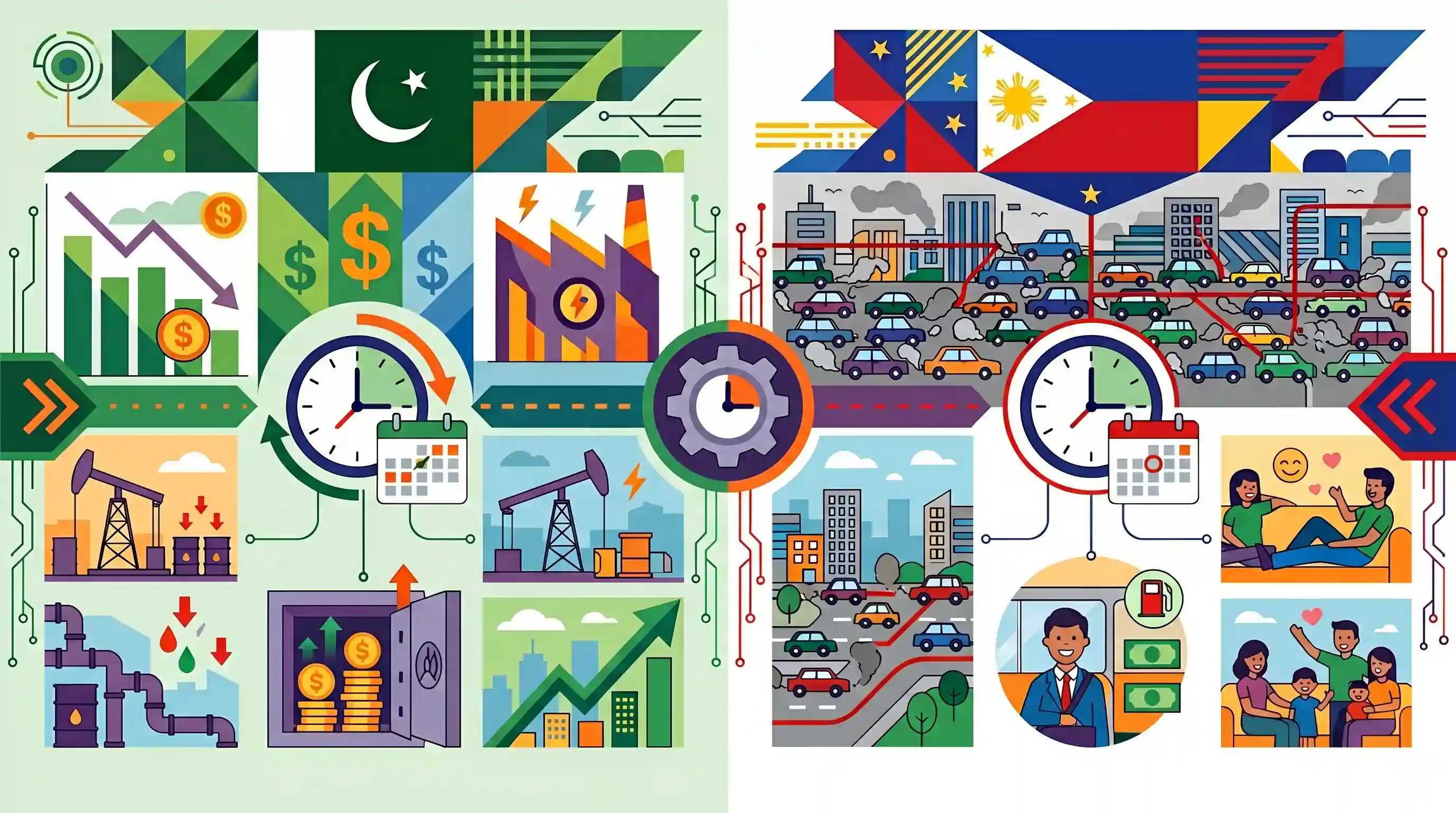
Pakistan and the Philippines have both announced shifts toward a four-day work week, but for vastly different reasons. Pakistan's measure is driven by an acute economic crisis, aiming to reduce energy consumption and lower its massive fuel import bill amid dwindling foreign exchange reserves. Conversely, the Philippines is utilizing compressed work schedules to alleviate severe urban traffic congestion, reduce commuter fuel expenses, and improve employee well-being. These developments highlight how restructuring labour hours can act as a multifaceted policy tool to address macroeconomic shocks, urban infrastructure deficits, and modern labour productivity demands.
Key Points
- Pakistan has introduced a reduced work week primarily as an emergency measure to slash its national energy consumption, conserve depleting foreign exchange reserves, and manage a severe balance of payments crisis by reducing fuel imports.
- The Philippines is exploring compressed work schedules largely to mitigate extreme urban traffic congestion (especially in Metro Manila), ease the burden on public transport, and lower fuel costs for commuters.
- At a broader level, these administrative shifts reflect a growing global trend in labour reforms aimed at improving work-life balance and increasing labour productivity without extending working hours.
- The contrasting motivations show how similar work-hour restructuring can be deployed to solve different structural issues: macroeconomic instability in one nation, and urban infrastructure bottlenecks in another.
Important Terms
Four-day work week

A labour model where the standard five-day work week is reduced to four, often used as an austerity measure to cut energy costs or a welfare tool to improve productivity.
UPSC context
GS Paper 3 (Economy); relevant for topics on labour reforms, energy conservation, and modern productivity-enhancing policy tools.
Labour Codes (India)
The consolidation of 29 central labour laws into four simplified codes: Wages (2019), Industrial Relations (2020), Social Security (2020), and Occupational Safety (2020).
UPSC context
GS Paper 3 (Labour Reforms); tests knowledge of flexibility in working hours (e.g., 12-hour shifts) versus worker welfare protections.
Energy Security
The uninterrupted availability of energy sources at an affordable price, encompassing physical availability, economic accessibility, and strategic resilience against global supply shocks.
UPSC context
GS Paper 3 (Infrastructure: Energy); critical for understanding national responses to global oil price volatility and import dependency.
Balance of Payments (BoP)
A systematic record of all economic transactions between residents of a country and the rest of the world, including the current, capital, and financial accounts.
UPSC context
GS Paper 3 (Indian Economy); essential for analyzing foreign exchange reserves, trade deficits, and external macroeconomic stability.
Macroeconomic Stability
A state where an economy maintains low inflation, sustainable debt levels, and resilience to external shocks through prudent fiscal and monetary policies.
UPSC context
GS Paper 3 (Indian Economy); tests ability to link sectoral policies (like work week changes) to broader economic health.
Prelims Trap
"India's OSH Code mandates a reduction in maximum weekly working hours when adopting a 4-day work week."
The OSH Code 2020 permits a 4-day work week, but the maximum statutory limit remains 48 hours (requiring 12-hour shifts), without actually reducing total weekly working hours.
Static Concepts Connected
How does the OSH Code 2020 regulate flexible working hours?
- Weekly Limit: Caps the maximum allowable working hours at 48 hours per week.
- Daily Spread: Allows spreading these 48 hours over 4 days (up to 12 hours/day) to facilitate a compressed work week, subject to state rules.
- Overtime Wages: Mandates payment at twice the normal wage rate for any work exceeding the standard daily or weekly limits.
What is Demand-Side Management (DSM) in energy policy?
- Definition: Modifying consumer demand for energy through various interventions, rather than simply increasing energy supply.
- Interventions: Includes load shifting, energy-efficient appliances, and administrative changes (like 4-day work weeks or daylight saving).
- Macro Impact: Reduces peak load infrastructure stress, lowers fuel import dependency, and aids in Balance of Payments stability.
Cross-Topic Patterns
BoP management beyond monetary policy
While central banks use rate hikes to manage BoP crises, administrative demand-compression tools (like restricting work days to save fuel) act as unconventional macroeconomic buffers for forex-starved nations.
Commute mitigation as economic policy
Similar to Manila's strategy, Indian megacities increasingly rely on staggered office timings and flexible SEZ work-from-home guidelines to mitigate severe infrastructure bottlenecks and reduce transport-related economic losses.

Expect a statement-based question linking the 4-day work week under India's OSH Code 2020 to the statutory 48-hour weekly limit.
Linked PYQs · 4
Linked PYQs · 4
- 2019MainsGS1
How is efficient and affordable urban mass transport key to the rapid economic development of India?
- 2022MainsGS3
Economic growth in the recent past has been led by increase in labour productivity." Explain this statement. Suggest the growth pattern that will lead to creation of more jobs without compromising labour productivity.
- 2024MainsGS3
Discuss the merits and demerits of the four 'Labour Codes' in the context of labour market reforms in India. What has been the progress so far in this regard?
- 2018MainsGS3
How would the recent phenomena of protectionism and currency manipulations in world trade affect macroeconomic stability of India?
