Pakistan Afghanistan Border Conflict and Operation Ghazab lil Haq
Source:Indian Express ↗
Why It Matters
The escalating military conflict between Pakistan and the Afghan Taliban highlights severe geopolitical instability on India's western periphery. The breakdown of the Pakistan-Taliban relationship and disputes over the Durand Line have direct implications for cross-border terrorism, regional security dynamics, and India's strategic posture in South Asia.
Summary
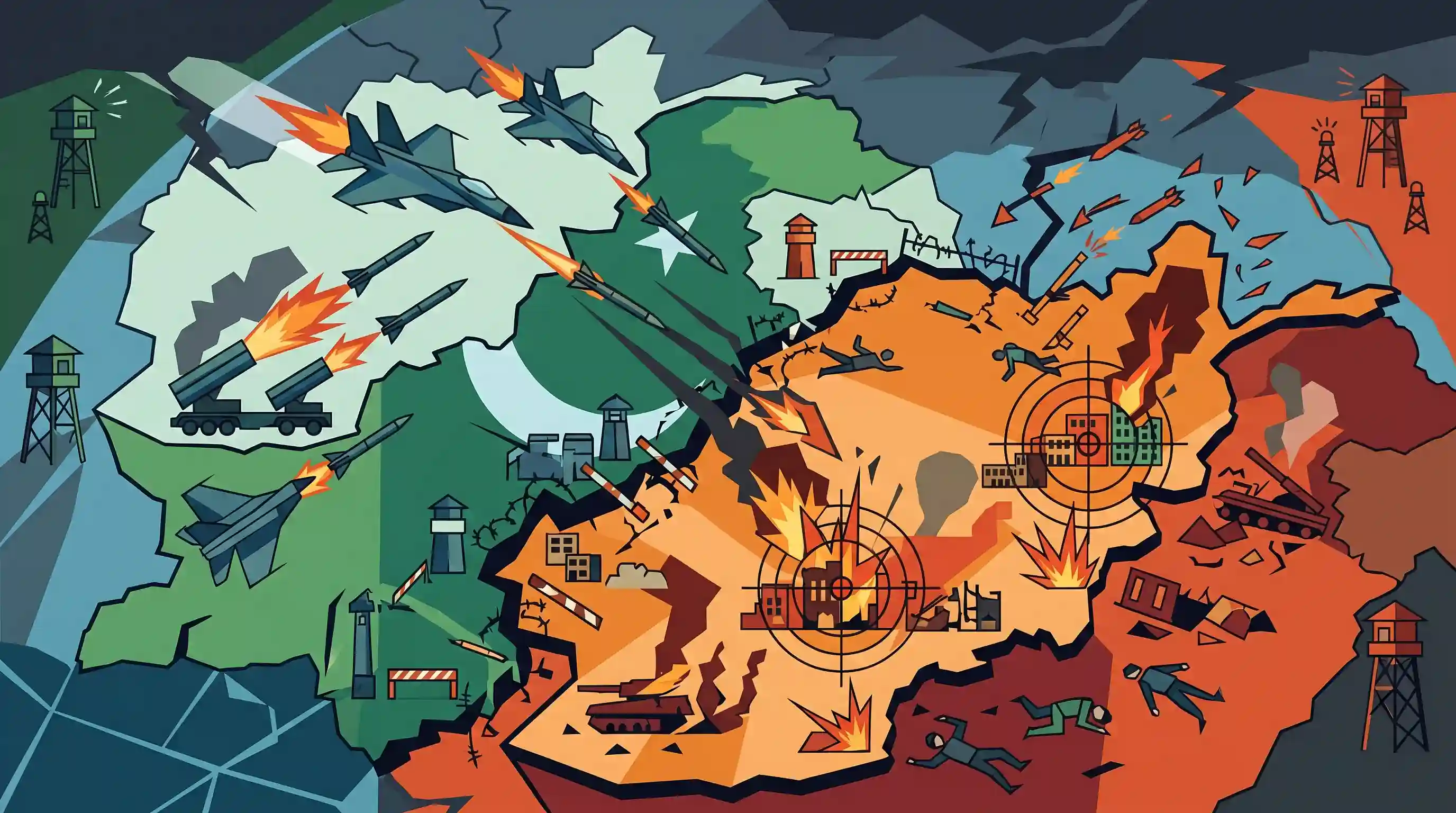
Tensions between Pakistan and Afghanistan have escalated into what Pakistan describes as an 'open war' following intense cross-border clashes along the Durand Line. In response to alleged attacks by the Afghan Taliban on border posts in Khyber Pakhtunkhwa, Pakistan launched 'Operation Ghazab Lil Haq'. The operation involved targeted military strikes against Taliban strongholds in Kabul, Kandahar, and Paktia. While Pakistan claimed significant operational success, including the destruction of Taliban military infrastructure and heavy enemy casualties, Afghan officials rejected these assertions and claimed retaliatory successes of their own. The ongoing hostilities reflect a severe breakdown in relations between Pakistan and the Taliban government, posing significant risks to regional security.
Key Points
- Pakistan and Afghanistan are engaged in an 'open war' characterised by escalating cross-border military strikes along the disputed Durand Line.
- Pakistan launched 'Operation Ghazab Lil Haq' (Righteous Fury) in retaliation against alleged unprovoked attacks by the Afghan Taliban on its border posts in Khyber Pakhtunkhwa.
- Pakistani military claims to have struck Taliban defence targets in Kabul, Kandahar, and Paktia, destroying infrastructure and killing over 130 fighters.
- The Afghan Taliban denied suffering heavy losses and counter-claimed to have killed Pakistani troops and seized border checkposts.
- The conflict underscores the dramatic deterioration in relations between Islamabad and the Taliban regime since the latter seized power in 2021.
Important Terms
Operation Ghazab Lil Haq

A major military offensive launched by Pakistan in February 2026 targeting Afghan Taliban positions in Kabul, Kandahar, and Paktia following cross-border clashes.
UPSC context
GS Paper II/III: Important for India's neighborhood relations, regional security, and military escalations in South Asia.
Durand Line
The 2,640-kilometer international border between Pakistan and Afghanistan, established in 1893. It remains unrecognized by successive Afghan governments, serving as a primary source of bilateral friction.
UPSC context
GS Paper II: Neighborhood Relations; essential for understanding border disputes and historical colonial legacies in South Asia.
Afghan Taliban
The Deobandi Islamic fundamentalist movement that has served as the de facto government of Afghanistan since the August 2021 withdrawal of US-led forces.
UPSC context
GS Paper II: International Relations; critical for analyzing regional stability and India's security interests in Afghanistan.
Tehrik-e-Taliban Pakistan (TTP)
An umbrella organization of various militant groups formed in 2007 that seeks to overthrow the Pakistani state and implement strict Sharia law.
UPSC context
GS Paper III: Internal Security; key to understanding cross-border terrorism and security challenges on India's western flank.
Fitna al-Khawarij
The official term adopted by the Pakistani government in 2024 to refer to the TTP, characterizing them as 'outcasts' to delegitimize their religious claims.
UPSC context
GS Paper III: Security/Current Affairs; relevant for understanding the ideological and narrative-building aspects of counter-terrorism strategies.
Prelims Trap
The Durand Line is the officially recognised international border by both Afghanistan and Pakistan.
No Afghan government, including the Taliban, has ever formally recognised the 1893 Durand Line, as it arbitrarily bisects the ethnic Pashtun and Baloch homelands.
Static Concepts Connected
What is Pakistan's 'Strategic Depth' doctrine in Afghanistan?
- Core objective: Establishing a pliant, pro-Pakistan government in Kabul to act as a security and geopolitical buffer.
- Anti-India calculus: Designed to prevent a two-front war (India in the east, hostile Afghanistan in the west) and secure military retreat space.
- Current status: The doctrine has effectively collapsed, as evidenced by cross-border airstrikes and the Taliban openly harboring anti-Pakistan TTP militants.
What are the key geographical features of Afghanistan's borders?
- Bordering nations: Landlocked; shares borders with Pakistan, Iran, Turkmenistan, Uzbekistan, Tajikistan, and China.
- Wakhan Corridor: A narrow panhandle in the northeast that connects Afghanistan to China (Xinjiang) and separates Tajikistan from Pakistan-occupied Kashmir (Gilgit-Baltistan).
- Durand Line: The 2,640 km contested eastern and southern boundary with Pakistan, drawn by the British in 1893.
Cross-Topic Patterns
Colonial cartography and ethnic fissures
The Durand Line conflict mirrors other colonial-era boundary disputes (McMahon Line, Sykes-Picot) where arbitrarily drawn lines ignored ground ethnic realities, breeding perpetual modern insurgencies.
Terrorism's boomerang effect
Pakistan's historical use of proxy terror groups has backfired. The Afghan Taliban now provides safe haven to the TTP, which executes deadly insurgent attacks within Pakistan.

Expect map-based Qs on Afghanistan's borders/Wakhan corridor, or a Mains Q on the collapse of Pakistan's Strategic Depth policy in 2026.
Linked PYQs · 3
Linked PYQs · 3
- 2022PrelimsGS1
Consider the following countries: 1. Azerbaijan 2. Kyrgyzstan 3. Tajikistan 4. Turkmenistan 5. Uzbekistan Which of the above have borders with Afghanistan ?
- 2016MainsGS2
Increasing cross-border terrorist attacks in India and growing interference in the internal affairs of several member-states by Pakistan are not conducive for the future of SAARC (South Asian Association for Regional Cooperation)." Explain with suitable examples.
- 2018MainsGS2
A number of outside powers have entrenched themselves in Central Asia, which is a zone of interest to India. Discuss the implications, in this context, of India's joining the Ashgabat Agreement, 2018.
