Pakistan Afghanistan Military Strikes State Sovereignty TTP ISKP
Source:The Hindu ↗
Why It Matters
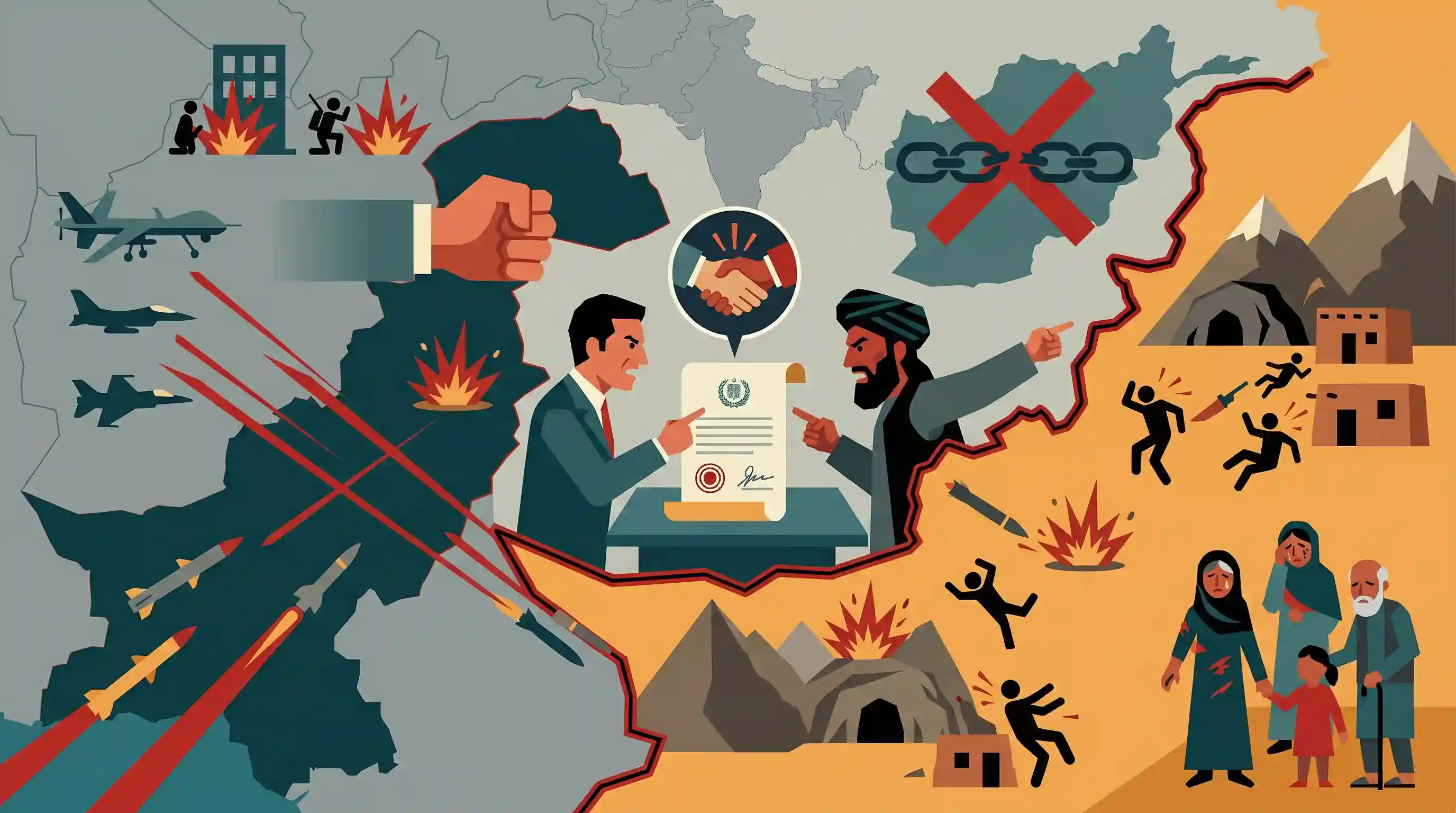
The escalating conflict between Pakistan and the Afghan Taliban over safe havens for non-state actors (TTP/ISKP) highlights regional instability. For UPSC aspirants, it serves as a contemporary case study in cross-border terrorism, state sovereignty disputes, and the failure of agreements like the Doha Accords to secure regional peace—factors that directly influence India's geopolitical and security calculations.
Summary
Pakistan's military claimed to have killed 70 terrorists in strikes targeting seven suspected hideouts of the Tehreek-e-Taliban Pakistan (TTP) and ISKP in Afghanistan. The operation, launched in retaliation for recent suicide bombings in Pakistan, has escalated diplomatic tensions. The Taliban administration accused Pakistan of violating Afghan sovereignty and killing civilians. In its defense, Pakistan cited the 2020 Doha agreement, emphasizing that the Taliban had pledged to prevent Afghan soil from being used to launch cross-border terrorist attacks.
Key Points
- Pakistan executed intelligence-based cross-border strikes in Afghanistan, claiming to have killed 70 terrorists linked to the TTP (referred to as Fitna-al-Khwarij) and ISKP.
- The strikes were a retaliatory measure following suicide bombings in the Pakistani cities of Islamabad, Bajaur, and Bannu.
- The Taliban-led Afghan government condemned the strikes as violations of sovereignty, claimed civilian and religious centers were targeted, and warned of a measured response.
- Pakistan invoked the 2020 Doha Accords, asserting that the Afghan Taliban failed to uphold their commitment to preventing terrorist groups from using Afghan territory.
- The diplomatic fallout includes the summoning of Pakistan's ambassador by Afghanistan's Foreign Ministry, marking a significant deterioration in bilateral ties.
Important Terms
2020 Doha Accords

A 2020 peace treaty between the U.S. and Taliban outlining foreign troop withdrawal. It mandated the Taliban prevent Afghan soil from being used by terrorist groups like Al-Qaeda to threaten global security.
UPSC context
GS Paper II (IR); tests understanding of regional peace processes and the legal basis for counter-terrorism commitments in Afghanistan.
Tehreek-e-Taliban Pakistan (TTP)
An umbrella organization of militant factions formed in 2007 seeking to overthrow the Pakistani state. It operates primarily along the porous Afghan-Pakistan border and shares ideological ties with the Afghan Taliban.
UPSC context
GS Paper III (Internal Security); critical for analyzing cross-border terrorism and non-state actors destabilizing India’s immediate neighborhood.
Islamic State of Khorasan Province (ISKP)
The regional branch of the Islamic State (ISIS) active in South and Central Asia. It seeks a transnational caliphate and is a violent rival to both the Afghan Taliban and Pakistan.
UPSC context
GS Paper III (Internal Security); relevant for tracking transnational jihadist threats and their impact on regional and Indian security.
Afghan Taliban
The Sunni Islamist movement that regained power in Afghanistan in August 2021. As the de facto government, it faces scrutiny over its links with foreign militants and border governance.
UPSC context
GS Paper II (International Relations); essential for analyzing India-Afghanistan ties and the challenges of statehood under non-state-origin regimes.
Durand Line
The 2,640 km border established in 1893 between British India and Afghanistan. Its non-recognition by various Afghan regimes remains a core driver of Pak-Afghan tension and cross-border militancy.
UPSC context
GS Paper II (Neighbourhood Relations); vital for understanding territorial disputes, border management, and historical legacies in South Asia.
State Sovereignty
The fundamental principle of international law asserting a state's supreme authority over its territory. It is often cited in disputes involving unauthorized cross-border military strikes.
UPSC context
GS Paper II (IR); core concept for debating interventionism, "hot pursuit," and the balance between security and territorial integrity.
Prelims Trap
"The 2020 Doha Agreement is a bilateral security pact signed between Pakistan and the Afghan Taliban."
The 2020 Doha Agreement was actually signed between the United States and the Afghan Taliban. Pakistan is not a signatory, though it frequently cites the treaty's counter-terrorism clauses.
Static Concepts Connected
What is the historical basis and dispute regarding the Durand Line?
- Colonial Origin: Drawn in 1893 by British diplomat Mortimer Durand and Afghan Amir Abdur Rahman Khan to divide ethnic Pashtun territories.
- Afghan Stance: Afghanistan rejects its legitimacy as a formal international border, claiming historical rights over Pashtun areas currently in Pakistan.
- Pakistan Stance: Pakistan recognizes it as its fixed western border and has undertaken extensive fencing projects to curb cross-border militancy, despite Afghan protests.
How does international law view preemptive strikes against non-state actors?
- UN Charter Article 51: Article 51 allows the right to self-defense against armed attacks, but traditionally applied to state-on-state conflicts rather than non-state actors.
- Sovereignty Violation: Host nations view unilateral cross-border strikes as a direct violation of their territorial integrity and state sovereignty.
- Unable or Unwilling: States increasingly justify interventions if the host nation is deemed "unable or unwilling" to neutralize threats originating from its soil.
Cross-Topic Patterns
The "Unable or Unwilling" Doctrine
Pakistan's strikes rely on the same "unable or unwilling" doctrine in international law that India utilized to justify its 2019 Balakot airstrikes against terrorist launchpads within Pakistan.
SCO-RATS and transnational terror
ISKP's presence in the Af-Pak region directly threatens Central Asian republics and India, elevating the importance of the Shanghai Cooperation Organisation's Regional Anti-Terrorist Structure (SCO-RATS).

Prelims 2026 may pair TTP, ISKP, and Houthis in a "Match the following" question on regional non-state actors and their primary bases.
Linked PYQs · 4
Linked PYQs · 4
- 2021MainsGS3
Analyse the multidimensional challenges posed by external state and non-state actors, to the internal security of India. Also discuss measures required to be taken to combat these threats.
- 2016MainsGS2
Increasing cross-border terrorist attacks in India and growing interference in the internal affairs of several member-states by Pakistan are not conducive for the future of SAARC (South Asian Association for Regional Cooperation)." Explain with suitable examples.
- 2020MainsGS3
Analyze internal security threats and transborder crimes along Myanmar, Bangladesh and Pakistan borders including Line of Control (LoC). Also discuss the role played by various security forces in this regard.
- 2022PrelimsGS1
Consider the following countries: 1. Azerbaijan 2. Kyrgyzstan 3. Tajikistan 4. Turkmenistan 5. Uzbekistan Which of the above have borders with Afghanistan ?
