China Provided Live Inputs to Pakistan Says Army
Source:Indian Express ↗
Why It Matters
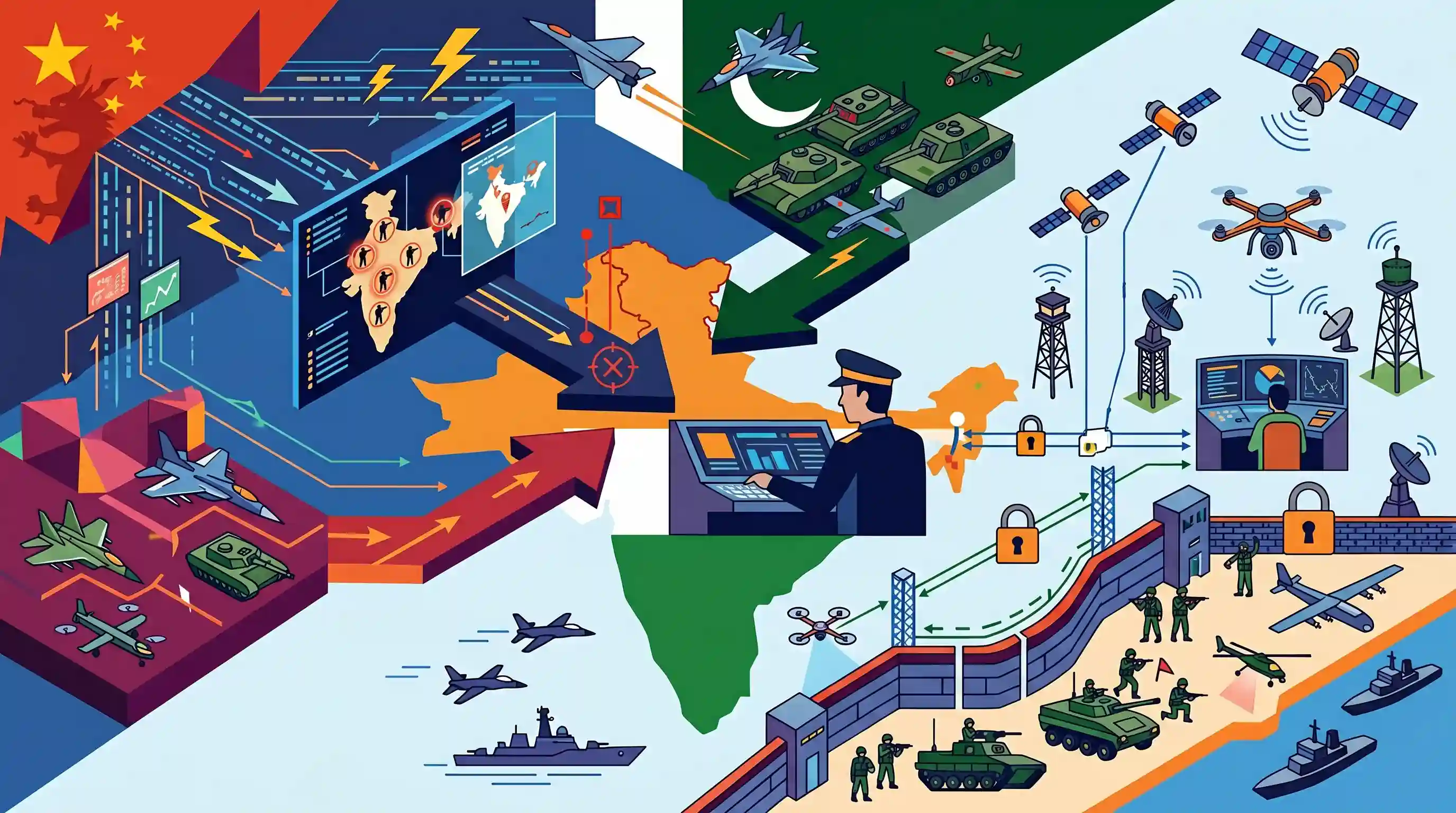
The article highlights a shift from a theoretical two-front war threat to active, real-time tactical collusion between China and Pakistan. This requires UPSC aspirants to understand the evolving nature of border security, modern intelligence warfare, and the implications of the China-Pakistan military axis on India's defense preparedness.
Summary
A top Indian Army officer has revealed that China provided Pakistan with live intelligence inputs on Indian military deployments, reportedly connected to 'Operation Sindoor'. This sharing of real-time operational data, combined with Pakistan's growing integration of Chinese military hardware, validates the strategic threat of a coordinated two-front military axis against India. The revelation underscores the urgent necessity for India to bolster its own Intelligence, Surveillance, and Reconnaissance (ISR) capabilities, secure border communications, and effectively prepare for collusive multi-domain threats from its neighbors.
Key Points
- China actively provided live intelligence and real-time inputs on Indian military deployments to Pakistan, demonstrating deep operational synergy between the two forces.
- The revelation validates the practical reality of a two-front war threat, showing that the China-Pakistan axis involves active tactical assistance rather than just strategic alignment.
- Pakistan's increasing reliance on advanced Chinese military hardware further augments its operational capabilities against India.
- The development emphasizes the critical need for India to enhance its Intelligence, Surveillance, and Reconnaissance (ISR) infrastructure and secure communications.
Important Terms
Operation Sindoor

A 2025 Indian counter-terrorism operation targeting terror infrastructure in Pakistan-controlled territories after the Pahalgam attack, involving precision strikes and advanced technology.
UPSC context
GS Paper III (Internal Security). Tests India's proactive defense doctrine and technology-driven warfare capabilities.
Two-Front War
A military scenario requiring India to simultaneously defend against China (north) and Pakistan (west), creating significant resource and strategic dilemmas.
UPSC context
GS Paper III (Security Challenges). Evaluates strategic preparedness and the threat of a coordinated China-Pakistan military axis.
ISR (Intelligence, Surveillance, and Reconnaissance)
The integrated system of gathering and processing battlefield data via satellites, drones, and sensors to provide real-time situational awareness.
UPSC context
GS Paper III (Science & Tech). Essential for modernizing the military into a network-centric force.
Collusive Threat
The strategic cooperation between China and Pakistan (e.g., live intelligence sharing) to jointly pressure India's military and diplomatic resources.
UPSC context
GS Paper II (International Relations). Analyzes regional power dynamics and the impact of the China-Pakistan axis.
People's Liberation Army (PLA)
The unified military force of China, directly involved in border standoffs with India and providing hardware/intel support to Pakistan.
UPSC context
GS Paper II (India-China Relations). Primary strategic competitor influencing India's defense procurement and border infrastructure.
C4ISR
An advanced framework integrating command, communications, and intelligence to enable synchronized military action across various domains.
UPSC context
GS Paper III (Defense). Focuses on technology-enabled decision-making and civil-military fusion in modern warfare.
DGMO (Director General of Military Operations)
A top military official overseeing operational planning and crisis communication via hotlines with neighboring militaries to prevent escalation.
UPSC context
GS Paper II (Conflict Resolution). Vital for operational diplomacy and de-escalating border tensions with Pakistan.
"Borrowed Knife" Strategy
A Chinese strategic concept of using a third party to weaken an adversary, avoiding direct involvement in a conflict.
UPSC context
GS Paper II (Strategic Studies). Understanding non-traditional and asymmetrical tactics in China’s regional statecraft.
Prelims Trap
BeiDou navigation system's military capabilities are exclusively restricted for use by the Chinese armed forces.
BeiDou provides global coverage and is heavily exported to partner nations like Pakistan for both civilian and encrypted military (restricted) positioning.
Static Concepts Connected
What constitutes the C4ISR framework in modern military strategy?
- Command & Control: The exercise of absolute authority and tactical direction over assigned military forces by a designated commander.
- Communications & Computers: The secure IT infrastructure, data links, and networks integrating personnel, hardware, and weapons systems across multiple domains.
- ISR: Intelligence, Surveillance, and Reconnaissance—the continuous gathering, processing, and distribution of real-time battlefield data to guide operations.
How does India's NavIC compare to China's BeiDou satellite navigation system?
- Coverage: NavIC provides regional coverage (India + 1500km radius), whereas BeiDou is a fully operational Global Navigation Satellite System (GNSS).
- Constellation: NavIC utilizes a regional constellation of 7-8 satellites, while BeiDou operates a massive global grid of over 30 satellites.
- Military Utility: Both systems offer an encrypted, highly accurate Restricted Service (RS) specifically reserved for authorized military and strategic users.
Cross-Topic Patterns
ISR indigenization & Space militarization
Pakistan's operational use of China's BeiDou navigation system emphasizes India's urgent need to expand NavIC's military applications and deploy dedicated defense satellites like the GSAT-7 series.
Collusive threat & border infrastructure
Real-time intelligence sharing between adversaries makes surprise harder, directly linking border intelligence gaps to the strategic push for the Vibrant Villages Programme and border C4ISR upgrades.

Expect a GS-3 Mains question in 2026 on the shift of the China-Pak two-front threat from strategic alignment to active ISR collusion.
Linked PYQs · 3
Linked PYQs · 3
- 2024MainsGS3
India has a long and troubled border with China and Pakistan fraught with contentious issues. Examine the conflicting issues and security challenges along the border. Also give out the development being undertaken in these areas under the Border Area Development Programme (BADP) and Border Infrastructure and Management (BIM) Scheme.
- 2023MainsGS3
What are the internal security challenges being faced by India? Give out the role of Central Intelligence and Investigative Agencies tasked to counter such threats.
- 2021MainsGS3
Keeping in view India's internal security, analyse the impact of cross-border cyber attacks. Also discuss defensive measures against these sophisticated attacks.
