Himalayan Mudslide Forms Lake, Threatening Outburst Floods in Region
Source:The Hindu ↗
Why It Matters
Provides a real-world case study of Landslide Dammed Lakes (LDLs) and outburst floods in the highly vulnerable Himalayan-Karakoram region, illustrating the cascading effects of climate-induced extreme weather (cloudbursts to mudslides to floods) and the critical value of early warning systems.
Summary
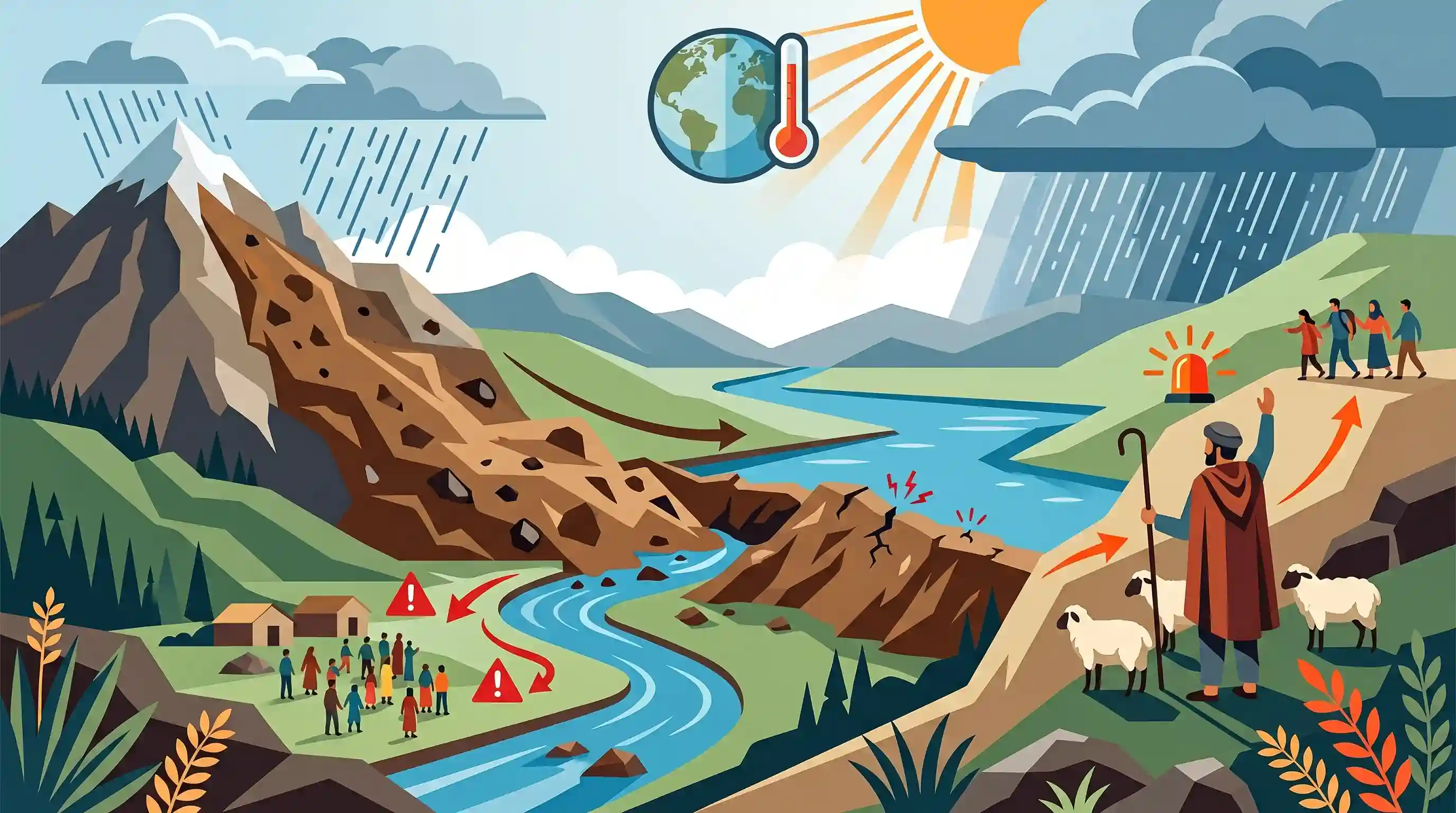
A massive mountain mudslide triggered by heavy monsoon rains and cloudbursts in Pakistan's Gilgit Baltistan region has blocked the Ghizer River, forming a 7-km-long lake. Authorities warn that the unstable, dam-like structure threatens catastrophic outburst floods in downstream areas, though natural water discharge has slightly lowered the immediate risk. An alert by a local shepherd helped save nearly 200 lives in the area. The event underscores the escalating threat of climate-induced, cascading disasters (extreme rainfall, mudslides, and artificial lake bursts) in fragile mountainous regions.
Key Points
- A major mountain mudslide in Pakistan's Gilgit Baltistan blocked the Ghizer River, creating a 7-km-long artificial lake.
- The dam-like blockage poses a severe risk of a catastrophic outburst flood, threatening the downstream districts of Ghizer, Gilgit, Astore, and Diamer.
- The disaster was triggered by extreme monsoon rains and cloudbursts that have killed almost 800 people across Pakistan since late June.
- Early visual detection by a local shepherd acted as an ad-hoc early warning system, leading to the successful rescue of nearly 200 people.
- While the lake has naturally started discharging water, easing the immediate outburst threat, the danger of downstream flash floods persists.
Important Terms
Landslide Lake Outburst Flood (LLOF)

A catastrophic flood occurring when a natural dam, formed by landslide debris blocking a river, suddenly breaches. It releases massive volumes of trapped water and sediment downstream.
UPSC context
GS Paper 1 (Geography) and Paper 3 (Disaster Management); tests knowledge of mountain hazards and sudden-onset disasters.
Cloudburst
An extreme weather event where more than 100 mm of rain falls within one hour over a small area (approx. 20-30 sq km), often causing flash floods.
UPSC context
GS Paper 1 (Geography); frequently tested in the context of Himalayan weather patterns and climate change impacts.
Cascading Disaster
A phenomenon where a primary hazard (e.g., cloudburst) triggers a secondary hazard (landslide), which in turn creates a tertiary threat (flooding), causing cumulative, widespread impacts.
UPSC context
GS Paper 3 (Disaster Management); tests understanding of complex risk interactions and multi-hazard mitigation strategies.
National Disaster Management Authority (NDMA)
The apex statutory body responsible for laying down policies, plans, and guidelines for disaster management to ensure a timely and effective response to disasters.
UPSC context
GS Paper 3 (Disaster Management/Governance); essential for understanding India's institutional framework and the 2005 Act.
Glacial Lake Outburst Flood (GLOF)
A catastrophic release of water from a glacial lake, often triggered by the failure of a moraine dam due to melting, landslides, or seismic activity.
UPSC context
GS Paper 3; critical for climate change and Himalayan ecology topics. It is a high-priority risk for India and Pakistan.
Barrier Lake
A natural dam formed when a landslide or mudslide blocks a river channel, creating an artificial upstream lake that poses a burst risk.
UPSC context
GS Paper 1 (Physical Geography); relates to river morphology and natural hazards in young fold mountain regions like the Himalayas.
Prelims Trap
The artificial lake on the Ghizer river poses a risk of a Glacial Lake Outburst Flood (GLOF).
This is a Landslide Dam Outburst Flood (LDOF) caused by a mudslide blocking a river, not a moraine-dammed glacial lake (GLOF).
Static Concepts Connected
What are the major right-bank tributaries of the Indus River?
- Right-bank Rivers: Major right-bank tributaries include Shyok, Gilgit, Kabul, Tochi, Gomal, and Kurram.
- Origin & Confluence: These rivers mostly originate in the Karakoram, Hindu Kush, and Sulaiman ranges, joining the Indus before or as it enters the plains.
What defines a 'Cascading Disaster' in mountainous regions?
- Definition: A chain reaction where a primary hazard triggers secondary and tertiary hazards, compounding the overall impact.
- Himalayan Example: Heavy rainfall (meteorological) causes a mudslide (geomorphological), which blocks a river causing a flash flood (hydrological).
Cross-Topic Patterns
Attabad Lake phenomenon repeating
The 2010 Attabad Lake in Hunza Valley formed via similar landslide blockages. UPSC frequently pairs trans-Himalayan geomorphological events with Indus drainage system questions.
Cascading multi-hazard risks
Extreme rainfall causing mudslides, which then block rivers leading to flash floods, is a textbook 'cascading disaster'—a rising focus area for Mains GS3.
Sendai Framework and local intel
The shepherd's successful alert perfectly illustrates Community-Based Disaster Risk Management (CBDRM), aligning with the Sendai Framework's emphasis on people-centered early warning systems.

Expect a pairs-matching question on right-bank Indus tributaries (Gilgit/Shyok) and cascading geomorphic hazards like LDOF vs GLOF in 2026.
Linked PYQs · 5
Linked PYQs · 5
- 2021MainsGS3
Describe the various causes and the effects of landslides. Mention the important components of the National Landslide Risk Management Strategy.
- 2019MainsGS3
Disaster preparedness is the first step in any disaster management process. Explain how hazard zonation mapping will help disaster mitigation in the case of landslides.
- 2021MainsGS1
Differentiate the causes of landslides in the Himalayan region and Western Ghats.
- 2016MainsGS1
The Himalayas are highly prone to landslides. Discuss the causes and suggest suitable measures of mitigation.
- 2024MainsGS3
Flooding in urban areas is an emerging climate-induced disaster. Discuss the causes of this disaster. Mention the features of two such major floods in the last two decades in India. Describe the policies and frameworks in India that aim at tackling such floods.
