Pakistan Faces Drug Shortage After Trade Suspension With India
Source:The Hindu ↗
Why It Matters
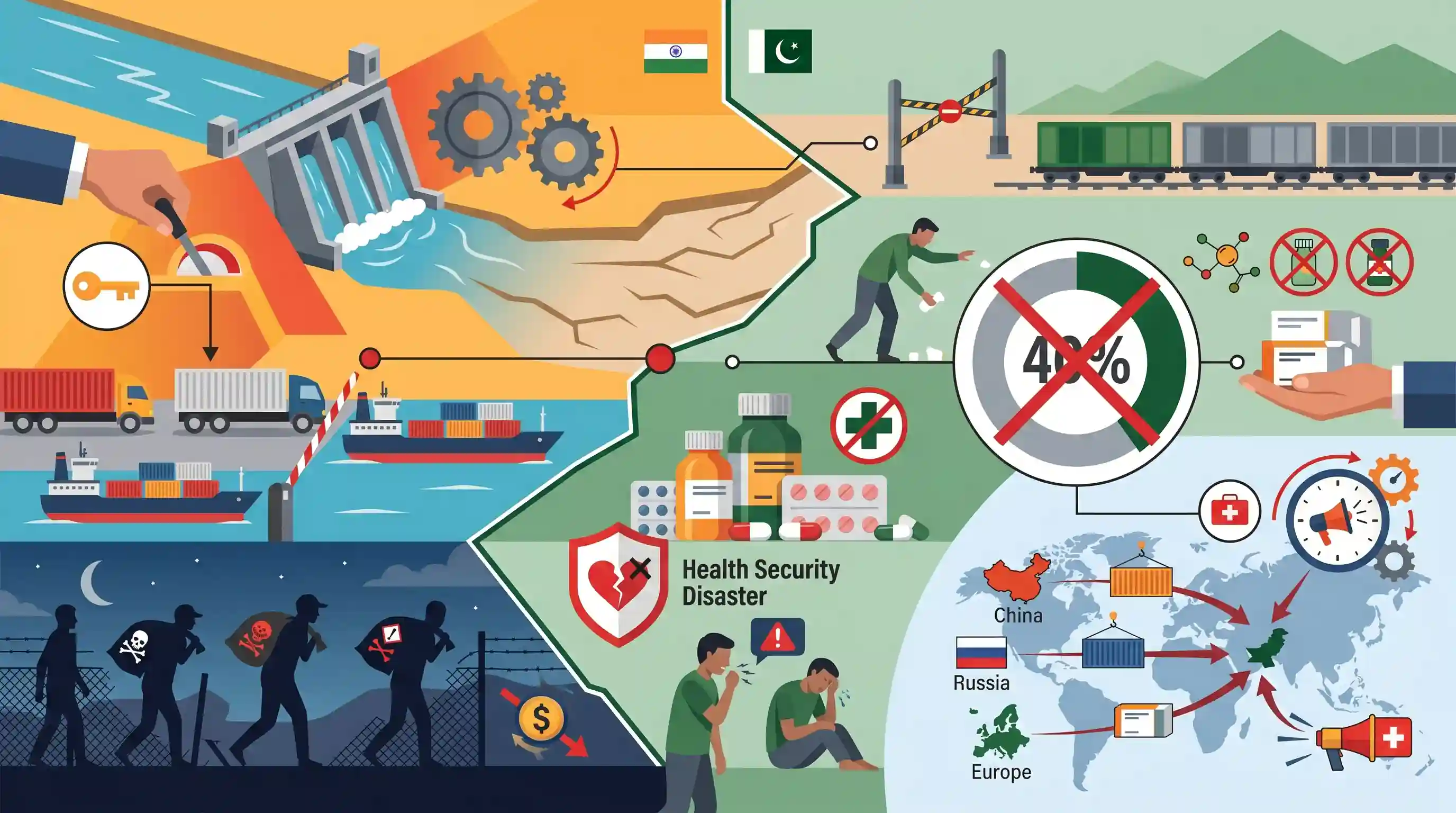
Illustrates the cascading effects of geopolitical tensions on vital sectors like healthcare. It emphasizes India's strategic position as a global pharmaceutical hub ("pharmacy of the world") and the risks of supply chain over-dependence for neighboring countries. Additionally, it highlights how trade embargoes can unintentionally drive illicit cross-border smuggling.
Summary
Following India's decision to suspend the Indus Water Treaty in response to the Pahalgam terrorist attack, Pakistan halted bilateral trade, sparking a severe pharmaceutical supply crisis. Relying on India for up to 40% of its Active Pharmaceutical Ingredients (APIs) and essential medical raw materials, Pakistan's drug regulatory body (DRAP) has declared an emergency to source alternatives from China, Russia, and Europe. Local pharmaceutical associations have pleaded for medical exemptions to avoid a public health disaster, while authorities warn the shortage may fuel cross-border smuggling of unapproved drugs. The episode underscores India's leverage as a critical pharmaceutical supplier and highlights the far-reaching socioeconomic impacts of diplomatic breakdowns in the region.
Key Points
- Pakistan suspended bilateral trade with India in retaliation for India's suspension of the Indus Water Treaty following the Pahalgam terrorist attack.
- The trade suspension has triggered a pharmaceutical supply chain crisis in Pakistan, which depends on India for 30% to 40% of its Active Pharmaceutical Ingredients (APIs) and raw materials.
- The Drug Regulatory Authority of Pakistan (DRAP) has initiated "emergency preparedness" measures, forming a crisis management cell to secure alternative supplies from China, Russia, and Europe.
- The Pakistan Pharmaceutical Manufacturers Association (PPMA) has requested that life-saving drugs and medical supplies be exempted from the trade ban.
- Authorities are concerned that the supply gap may exacerbate the black market, leading to the smuggling of unregistered, potentially dangerous medicines across borders from Afghanistan and Iran.
Important Terms
Indus Water Treaty (IWT)

A 1960 World Bank-mediated water-sharing agreement between India and Pakistan, partitioning six rivers. It recently faced suspension by India following security escalations and cross-border terrorism concerns.
UPSC context
GS Paper II (International Relations). Tests knowledge of transboundary water governance and its role in bilateral diplomacy.
Active Pharmaceutical Ingredients (APIs)
The primary biologically active chemical components in a drug responsible for the intended medicinal effect. Pakistan relies on India for approximately 40% of these raw materials.
UPSC context
GS Paper III (Economy/Science). Relevant to pharma supply chains, self-reliance (Atmanirbhar Bharat), and trade dependencies.
Geoeconomics
The use of economic instruments, trade dependencies, and financial resources as tools of statecraft to achieve geopolitical objectives or national security goals.
UPSC context
GS Paper II (IR). Essential for analyzing the "weaponization" of trade and resource interdependence in regional conflicts.
Drug Regulatory Authority of Pakistan (DRAP)
The autonomous federal body responsible for regulating the manufacture, import, and sale of therapeutic goods in Pakistan, currently managing emergency sourcing for Indian-dependent medical supplies.
UPSC context
GS Paper II (International Relations). Illustrates the administrative and regulatory fallout of diplomatic breakdowns on public health.
Pakistan Pharmaceutical Manufacturers Association (PPMA)
The leading trade body representing licensed pharmaceutical manufacturers in Pakistan, advocating for industry interests and medical trade exemptions during bilateral crises.
UPSC context
GS Paper II (International Relations). Highlights the role of non-state actors and industry stakeholders in shaping foreign policy.
Prelims Trap
India is completely self-sufficient in Active Pharmaceutical Ingredients (APIs) and is a net exporter globally.
While India exports APIs and formulations to Pakistan, India itself heavily relies on China for around 70% of its own API requirements. India is not self-sufficient.
Static Concepts Connected
What are Active Pharmaceutical Ingredients (APIs) and how is India reducing import dependence?
- Definition: APIs are the biologically active components in a drug that produce the intended therapeutic effects, distinct from inactive excipients used for delivery.
- Import Vulnerability: India heavily depends on Chinese imports for Key Starting Materials (KSMs) and APIs, creating a massive strategic supply chain vulnerability during geopolitical tensions.
- PLI Mitigation: The government launched the Production Linked Incentive (PLI) scheme for bulk drugs to boost domestic manufacturing and reduce reliance on single-source imports.
What is the structural allocation of rivers under the Indus Water Treaty (1960)?
- Eastern Rivers: The waters of the Ravi, Beas, and Sutlej are allocated to India for unrestricted use.
- Western Rivers: The waters of the Indus, Jhelum, and Chenab are allocated largely to Pakistan, though India is allowed limited run-of-the-river hydroelectric usage.
- Institutional Mechanism: The treaty established the Permanent Indus Commission and designates the World Bank as a broker for resolving technical disputes.
Cross-Topic Patterns
Economic coercion in bilateral conflicts
India's withdrawal of MFN status (post-Pulwama) and IWT suspension illustrate a definitive shift from kinetic military retaliation to geoeconomic isolation strategies against state-sponsored terrorism.
India's dual API vulnerability
India wields pharmaceutical leverage over neighbors but simultaneously battles massive API dependence on China, prompting domestic structural reforms like the PLI scheme for critical bulk drugs.
Trade embargoes fueling border smuggling
The resultant drug shortage in Pakistan raises risks of transnational organized crime, potentially utilizing established narcotic smuggling routes near the Golden Crescent for counterfeit medicine trafficking.

Expect a multi-statement Prelims question linking India's API import reliance on China with its pharma-export leverage over South Asia.
Linked PYQs · 4
Linked PYQs · 4
- 2015MainsGS2
Terrorist activities and mutual distrust have clouded India-Pakistan relations. To what extent the use of soft power like sports and cultural exchanges could help generate goodwill between the two countries? Discuss with suitable examples.
- 2012MainsGS2
The situation today is far different to that prevalent fifty years back when the Indus Water Treaty was signed." Highlight the complexity of the current challenges on both sides of the border in this regard. Do you think that a review of the Treaty is in India's best interests?
- 2016MainsGS3
Border management is a complex task due to difficult terrain and hostile relations with some countries. Elucidate the challenges and strategies for effective border management.
- 2025MainsGS3
Discuss the rationale of the Production Linked Incentive (PLI) scheme. What are its achievements? In what way can the functioning and outcomes of the scheme be improved?
