US Pakistan Security Ties Impact India West Asia Strategic Interests
Source:The Hindu ↗
Why It Matters
This development highlights the fluid nature of major-power diplomacy and realpolitik in South and West Asia. The resurgence of US-Pakistan security cooperation under the Trump administration directly affects India's regional hegemony, its neighborhood-first policy, and its long-term strategic and energy interests in West Asia. It also serves as a critical point of domestic debate on the effectiveness and narrative of India's foreign policy.
Summary
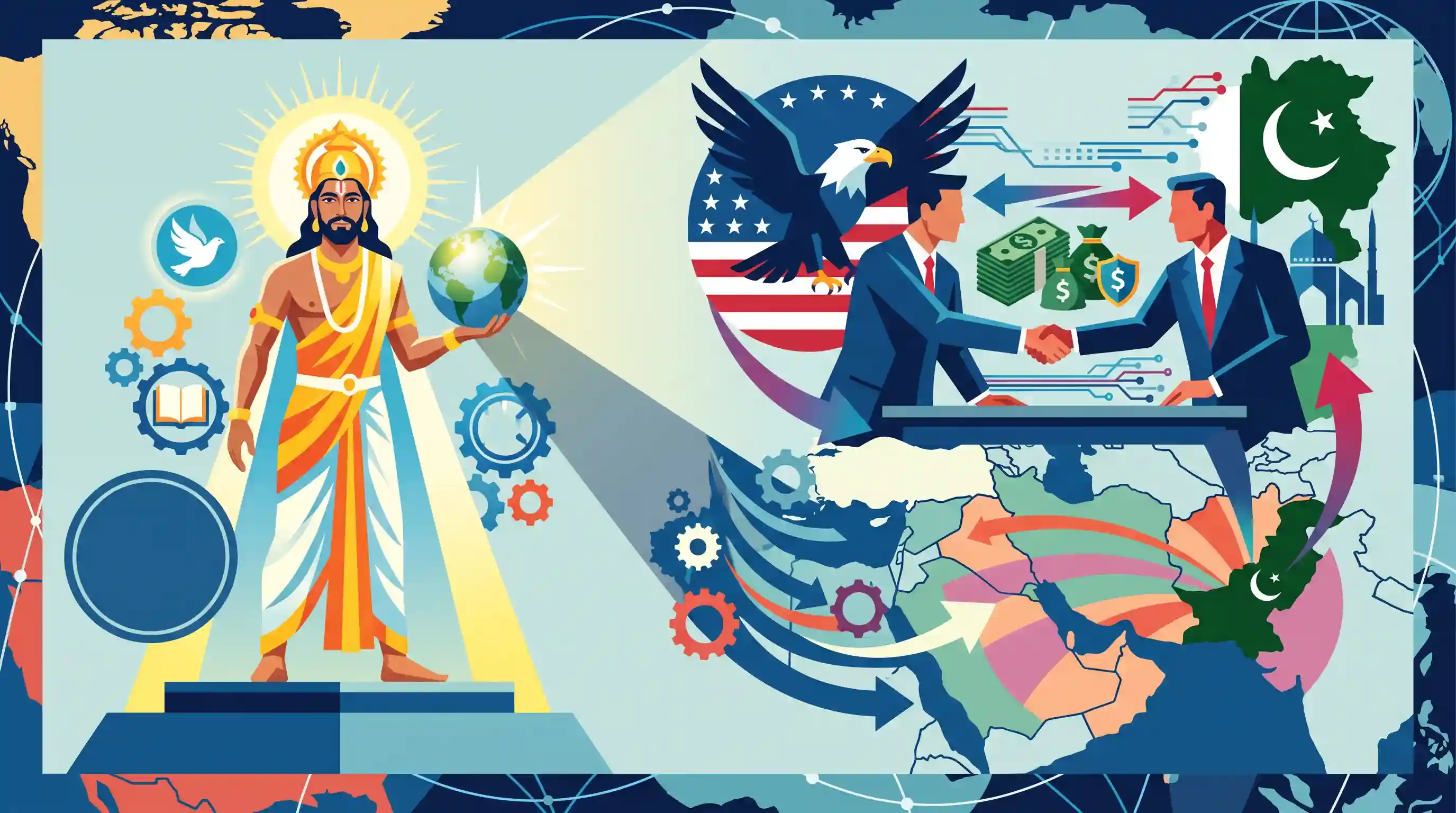
The Congress party, through General Secretary Jairam Ramesh, has questioned India's 'Vishwaguru' foreign policy narrative, characterizing the growing strategic bonhomie between the United States and Pakistan as a major diplomatic setback. Highlighting a meeting between FBI Director Kash Patel and Pakistan's Interior Minister Mohsin Naqvi to discuss counter-terrorism financing and cyber investigations, Ramesh argued that Pakistan's rising influence in West Asia and its strong ties with the US under the Trump administration present serious geopolitical challenges to India's regional and international security objectives.
Key Points
- Congress general secretary Jairam Ramesh criticized the Indian government's 'Vishwaguru' foreign policy narrative, stating that Pakistan's rising global and regional influence represents a severe setback for India.
- The criticism follows a high-profile meeting at the FBI headquarters, where FBI Director Kash Patel hosted Pakistan's Interior Minister Mohsin Naqvi.
- During the meeting, the FBI expressed appreciation for Pakistan's support in protecting US interests and discussed cooperation in counterterrorism financing and cyber investigations.
- Ramesh noted that multiple top-tier US officials—including President Donald Trump, the Vice President, the Secretary of State, and the Central Command Chief—have warmly embraced Pakistan.
- Despite the collapse of the 'Islamabad Memorandum of Understanding' between the US and Iran, US-Pakistan strategic bonhomie has remained resilient.
- The ongoing diplomatic realignment signals a challenge to India's strategic calculations in West Asia and its counterterrorism diplomacy.
Important Terms
Islamabad Memorandum of Understanding

A June 2026 framework agreement brokered by Pakistan to halt the U.S.-Iran war, establishing an immediate ceasefire, reopening the Strait of Hormuz, and outlining a 60-day roadmap for comprehensive negotiations.
UPSC context
GS Paper II (West Asia Geopolitics); tests analytical understanding of regional peace processes and their strategic implications for Indian diplomacy.
US Central Command
A geographic combatant command of the United States Department of Defense, responsible for coordinating military operations and security partnerships across the Middle East, Central Asia, and parts of South Asia.
UPSC context
GS Paper II (Global Groupings); evaluates how major foreign military commands influence security dynamics and trade routes near India's borders.
Federal Bureau of Investigation (FBI)
The primary federal law enforcement and domestic intelligence agency of the United States, which works with international law enforcement agencies to combat transnational crimes, terrorism, and cyber threats.
UPSC context
GS Paper II (International Agencies); tests knowledge of foreign intelligence organizations and bilateral law enforcement cooperation models affecting regional security.
Indian National Congress
A major national political party in India, founded in 1885, serving as the principal parliamentary opposition and a crucial pillar of the nation's democratic oversight and policy debates.
UPSC context
GS Paper II (Polity & Constitution); tests understanding of the role of political parties in shaping foreign policy critique and national narratives.
Prelims Trap
Both India and Pakistan fall under the operational jurisdiction of the US Indo-Pacific Command (INDOPACOM) given their South Asian geography.
The US structurally separates South Asia: Pakistan is under CENTCOM (West Asia focus), while India is under INDOPACOM. This bureaucratic split allows de-hyphenated bilateral ties.
Static Concepts Connected
What does the shift from 'Vishwaguru' to 'Vishwamitra' signify in Indian diplomacy?
- Vishwaguru concept: Emphasizes normative, moral-civilizational leadership and guiding global policy through cultural authority.
- Vishwamitra transition: Signals pragmatic, interest-based bilateralism, positioning India as a reliable global friend and transaction-oriented partner.
- Strategic rationale: Reflects a realistic shift to multi-alignment, prioritizing economic and security gains over ideological posture.
How does the US military's geographic command division affect India-Pakistan relations?
- Operational divide: Places Pakistan under Central Command (CENTCOM) and India under Indo-Pacific Command (INDOPACOM).
- Policy de-hyphenation: Allows the US to pursue distinct defense agendas with both nations without letting them overlap structurally.
Cross-Topic Patterns
West Asian stability & South Asian rivalries
Pakistan's mediation in US-Iran conflicts highlights how West Asian diplomatic shifts can restore its strategic leverage, directly impacting India's regional containment strategies.
Command structures & strategic de-hyphenation
The CENTCOM-INDOPACOM division shows how bureaucratic military boundaries allow major powers to balance competing regional partnerships without direct zero-sum trade-offs.

Mains 2026 may contrast 'Vishwaguru' moralism with 'Vishwamitra' pragmatism against the backdrop of US-Pakistan-Iran multi-alignment.
Linked PYQs · 3
Linked PYQs · 3
- 2025MainsGS2
"Energy security constitutes the dominant kingpin of India's foreign policy, and is linked with India's overarching influence in Middle Eastern countries.” How would you integrate energy security with India's foreign policy trajectories in the coming years?
- 2017MainsGS2
The question of India's Energy Security constitutes the most important part of India's economic progress. Analyze India's energy policy cooperation with West Asian countries.
- 2016MainsGS2
Increasing cross-border terrorist attacks in India and growing interference in the internal affairs of several member-states by Pakistan are not conducive for the future of SAARC (South Asian Association for Regional Cooperation)." Explain with suitable examples.
