Information Warfare and Military Preparedness along the Border
Source:Indian Express ↗
Why It Matters
Information warfare is a critical component of internal security and modern warfare doctrines. UPSC frequently tests the impact of non-state actors, cyber threats, and social media on national security under GS Paper 3. Understanding how information operations influence cross-border dynamics and military strategy is essential for aspiring administrators.
Summary
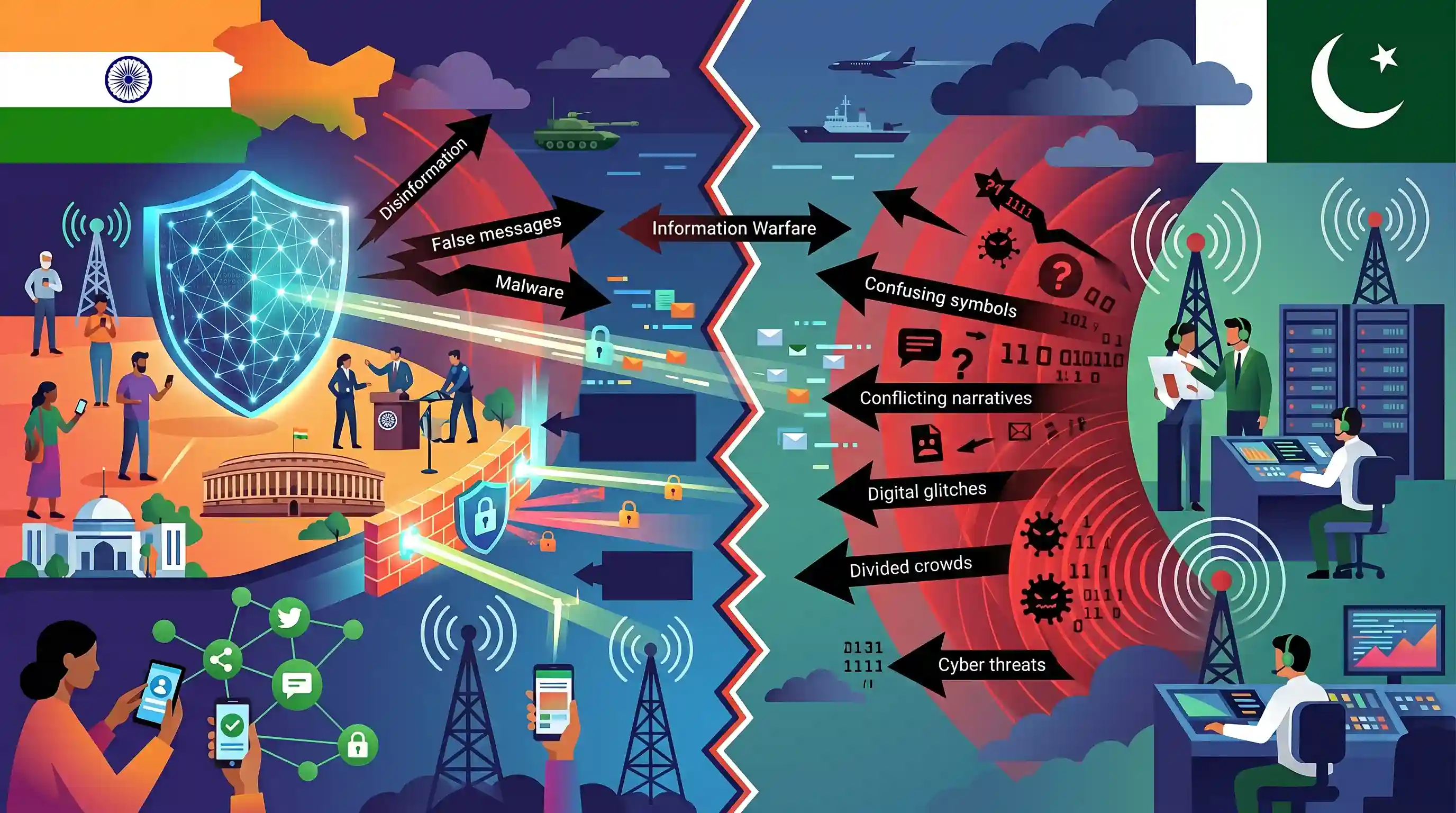
The article emphasizes the growing significance of the "information front" in the context of military preparedness between India and Pakistan. It highlights that modern conflicts are increasingly fought in non-kinetic domains, making information warfare, strategic communication, and narrative building just as crucial as conventional military strength. The piece argues that India faces persistent threats from cross-border propaganda, cyber-attacks, and disinformation campaigns aimed at destabilizing its internal security. To counter these challenges, India must elevate its information warfare capabilities, seamlessly integrate them into its national defense strategy, and build resilience against adversarial narratives.
Key Points
- Modern warfare extends beyond kinetic operations into the non-kinetic domains of information warfare, psychological operations, and strategic communications.
- Adversaries like Pakistan leverage information warfare, cross-border propaganda, and cyber capabilities to exploit internal fault lines and challenge India's security.
- India's military preparedness requires structural integration of information warfare into broader national security and defense doctrines.
- Developing robust mechanisms to counter disinformation, deepfakes, and negative narrative building is critical to safeguarding internal security and global perception.
Important Terms
Information Warfare (IW)

The strategic use of information and communication technology to manipulate an adversary's decision-making or public opinion through misinformation, cyber operations, and propaganda.
UPSC context
GS Paper III (Internal Security); tests understanding of modern conflict domains and challenges to stability via digital networks.
Hybrid Warfare
A conflict strategy blending conventional military force with unconventional tools like cyberattacks, disinformation, and economic coercion to achieve objectives below the threshold of open war.
UPSC context
GS Paper III (Security Challenges); examines India's preparedness against multifaceted threats from state and non-state actors.
Non-Kinetic Warfare
Warfare that achieves objectives without physical force, utilizing electronic warfare, cyberattacks, psychological tactics, and economic pressure to disrupt an adversary's infrastructure or governance.
UPSC context
GS Paper III (Defence Strategy); focuses on the shift from 'contact' to 'contactless' warfare and technological absorption in defense.
Strategic Communication (StratCom)
The purposeful use of communication to shape perceptions and ensure audiences understand a nation's intentions, actions, and capabilities to support strategic objectives.
UPSC context
GS Paper III (Role of Media); crucial for building narrative resilience and countering adversarial propaganda or disinformation.
Psychological Operations (PsyOps)
Planned operations conveying selected information to influence the emotions, motives, and objective reasoning of foreign audiences to affect their behavior and perception.
UPSC context
GS Paper III (Social Networking Sites); relevant for analyzing digital propaganda and its impact on internal security.
Cyber Security
Protecting systems, networks, and programs from digital attacks intended to access sensitive information, disrupt governance, or cripple critical national infrastructure.
UPSC context
GS Paper III (Basics of Cyber Security); a core topic testing knowledge of defensive frameworks and institutional responses.
Prelims Trap
Cognitive warfare primarily targets a nation's critical information infrastructure (CII) and computer networks to paralyze the state.
False. Cyber warfare targets digital networks and physical infrastructure (CII), whereas cognitive warfare specifically targets the human mind using disinformation to alter public perception.
Static Concepts Connected
What constitutes Non-Kinetic Warfare in modern security doctrines?
- Definition: Military or state actions designed to degrade, disrupt, or defeat an adversary without the use of direct, conventional physical force.
- Key Components: It includes cyber attacks, electronic warfare (EW), psychological operations (PsyOps), economic sanctions, and strategic disinformation campaigns.
- Strategic Objective: To exploit socio-political fault lines and manipulate perception while remaining below the threshold of conventional armed conflict.
What is India's institutional framework for countering cyber and information threats?
- Defence Cyber Agency: A tri-service agency mandated to handle military cyber security threats and formulate India's military cyber doctrine.
- CERT-In: The national nodal agency under MeitY responsible for responding to computer security incidents as they occur.
- NCIIPC: A nodal agency under the National Technical Research Organisation (NTRO) dedicated specifically to protecting India's Critical Information Infrastructure.
Cross-Topic Patterns
AI Deepfakes + Internal Security
AI-generated synthetic media is increasingly weaponized by state and non-state actors for cross-border psychological operations, merging GS3 Technology (AI) with GS3 Internal Security challenges.
Border Management & Perception Warfare
Physical border infrastructure upgrades (like the Vibrant Villages Programme) are now conceptually linked with perception management to counter adversarial propaganda aimed at alienating border populations.

Expect a 2026 multi-statement Prelims question distinguishing Cognitive Warfare from Cyber Terrorism, alongside CERT-In/NCIIPC mandates.
Linked PYQs · 4
Linked PYQs · 4
- 2021MainsGS3
Keeping in view India's internal security, analyse the impact of cross-border cyber attacks. Also discuss defensive measures against these sophisticated attacks.
- 2024MainsGS3
India has a long and troubled border with China and Pakistan fraught with contentious issues. Examine the conflicting issues and security challenges along the border. Also give out the development being undertaken in these areas under the Border Area Development Programme (BADP) and Border Infrastructure and Management (BIM) Scheme.
- 2022MainsGS3
What are the different elements of cyber security ? Keeping in view the challenges in cyber security, examine the extent to which India has successfully developed a comprehensive National Cyber Security Strategy.
- 2015MainsGS3
Considering the threats cyberspace poses for the country, India needs a "Digital Armed Force" to prevent crimes. Critically evaluate the National Cyber Security Policy, 2013 outlining the challenges perceived in its effective implementation.
