Information Warfare and Perception Management in Border Security
Source:Indian Express ↗
Why It Matters
This topic directly addresses the GS3 syllabus on the role of media and social networks in internal security challenges and border management. It highlights the shift towards hybrid and cognitive warfare, a key contemporary security challenge for India.
Summary
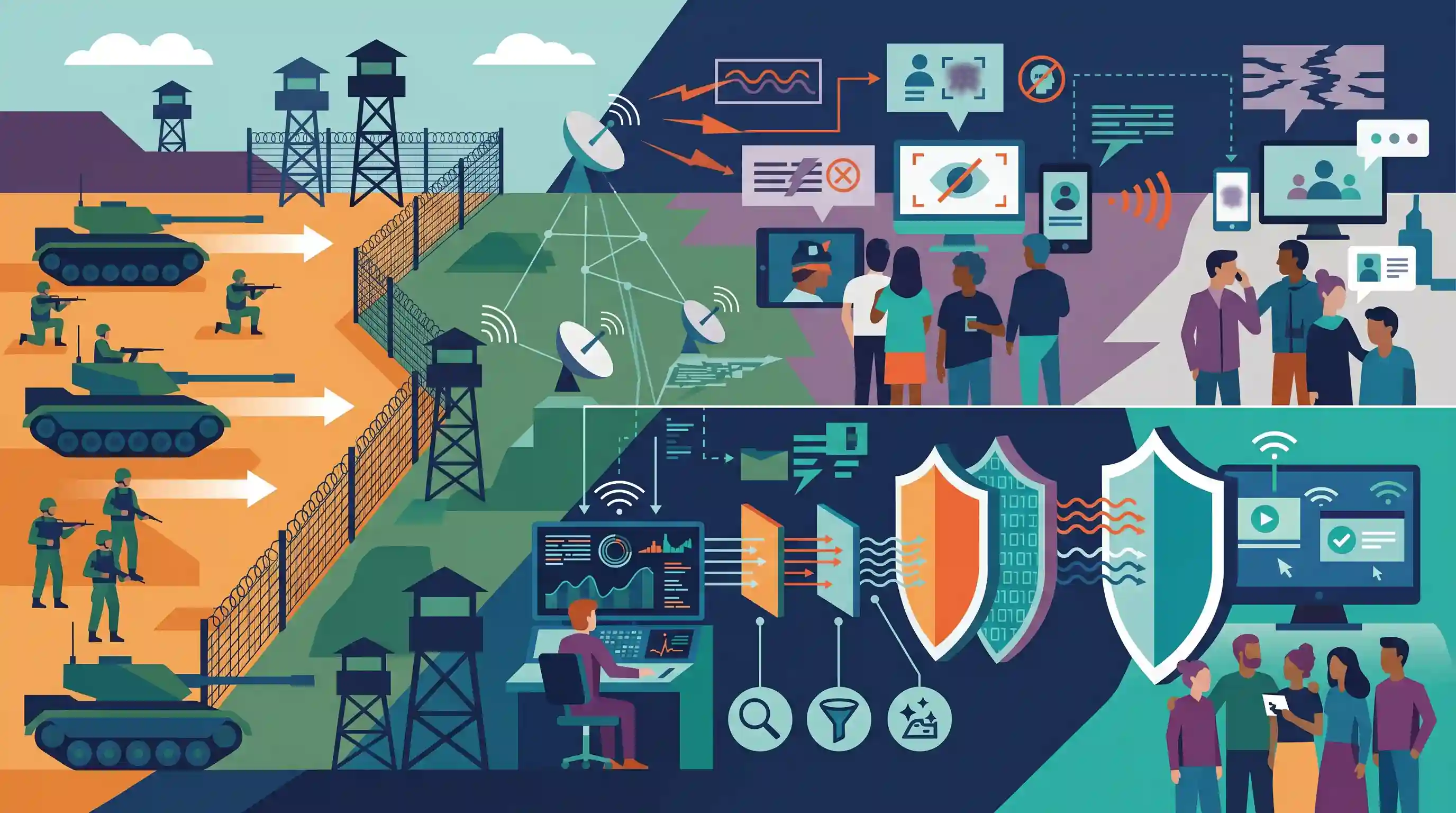
The article highlights how military preparedness in the context of India and Pakistan has evolved to prominently feature the "information front." It underscores the growing significance of information warfare, perception management, and cognitive operations in modern hybrid conflicts. As adversaries increasingly leverage digital media for psychological warfare and to influence local populations—especially in border regions—the piece argues that India's military strategy must integrate robust counter-narrative and propaganda-busting capabilities. Effective preparedness now requires winning the cognitive battle alongside maintaining conventional military readiness to safeguard internal security.
Key Points
- The scope of military preparedness between India and Pakistan has expanded beyond conventional kinetic warfare to include the critical "information front."
- Information warfare, cognitive operations, and narrative management have become central to modern hybrid conflicts.
- Adversaries actively exploit digital and social media platforms to wage psychological warfare, spread disinformation, and influence local populations in border areas.
- India must systematically integrate robust narrative-building and perception management strategies into its national security framework to effectively counter non-contact warfare.
Important Terms
Information Warfare

The strategic use of information (misinformation, cyber-attacks, and propaganda) to gain a competitive advantage over adversaries, influence public opinion, and disrupt the decision-making of the state.
UPSC context
GS Paper III: Internal Security; tests understanding of non-kinetic threats and communication network challenges.
Cognitive Warfare
A conflict domain targeting the human mind to influence beliefs, emotions, and decision-making through psychological manipulation and disinformation, often leveraging AI and digital platforms.
UPSC context
GS Paper III: Internal Security; focuses on emerging threats to societal cohesion and democratic stability.
Hybrid Warfare
A multifaceted military strategy blending conventional kinetic force with unconventional tactics like cyberattacks, economic coercion, and information operations to destabilize a nation below the threshold of open war.
UPSC context
GS Paper III: Internal Security; critical for analyzing cross-border proxy dynamics and state/non-state actor threats.
Perception Management
Planned operations to convey specific information to foreign and domestic audiences to influence their emotions, motives, and reasoning, ultimately guiding their actions toward the originator's objectives.
UPSC context
GS Paper III: Internal Security/Role of Media; examines the strategic use of narrative in conflict resolution.
Counter-narrative
A communication strategy designed to debunk misinformation and challenge extremist or adversarial ideologies by presenting alternative, factual, and constructive perspectives to vulnerable populations.
UPSC context
GS Paper III: Internal Security; vital for topics on radicalization and social media's role in security.
Prelims Trap
The Defence Cyber Agency (DCyA) operates under the Ministry of Home Affairs to counter internal cyber threats.
DCyA is a tri-service military agency under the Ministry of Defence (HQ IDS), not the MHA or MeitY. It focuses on military cyber operations.
Static Concepts Connected
What characterizes Fifth-Generation Warfare (5GW)?
- Cognitive Focus: Aims to manipulate perceptions, exploit societal fault lines, and win the psychological battle without requiring direct physical combat.
- Non-Kinetic Means: Relies heavily on cyber attacks, social media disinformation, deepfakes, and economic coercion rather than traditional kinetic military force.
- Blurring Lines: Erases the traditional distinctions between war and peace, and deliberately targets civilian populations alongside military installations.
What comprises India's institutional framework for military cyber and information operations?
- Defence Cyber Agency: A tri-service command under Headquarters Integrated Defence Staff (HQ IDS) responsible for managing military cyber threats and operations.
- Operation Sadbhavana: The Indian Army's civic action program in J&K and Ladakh, acting as a crucial on-ground perception management tool to counter adversary propaganda.
- CERT-In vs DCyA: CERT-In handles civilian cybersecurity under MeitY, whereas DCyA focuses specifically on safeguarding military networks and executing cyber warfare.
Cross-Topic Patterns
AI Deepfakes & Cognitive Warfare
Military preparedness against narrative manipulation directly links to GS3 cyber security challenges where AI-generated deepfakes are used to incite internal riots and subvert democratic institutions.
CIBMS & Virtual Border Threats
While the Comprehensive Integrated Border Management System (CIBMS) secures physical frontiers, adversaries bypass this entirely using encrypted social media for cross-border youth radicalization.

Expect a GS3 Mains question linking 5th-gen warfare, border radicalization, and AI deepfakes as a unified hybrid threat in 2026.
Linked PYQs · 3
Linked PYQs · 3
- 2020MainsGS3
For effective border area management, discuss the steps required to be taken to deny local support to militants and also suggest ways to manage favourable perception among locals.
- 2021MainsGS3
Keeping in view India's internal security, analyse the impact of cross-border cyber attacks. Also discuss defensive measures against these sophisticated attacks.
- 2024MainsGS3
India has a long and troubled border with China and Pakistan fraught with contentious issues. Examine the conflicting issues and security challenges along the border. Also give out the development being undertaken in these areas under the Border Area Development Programme (BADP) and Border Infrastructure and Management (BIM) Scheme.
