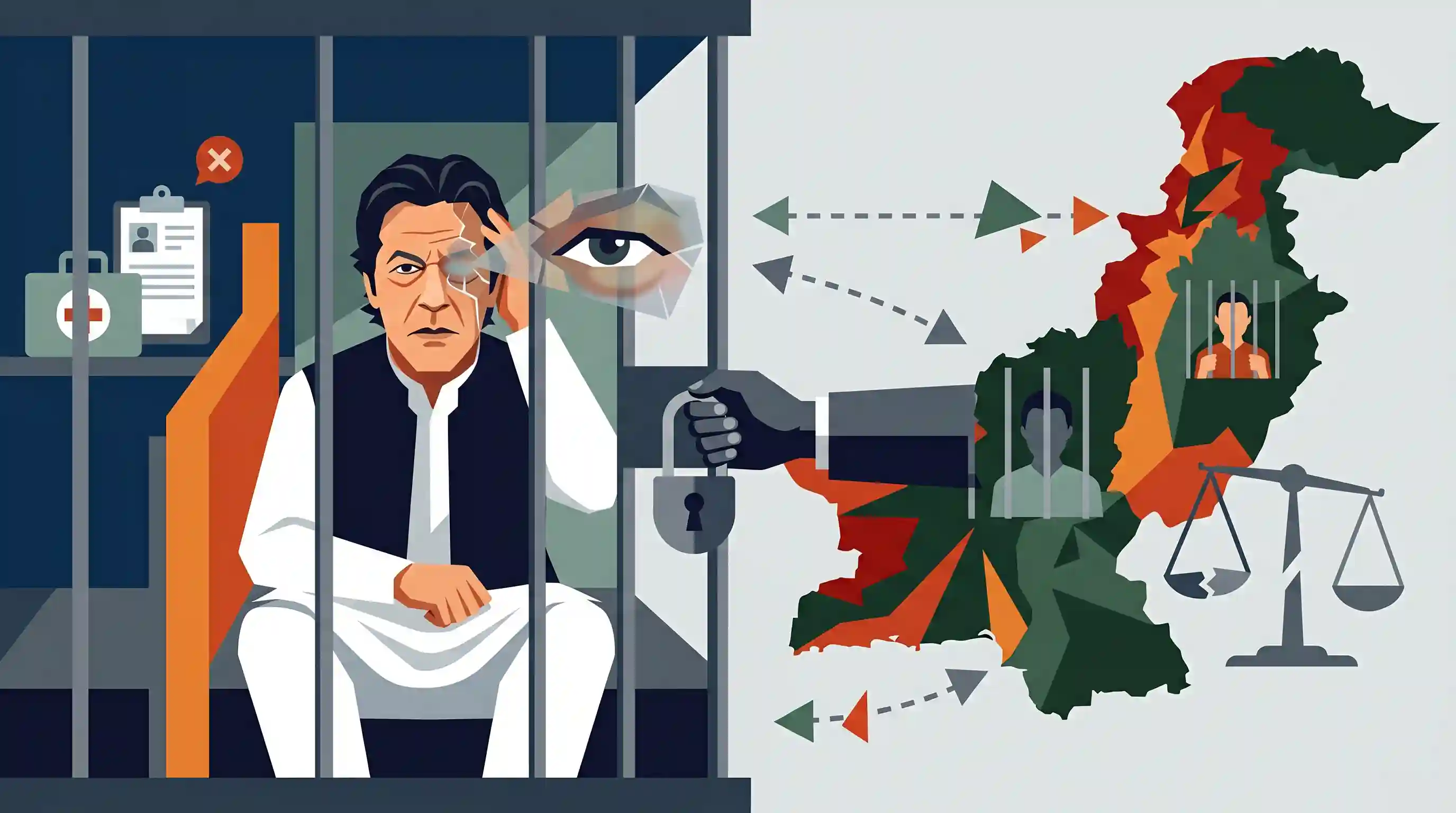
Imran Khan Health Concerns and Political Turmoil in Pakistan
Source:Indian Express ↗
Why It Matters
Pakistan's internal political turbulence, including the jailing and alleged mistreatment of a former Prime Minister, directly impacts regional stability. For UPSC aspirants, understanding the internal dynamics of India's immediate neighbors is crucial for analyzing the security and diplomatic landscape of South Asia.
Summary
Former Pakistani Prime Minister Imran Khan, currently incarcerated in Adiala Jail, has reportedly lost significant vision, retaining only 15% sight in his right eye according to his lawyer. This assertion raises serious questions about the medical treatment and human rights conditions for political prisoners in Pakistan, whilst underscoring the deep and ongoing political instability within the country.
Key Points
- Former Pakistani Prime Minister Imran Khan has reportedly retained only 15% vision in his right eye while incarcerated at Adiala Jail, according to his lawyer.
- The claim underscores concerns regarding the medical care and treatment of high-profile political prisoners in Pakistan.
- These developments reflect the ongoing, severe political instability and legal conflicts involving major political leaders in Pakistan.
Important Terms
Supreme Court of Pakistan

The highest judicial body in Pakistan, holding final appellate authority and constitutional jurisdiction. It plays a pivotal role in resolving political crises and supervising the rule of law.
UPSC context
GS Paper II: Governance and Constitution. Tests understanding of judicial independence and its role in neighboring democratic frameworks.
Adiala Jail
Formally Central Jail Rawalpindi, it is a high-security prison in Pakistan. It is notable for incarcerating former Prime Ministers and sensitive prisoners, reflecting the country's political volatility.
UPSC context
GS Paper II: International Relations. Tests awareness of political developments in neighboring countries and their impact on regional stability.
Political Prisoner
A person imprisoned for their political beliefs or opposition to the government. This involves human rights, civil liberties, and international conventions regarding the treatment of detainees.
UPSC context
GS Paper II: Human Rights. Tests knowledge of humanitarian standards and treatment of political dissidents globally.
India-Pakistan Relations
The bilateral diplomatic and political interactions between India and Pakistan. Key issues include border security, cross-border terrorism, and the stability of Pakistan’s internal political landscape.
UPSC context
GS Paper II: India and its neighborhood-relations. Tests understanding of bilateral dynamics and regional security implications.
Pakistan Tehreek-e-Insaf (PTI)
A major political party in Pakistan founded by Imran Khan. Its legal battles and popular support significantly impact Pakistan's democratic stability and diplomatic posture.
UPSC context
GS Paper II: International Relations. Tests knowledge of the internal politics of neighboring nations and its influence on foreign policy.
National Accountability Bureau (NAB)
Pakistan's premier anti-corruption agency tasked with investigating financial crimes. It often handles high-profile corruption cases involving top political leaders, affecting regional governance stability.
UPSC context
GS Paper II: Governance. Tests understanding of anti-corruption frameworks and their use in the political landscapes of South Asian nations.
Prelims Trap
"The Nelson Mandela Rules are legally binding international treaties governing prisoners."
They are UN Standard Minimum Rules (soft law), not legally binding treaties, though they act as universal blueprints for humane prisoner treatment.
Static Concepts Connected
What are the constitutional rights of prisoners under the Indian framework?
- Article 21 scope: Fundamental rights are not suspended upon incarceration. Prisoners retain the right to health, adequate medical care, and basic human dignity.
- Judicial precedents: Landmark Supreme Court rulings (like the Sunil Batra case) explicitly protect inmates against cruel, inhuman, or degrading treatment within jails.
What are the primary international standards for the treatment of prisoners?
- Nelson Mandela Rules: The 2015 revised UN Standard Minimum Rules for the Treatment of Prisoners, outlining universally acknowledged blueprints for humane prison conditions.
- ICCPR Article 10: An international covenant India is party to; mandates that all persons deprived of liberty must be treated with humanity, prohibiting denial of medical care.
Cross-Topic Patterns
Pakistan's instability & India's border security
Pakistan's chronic political crises and civil-military friction often incentivize its "Deep State" establishment to externalize domestic pressures by escalating cross-border terrorism or tensions with India.
Global human rights vs Indian Prison Reforms
The denial of medical care to political prisoners abroad connects to India's domestic debates around undertrial rights, prison overcrowding, and the implementation of the Model Prisons Act, 2023.

While Pakistan's politics won't be tested directly, the Nelson Mandela Rules or Article 21 prisoner rights are prime Prelims candidates.
Linked PYQs · 2
Linked PYQs · 2
- 2016MainsGS2
Increasing cross-border terrorist attacks in India and growing interference in the internal affairs of several member-states by Pakistan are not conducive for the future of SAARC (South Asian Association for Regional Cooperation)." Explain with suitable examples.
- 2021MainsGS2
Though the Human Rights Commissions have contributed immensely to the protection of human rights in India, yet they have failed to assert themselves against the mighty and powerful. Analyzing their structural and practical limitations, suggest remedial measures.
