Constitutional Immunity and Judicial Overreach in Pakistan
Source:The Hindu ↗
Why It Matters
Provides a stark comparative case study for GS-2 Polity (Basic Structure Doctrine, separation of powers, and judicial independence) by demonstrating how parliamentary supremacy can be used to oust judicial review. Also vital for understanding Pakistan's internal political dynamics and civil-military relations, which directly affect regional security and India's neighborhood policy.
Summary
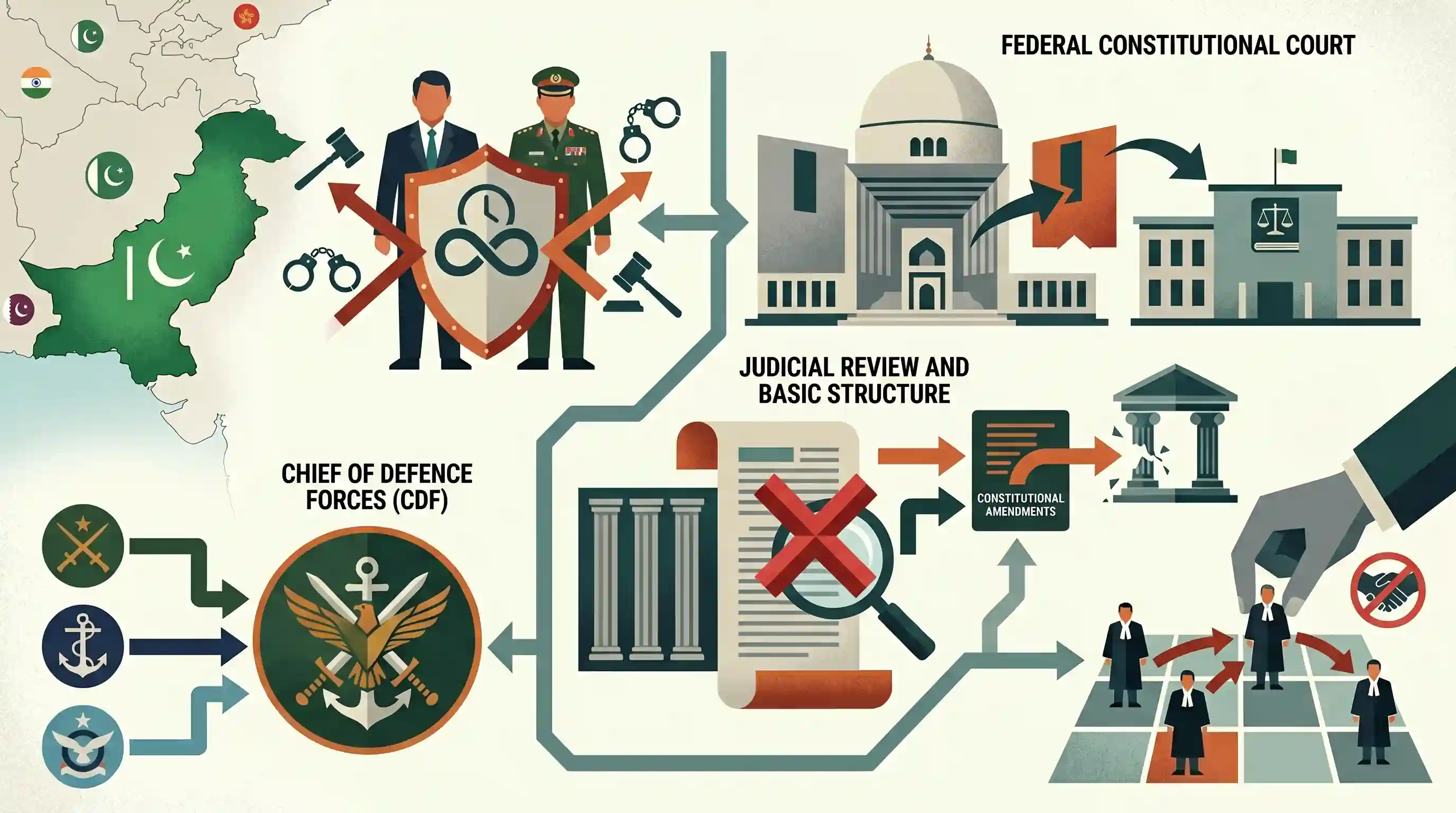
Pakistan has enacted the controversial 27th Constitutional Amendment, granting lifetime immunity from prosecution to the President and the current Army Chief. The amendment fundamentally alters Pakistan's constitutional architecture by creating a Federal Constitutional Court that strips the Supreme Court of its original jurisdiction over constitutional matters. It also bars judicial review of constitutional amendments, effectively preventing any 'Basic Structure Doctrine' challenge. Furthermore, it entrenches military hegemony by establishing a powerful Chief of Defence Forces post, while undermining judicial independence by allowing the non-consensual transfer of High Court judges. Critics warn this signals severe democratic backsliding and an institutionalization of military power.
Key Points
- Pakistan's 27th Constitutional Amendment grants lifetime immunity from prosecution to President Asif Ali Zardari and Army Chief Asim Munir.
- A new Federal Constitutional Court has been created, stripping the Supreme Court of its original jurisdiction to hear cases involving constitutional interpretation.
- An absolute ouster clause explicitly bars any court from reviewing or questioning constitutional amendments on any grounds, nullifying basic structure review.
- The amendment establishes the new position of Chief of Defence Forces, concentrating sweeping military authority under Asim Munir.
- The President is now empowered to transfer High Court judges without their consent, leading to concerns about the erosion of judicial independence.
Important Terms
27th Constitutional Amendment (Pakistan)

Enacted in November 2025, this legislation grants lifetime immunity to Pakistan's President and Army Chief, establishes a Federal Constitutional Court, and consolidates military power under a new unified command structure.
UPSC context
GS Paper II: India and its Neighborhood. Crucial for understanding regional democratic stability and constitutional shifts in a neighboring nuclear-armed state.
Federal Constitutional Court (FCC)
A new apex judicial body established to handle constitutional interpretation and fundamental rights, effectively stripping the Supreme Court of Pakistan of its original jurisdiction over constitutional matters.
UPSC context
GS Paper II: Separation of Powers and Comparison of Constitutions. Tests understanding of parallel judicial structures and their impact on judicial supremacy.
Chief of Defence Forces (CDF)
A high-ranking military post created to unify command over the Army, Navy, and Air Force, concurrently held by the Army Chief, granting unprecedented institutional authority and lifetime immunity.
UPSC context
GS Paper II: Government Policies and Interventions. Important for analyzing civil-military relations and the 'hybrid' governance model in South Asia.
Basic Structure Doctrine (Pakistan Context)
The legal principle that certain core features of a constitution are beyond the reach of parliamentary amendment; the 27th Amendment explicitly bars such challenges to prevent judicial review.
UPSC context
GS Paper II: Constitutional Comparison. Evaluates the divergence between Indian and Pakistani jurisprudence regarding the limits of parliamentary amending power.
Judicial Independence
The ability of courts to function without influence from other branches of government; significantly weakened in Pakistan by executive control over judicial transfers and appointments.
UPSC context
GS Paper II: Judiciary. Tests the concept of 'democratic backsliding' and the erosion of checks and balances in a parliamentary system.
Separation of Powers
The distribution of authority among the legislative, executive, and judicial branches; the 27th Amendment shifts this balance toward the executive and military in Pakistan.
UPSC context
GS Paper II: Constitutional Provisions. Essential for comparing the functional efficacy of democratic institutions across the Indian subcontinent.
Prelims Trap
"The Indian President, like the Pakistani President, enjoys lifetime immunity from criminal proceedings."
Article 361 grants immunity from criminal proceedings to the Indian President only during their term of office, not for their entire lifetime.
Static Concepts Connected
What immunities are granted under Article 361 of the Indian Constitution?
- Criminal Immunity: Absolute immunity from criminal proceedings and arrest or imprisonment strictly during their active term of office.
- Civil Proceedings: Civil suits for personal acts require a two-month prior written notice before initiation during their term.
- Official Acts: They are not answerable to any court for the exercise of their official powers and duties.
How does India protect against arbitrary High Court judge transfers?
- Article 222: Allows the President to transfer High Court judges, but strictly requires consultation with the Chief Justice of India.
- Collegium System: The CJI's recommendation is binding on the executive, acting as a structural safeguard against arbitrary political transfers.
- Judicial Review: Transfers are subject to limited judicial review if made without CJI consultation or if proven to be punitive.
Cross-Topic Patterns
Comparative Constitution GS-2
UPSC frequently tests India's constitutional stability against crises in its neighborhood, such as Sri Lanka's executive presidency or Nepal's constitutional transitions.
Ouster Clauses & Basic Structure
Pakistan's explicit bar on judicial review mirrors India's 42nd Amendment, which the Supreme Court explicitly struck down in Minerva Mills (1980) to protect judicial review.

GS-2 Mains 2026 will likely feature a comparative question on the 'Basic Structure Doctrine' vs executive overreach in South Asia.
Linked PYQs · 4
Linked PYQs · 4
- 2025MainsGS2
Indian Constitution has conferred the amending power on the ordinary legislative institutions with a few procedural hurdles. In view of this statement, examine the procedural and substantive limitations on the amending power of the Parliament to change the Constitution.
- 2023MainsGS2
“Constitutionally guaranteed judicial independence is a prerequisite of democracy.” Comment.
- 2020MainsGS2
Judicial Legislation is antithetical to the doctrine of separation of powers as envisaged in the Indian Constitution. In this context justify the filing of large number of public interest petitions praying for issuing guidelines to executive authorities.
- 2016MainsGS2
Increasing cross-border terrorist attacks in India and growing interference in the internal affairs of several member-states by Pakistan are not conducive for the future of SAARC (South Asian Association for Regional Cooperation)." Explain with suitable examples.
