Pakistan Government Signs Settlement Agreement to End Protests in PoK
Source:The Hindu ↗
Why It Matters
Civil unrest and socioeconomic grievances in Pakistan-occupied Kashmir (PoK) reflect broader structural issues in Pakistan's administration of the occupied territory. Understanding these internal dynamics is crucial for grasping regional stability and India's geopolitical calculus vis-a-vis Pakistan.
Summary
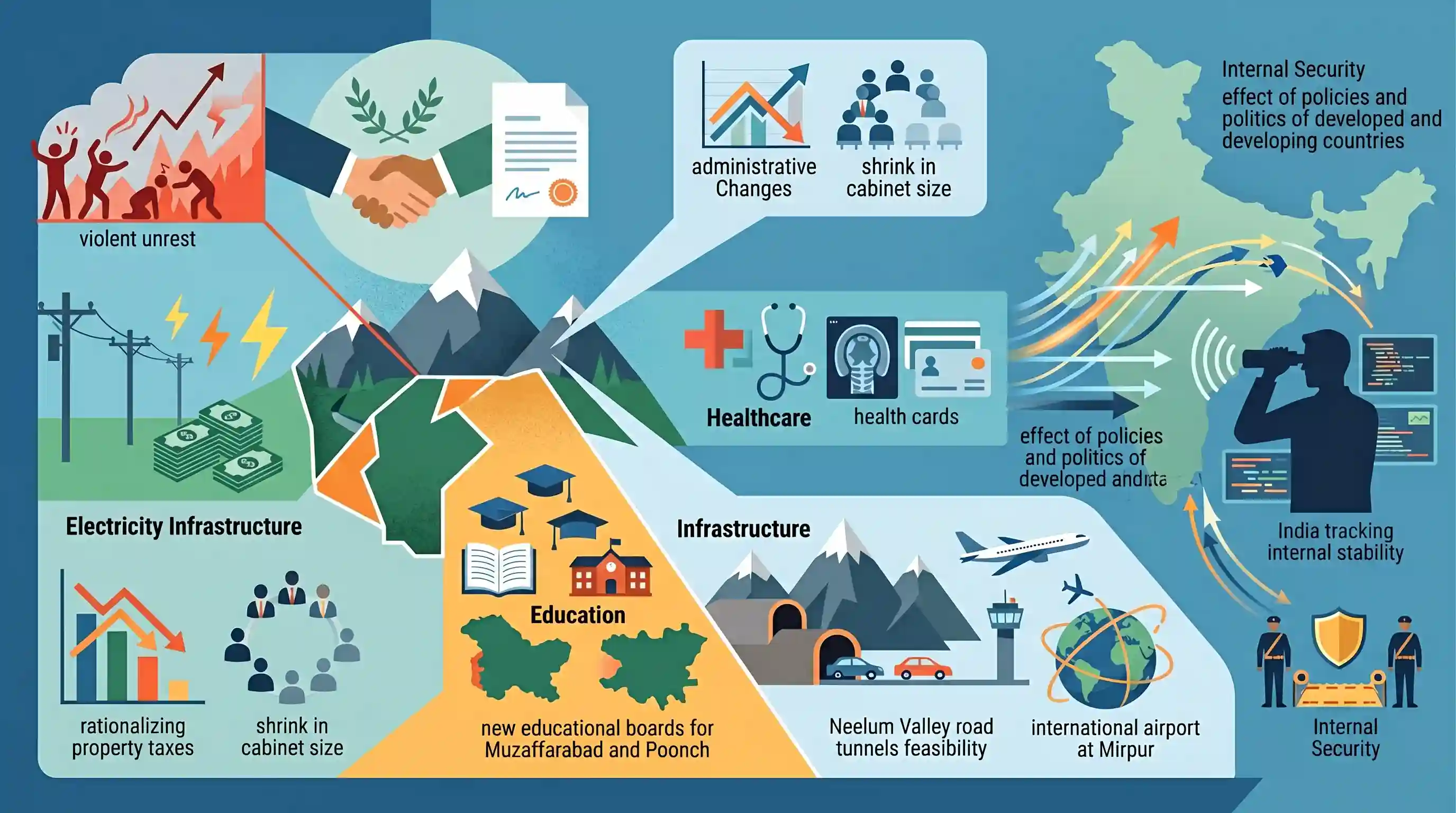
Following days of violent unrest in Pakistan-occupied Kashmir (PoK) that claimed 10 lives, the Pakistan government and the Jammu Kashmir Joint Awami Action Committee (JKJAAC) have reached a 25-point agreement to restore peace. The negotiated settlement includes significant financial and administrative concessions, such as PKR 10 billion for upgrading the region's electricity infrastructure, rationalizing property taxes, and shrinking the PoK Cabinet size to a maximum of 20 members. Additional development commitments feature the provision of healthcare infrastructure (health cards, MRI/CT scans), new educational boards for Muzaffarabad and Poonch, feasibility studies for Neelum Valley road tunnels, and plans for an international airport at Mirpur. The successful talks highlight the socio-economic grievances and governance challenges facing PoK, with direct relevance to India's tracking of internal stability in its immediate neighborhood.
Key Points
- The Pakistan government and the Jammu Kashmir Joint Awami Action Committee (JKJAAC) signed a 25-point agreement to end days of violent protests in Pakistan-occupied Kashmir (PoK) that resulted in 10 deaths.
- The federal government agreed to provide PKR 10 billion to improve the electricity system in PoK and align property transfer taxes with those in Punjab or Khyber Pakhtunkhwa.
- Governance reforms include reducing the PoK Cabinet size to a maximum of 20 ministers/advisors and merging administrative departments to downsize the government.
- Development initiatives promised encompass establishing new educational boards in Muzaffarabad and Poonch, rolling out health cards, providing MRI/CT scan machines, and assessing feasibility for two tunnels in the Neelum Valley.
- A high-powered legal and constitutional committee will deliberate on issues related to the PoK Assembly, while steps will be taken to build an international airport at Mirpur.
Important Terms
Jammu Kashmir Joint Awami Action Committee (JKJAAC)

A grassroots civil-society coalition in PoK comprising traders and professionals, advocating for economic rights, governance reforms, and subsidies on essential commodities like electricity and wheat.
UPSC context
GS Paper II (IR); tests understanding of local socio-political movements in disputed territories and their impact on regional stability.
Pakistan-occupied Kashmir (PoK)
The part of the erstwhile princely state of Jammu and Kashmir under Pakistani control since 1947; India maintains it is an integral part of its territory.
UPSC context
GS Paper II (IR/Bilateral Relations); central to territorial disputes, India-Pakistan relations, and sovereignty issues.
Neighborhood First Policy
India's diplomatic strategy prioritizing political and economic relations with immediate neighbors to ensure regional stability, connectivity, and security.
UPSC context
GS Paper II (Foreign Policy); essential for analyzing India's regional leadership and responses to neighbor-state instability.
Neelum Valley
A strategically vital valley in PoK running parallel to the Line of Control, significant for its hydroelectric resources and proximity to the Indian border.
UPSC context
GS Paper I (Geography) & III (Security); relevant for understanding border terrain, strategic infrastructure, and resource-based conflicts.
Mirpur-Muzaffarabad-Poonch
Three major administrative and geographic divisions in PoK; Muzaffarabad serves as the capital, while Mirpur and Poonch are critical hubs near the LoC.
UPSC context
GS Paper II/III; important for tracking regional internal security developments and potential cross-border spillover effects.
Prelims Trap
"The Neelum River is an independent Western river flowing directly into the Indus without joining the Jhelum."
Aspirants often forget that the Neelum River is just the Pakistani name for India's Kishanganga River, a major tributary of the Jhelum.
Static Concepts Connected
How does the Indus Water Treaty govern the Kishanganga/Neelum river?
- Western River System: Kishanganga is a major tributary of the Jhelum river, a Western river allocated primarily to Pakistan under the 1960 treaty.
- Run-of-the-River Rights: India retains the right to build run-of-the-river (RoR) hydroelectric projects on Western rivers, provided they don't violate specific storage and design restrictions.
- Naming Convention: The river is known as Kishanganga in India and Neelum in Pakistan, eventually joining the Jhelum near Muzaffarabad in PoK.
What is the geographic and administrative distinction between PoK and Gilgit-Baltistan?
- Administrative Split: Pakistan governs the occupied territory as two separate entities: so-called "Azad Jammu and Kashmir" (PoK) and Gilgit-Baltistan.
- Geographic Location: PoK is a narrow strip bordering Indian J&K, containing Muzaffarabad and Mirpur. Gilgit-Baltistan lies further north, sharing a border with China's Xinjiang.
- India's Position: India officially maps and claims both regions as integral parts of the Union Territories of Jammu & Kashmir and Ladakh.
Cross-Topic Patterns
CPEC + Hydropower Politics
PoK electricity shortages highlight local anger against Chinese-backed CPEC mega-dams (e.g., Karot and Kohala projects) where resources are extracted without adequate regional benefit.
Internal Security + 1994 Resolution
Deepening socio-economic instability in PoK gives India strategic leverage, reinforcing its 1994 Parliamentary Resolution demanding Pakistan vacate the illegally occupied territory.

Expect a Prelims map question matching tributaries (Kishanganga/Neelum) to the Jhelum, or a Mains question on PoK unrest's impact on CPEC.
Linked PYQs · 3
Linked PYQs · 3
- 2015MainsGS2
Terrorist activities and mutual distrust have clouded India-Pakistan relations. To what extent the use of soft power like sports and cultural exchanges could help generate goodwill between the two countries? Discuss with suitable examples.
- 2016MainsGS2
Increasing cross-border terrorist attacks in India and growing interference in the internal affairs of several member-states by Pakistan are not conducive for the future of SAARC (South Asian Association for Regional Cooperation)." Explain with suitable examples.
- 2025MainsGS2
"Energy security constitutes the dominant kingpin of India's foreign policy, and is linked with India's overarching influence in Middle Eastern countries.” How would you integrate energy security with India's foreign policy trajectories in the coming years?
