Pakistan holds dialogue with protest leaders in occupied Kashmir
Source:The Hindu ↗
Why It Matters
The political and economic unrest in Pakistan-occupied Kashmir (PoK) is critical for UPSC aspirants studying International Relations (GS2) and Internal Security (GS3). India maintains that PoK is an integral part of its sovereign territory; thus, internal strife, civil rights violations, and potential spillover effects directly influence India's neighborhood policy, border management strategies, and diplomatic positioning against Pakistan.
Summary
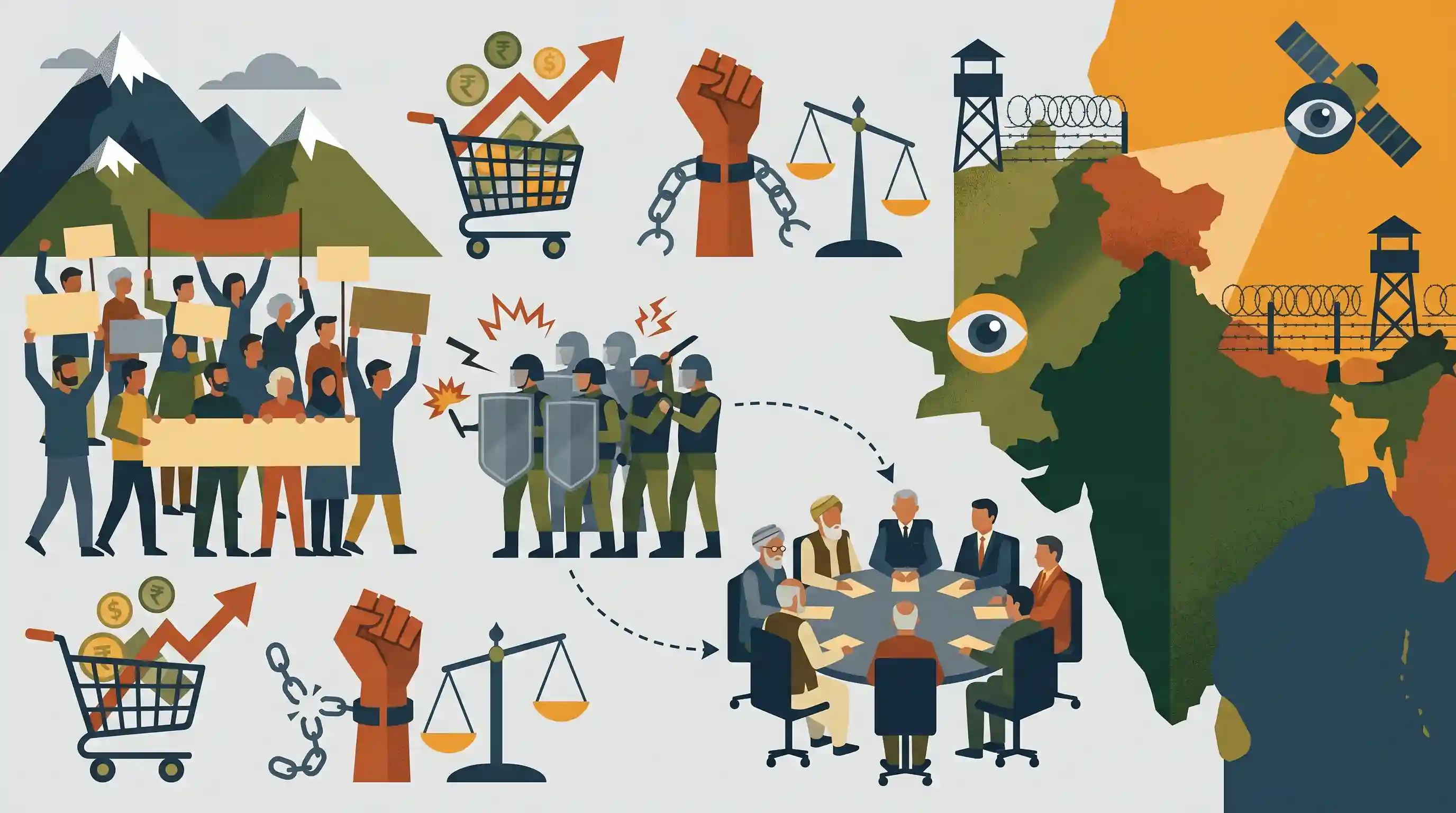
The Pakistan government has engaged in a second round of talks with leaders of the Joint Awami Action Committee (JAAC) in Pakistan-occupied Kashmir (PoK) following escalating and violent protests. The demonstrations have been driven by local grievances regarding the rising cost of living, political disenfranchisement, and perceived human rights abuses. Human rights organizations, including the HRCP, have condemned the state's use of force against civilians. The ongoing unrest sheds light on the fragile political and economic climate in PoK, bearing significance for regional stability and India's geopolitical interests.
Key Points
- The Pakistan government has initiated talks with the Joint Awami Action Committee (JAAC) to resolve violent protests in Pakistan-occupied Kashmir (PoK).
- The protests were triggered by widespread grievances concerning the high cost of living, political disenfranchisement, and civil rights issues.
- The Human Rights Commission of Pakistan (HRCP) has expressed alarm over the state's disproportionate use of force, which has resulted in several casualties.
- For India, this internal instability in PoK underscores the socio-political challenges in a region it considers its sovereign territory, impacting broader India-Pakistan neighborhood dynamics.
Important Terms
Joint Awami Action Committee (JAAC)

A grassroots civil-society coalition in PoK comprising traders, lawyers, and students. It leads protests demanding economic rights, specifically subsidized flour and electricity prices tied to local hydropower production.
UPSC context
GS Paper II (International Relations); tests understanding of non-state actors and internal political dynamics in India's neighborhood.
Human Rights Commission of Pakistan (HRCP)
An independent, non-profit human rights organization in Pakistan. It monitors civil liberties and conducted fact-finding missions into state violence during the 2024 PoK protests.
UPSC context
GS Paper II (Human Rights); relevant for analyzing regional stability and democratic accountability in neighboring countries.
Pakistan-occupied Kashmir (PoK)
The portion of the former princely state of Jammu and Kashmir under Pakistani control since 1947. India maintains it as an integral part of its sovereign territory.
UPSC context
GS Paper II (India and its Neighborhood); a core geopolitical issue concerning sovereignty, border security, and bilateral relations.
Pakistan Rangers
A federal paramilitary law enforcement force in Pakistan. They were deployed to Muzaffarabad in 2024 to quell JAAC-led protests, leading to fatal clashes with civilians.
UPSC context
GS Paper III (Internal Security); relates to border management and the role of paramilitary forces in regional unrest.
Shutter-down and Wheel-jam Strike
A form of civil disobedience prevalent in South Asia involving the complete closure of businesses (shutter-down) and the halting of all public and private transport (wheel-jam).
UPSC context
GS Paper II (Governance); tests knowledge of protest methodologies and their impact on administrative stability in the subcontinent.
Charter of Demands
The primary list of 10 (later expanded) requirements by JAAC, including electricity at production cost and the removal of elite privileges for PoK officials.
UPSC context
GS Paper II (International Relations); relevant for understanding the socio-economic drivers of political instability in the neighborhood.
Prelims Trap
India formally established its sovereign claim over PoK only after the abrogation of Article 370 in 2019.
India's sovereign claim has been consistent and is anchored in the unanimous 1994 Parliamentary Resolution, decades prior to the 2019 changes to Article 370.
Static Concepts Connected
What are the key elements of India's 1994 Parliamentary Resolution on J&K?
- Integral Part: Declares the entire State of J&K (including PoK) to be an integral and inseparable part of India.
- Demand to Vacate: Firmly demands that Pakistan must vacate the areas of the Indian State that remain under its illegal occupation.
- No Interference: Asserts that any attempt to interfere in India's internal affairs will be met with resolute action.
How does the Indus Water Treaty (IWT) connect to the resource disputes in PoK?
- Western Rivers: Pakistan has unrestricted use of the Indus, Jhelum, and Chenab rivers, which flow through PoK, while India retains run-of-the-river rights.
- Key Hydro Projects: Major projects like the Mangla Dam (Jhelum) and Neelum-Jhelum are in PoK, leading to local grievances over mass resource extraction.
- Resource Plunder: Despite generating significant power for Pakistan, PoK locals pay inflated tariffs, a core economic grievance driving the current JAAC protests.
Cross-Topic Patterns
PoK unrest & Indus Water Treaty
Protests over hydro-tariffs (Mangla, Neelum-Jhelum) highlight the weaponization of resource extraction on western rivers, linking local PoK unrest directly to broader Indus Water Treaty (IWT) geopolitics.
Gilgit-Baltistan vs AJK Status
While Pakistan attempts to grant Gilgit-Baltistan provincial status to secure CPEC investments, PoK (AJK) remains legally ambiguous, showcasing Islamabad's disparate administration of occupied territories.

PoK’s legal status, the 1994 Parliamentary Resolution, and IWT river allocations (Jhelum) could form a multi-statement Prelims question.
Linked PYQs · 3
Linked PYQs · 3
- 2024MainsGS3
India has a long and troubled border with China and Pakistan fraught with contentious issues. Examine the conflicting issues and security challenges along the border. Also give out the development being undertaken in these areas under the Border Area Development Programme (BADP) and Border Infrastructure and Management (BIM) Scheme.
- 2016MainsGS2
Increasing cross-border terrorist attacks in India and growing interference in the internal affairs of several member-states by Pakistan are not conducive for the future of SAARC (South Asian Association for Regional Cooperation)." Explain with suitable examples.
- 2025MainsGS2
Civil Society Organizations are often perceived as being anti-State actors than non-State actors. Do you agree? Justify.
