Pakistan Geopolitics Cross Border Terrorism Regional Security India
Source:Indian Express ↗
Why It Matters
Understanding the nexus between Pakistan's internal volatility, its relations with Afghanistan, and its foreign alliances is crucial for aspirants analyzing India's security and diplomatic challenges in combating cross-border terrorism.
Summary
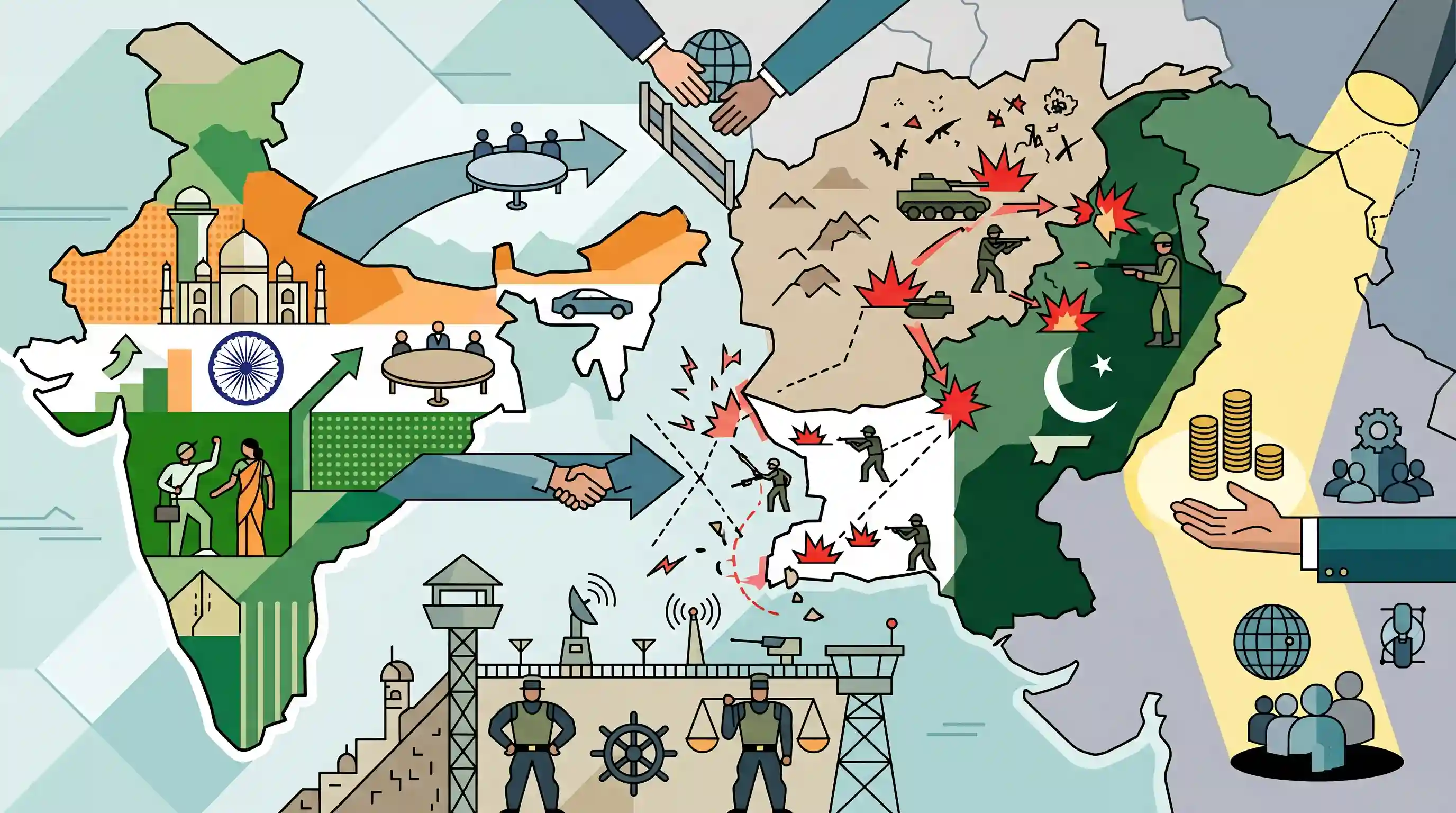
The article examines the strategic implications of Pakistan's current geopolitical posture for India. It highlights the dual dynamic of Pakistan’s internal security conflicts—marked by military strikes inside Afghanistan against militant groups like the TTP—and its sustained diplomatic support from 'friends abroad.' This rising global profile and external backing complicate New Delhi's strategy of diplomatically isolating Pakistan. Consequently, India faces ongoing challenges regarding cross-border terrorism and regional instability, necessitating a calibrated approach to border security and neighborhood diplomacy.
Key Points
- Pakistan is facing significant internal and cross-border security challenges, as evidenced by its military strikes inside Afghanistan targeting militant sanctuaries.
- Despite its domestic turmoil, Pakistan maintains a rising global profile supported by strategic foreign allies, complicating India's efforts to diplomatically isolate Islamabad.
- For New Delhi, Pakistan's external backing risks emboldening its stance on cross-border terrorism.
- The volatility on the Pakistan-Afghanistan border and Pakistan's continued use of asymmetric warfare present persistent security and diplomatic challenges for India.
Important Terms
Tehrik-i-Taliban Pakistan (TTP)

A militant Islamist organization formed in 2007, operating primarily along the Afghanistan-Pakistan border, seeking to overthrow the Pakistani state and impose a strict interpretation of Sharia law.
UPSC context
Relevant for GS Paper 3 (Internal Security) and GS Paper 2 (International Relations) regarding regional stability and non-state actors.
Taliban
A Sunni Islamist nationalist movement that returned to power in Afghanistan in 2021; they maintain a complex relationship with the TTP, providing sanctuaries while occasionally mediating talks.
UPSC context
Crucial for GS Paper 2 (International Relations) regarding India's neighborhood policy and the security implications of the regime change in Kabul.
Cross-border Terrorism
Terrorism where militants from one country enter another to commit violence; for India, it primarily refers to state-sponsored or facilitated groups operating from Pakistan.
UPSC context
Core topic in GS Paper 3 (Internal Security) and GS Paper 2 (India-Pakistan relations) concerning border management and national security.
Neighborhood First Policy
India's foreign policy priority to foster stable, cooperative, and mutually beneficial relations with its immediate neighbors, based on the principle of 'non-reciprocity' and regional prosperity.
UPSC context
Central theme in GS Paper 2 (International Relations) for questions on regional diplomacy and countering external influences in South Asia.
Diplomatic Isolation
India's strategic effort to marginalize Pakistan in the international community by highlighting its role in sponsoring terrorism, aiming to reduce its global legitimacy and financial support.
UPSC context
Significant for GS Paper 2 (International Relations) when discussing India's 'soft power' and 'hard power' strategies against state-sponsored terror.
Prelims Trap
"Pakistan remains on the FATF 'Grey List' due to its continued state sponsorship of cross-border terrorism."
Pakistan was removed from the FATF Grey List in October 2022. Aspirants often incorrectly assume it is still listed because of ongoing terror incidents.
Static Concepts Connected
What constitutes 'Asymmetric Warfare' in India's neighborhood context?
- Strategic disparity: Conflict between belligerents whose relative military power differs significantly, relying on unconventional tactics to bridge the gap.
- Proxy usage: The deliberate employment of non-state actors (terror groups) by a state to achieve strategic goals without triggering conventional war.
- Plausible deniability: The sponsor state maintains formal distance from the militant proxies to avoid international sanctions, full-scale retaliation, or direct attribution.
Why is the Durand Line a source of persistent regional conflict?
- Colonial legacy: Drawn in 1893 by the British, the line artificially divides ethnic Pashtun and Baloch populations across Pakistan and Afghanistan.
- Non-recognition: Successive Afghan governments, including the current Taliban regime, historically reject it as a legitimate, finalized international border.
- Militant sanctuary: The porous and disputed nature of the border allows groups like the TTP to maintain safe havens, escalating Af-Pak hostilities.
Cross-Topic Patterns
Gulf States balancing India and Pakistan
India's deepening strategic and economic ties with Saudi Arabia and UAE run parallel to these nations acting as crucial financial lifelines for Pakistan, strictly limiting New Delhi's "total isolation" strategy.
China's CPEC as a geopolitical shield
Beijing's sovereign debt rollovers for Islamabad transcend economic interests; they actively preserve Pakistan as a viable "two-front" strategic threat against India while shielding the CPEC corridor.

Expect a 2026 Mains question analyzing the limits of India's diplomatic isolation strategy given Pakistan's economic bailouts (China/Gulf).
Linked PYQs · 4
Linked PYQs · 4
- 2015MainsGS2
Terrorist activities and mutual distrust have clouded India-Pakistan relations. To what extent the use of soft power like sports and cultural exchanges could help generate goodwill between the two countries? Discuss with suitable examples.
- 2016MainsGS2
Increasing cross-border terrorist attacks in India and growing interference in the internal affairs of several member-states by Pakistan are not conducive for the future of SAARC (South Asian Association for Regional Cooperation)." Explain with suitable examples.
- 2020MainsGS3
Analyze internal security threats and transborder crimes along Myanmar, Bangladesh and Pakistan borders including Line of Control (LoC). Also discuss the role played by various security forces in this regard.
- 2024MainsGS3
India has a long and troubled border with China and Pakistan fraught with contentious issues. Examine the conflicting issues and security challenges along the border. Also give out the development being undertaken in these areas under the Border Area Development Programme (BADP) and Border Infrastructure and Management (BIM) Scheme.
