Pakistan and Iran Talks: West Asia Diplomatic Mediation
Source:The Hindu ↗
Why It Matters
The ongoing US-Iran friction and associated threats to the Strait of Hormuz have direct implications for global energy supply chains. For India, maintaining stability in West Asia is crucial for both energy security and its broader strategic footprint in the region.
Summary
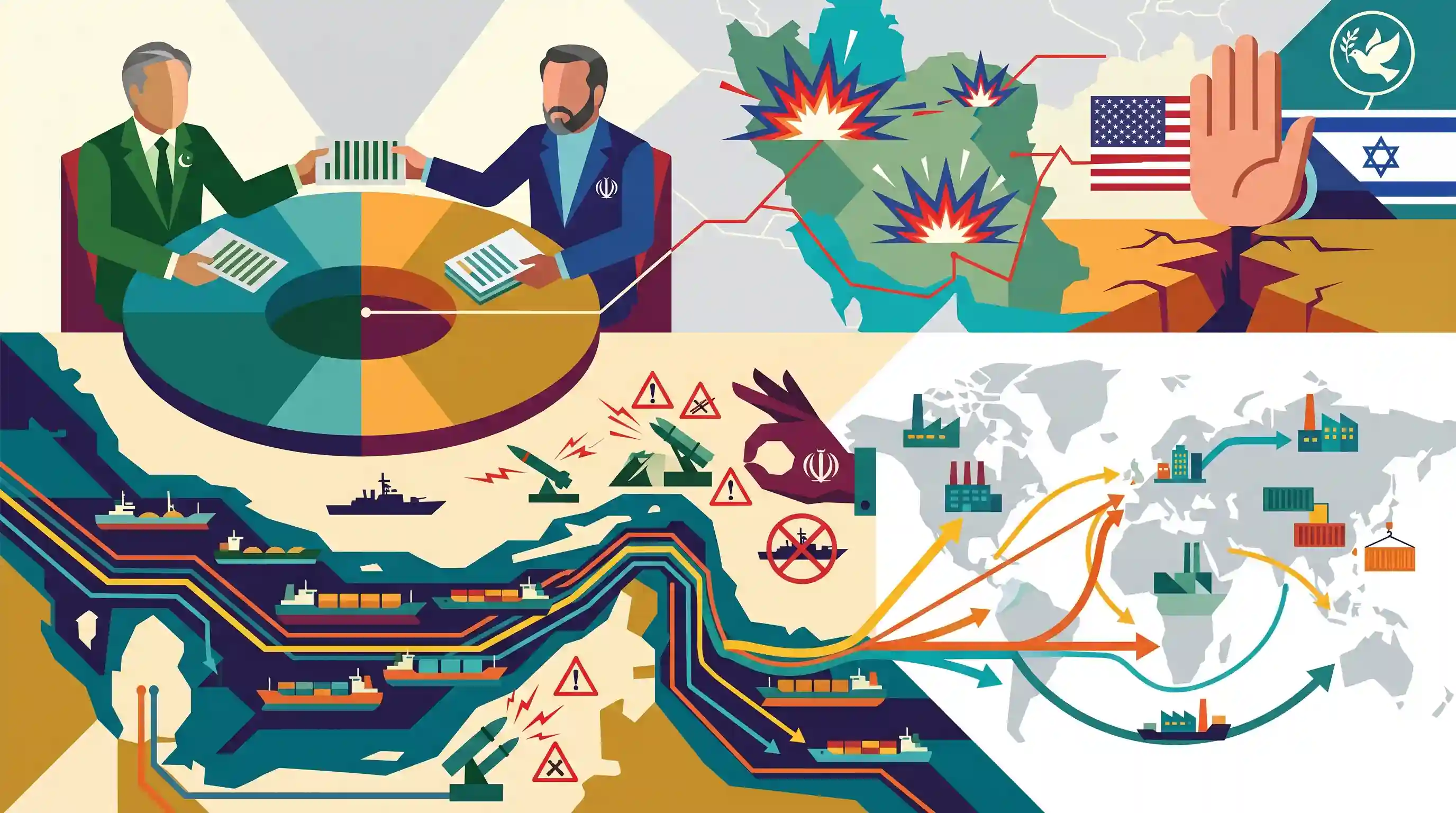
Pakistan's Foreign Minister Ishaq Dar recently met his Iranian counterpart Abbas Araghchi in Islamabad to deliberate on diplomatic channels to attain peace in West Asia. The talks reflect Pakistan's active mediation role between the US and Iran over a burgeoning regional conflict triggered by joint US-Israeli strikes on Iran. As part of this mediation, Pakistan has relayed a 14-point counter-proposal from Iran addressing an initial nine-point US proposal. Although US President Donald Trump announced an indefinite ceasefire, the region remains tense with Iranian military warnings about striking US forces should they enter the Strait of Hormuz—a critical maritime chokepoint for global energy trade.
Key Points
- Pakistan is playing a key diplomatic role in mediating peace talks between the United States and Iran amid heightening tensions in West Asia.
- The regional crisis escalated following joint military strikes on Iran conducted by the U.S. and Israel.
- In response to a nine-point proposal from the United States, Iran has transmitted a 14-point counter-proposal via Pakistan.
- Although an indefinite ceasefire has been announced by the US, Iran has threatened to target US forces entering the Strait of Hormuz, a critical global energy chokepoint.
Important Terms
Strait of Hormuz

A narrow, strategically vital waterway connecting the Persian Gulf with the Gulf of Oman and the Arabian Sea. It facilitates the transit of approximately 20% of global oil supplies.
UPSC context
GS Paper II (IR) & GS Paper I (Geography). Vital for India’s energy security, as 40% of its crude imports pass through it.
US nine-point proposal
A 2026 diplomatic framework from Washington seeking a two-month ceasefire and regional de-escalation with Iran following a period of military conflict involving U.S. and Israeli forces.
UPSC context
GS Paper II (International Relations). Relates to major power diplomacy and its impact on regional stability in West Asia.
Iranian 14-point proposal
Tehran's 2026 counter-offer demanding a permanent end to hostilities, lifting of maritime blockades, and unfreezing of assets within 30 days, while initially excluding the nuclear issue from negotiations.
UPSC context
GS Paper II (IR). Tests understanding of West Asian geopolitics, diplomatic negotiation tactics, and regional conflict resolution.
Maritime Chokepoint
Narrow geographical passages on high-volume sea routes that constrain shipping traffic. Their control grants significant strategic leverage over global trade and energy security.
UPSC context
GS Paper I (Geography) & GS Paper III (Security). Key to understanding global trade vulnerabilities and maritime security doctrines.
Diplomatic Mediation
The process where a third party (like Pakistan in 2026) facilitates communication between disputing nations to reach a settlement, often used when direct trust is nonexistent.
UPSC context
GS Paper II (IR). Focuses on the role of middle powers and neighboring states in maintaining international peace and security.
Prelims Trap
"The Strait of Hormuz lies between Iran and Saudi Arabia."
Aspirants often assume Saudi Arabia borders the strait due to its oil prominence. It is bordered by Iran to the north and Oman/UAE to the south.
Static Concepts Connected
What are the critical maritime chokepoints of West Asia?
- Strait of Hormuz: Connects the Persian Gulf to the Gulf of Oman and the Arabian Sea. Transits ~20% of global oil trade.
- Bab-el-Mandeb: Connects the Red Sea to the Gulf of Aden and the Arabian Sea. Crucial gateway for Suez Canal maritime traffic.
- Suez Canal: An artificial sea-level waterway in Egypt, connecting the Mediterranean Sea to the Red Sea.
What is India's 'De-hyphenation' policy in West Asia?
- Independent Ties: Maintaining parallel, independent bilateral relations with two historically hostile nations (e.g., Israel and Iran, or Israel and Palestine).
- Strategic Autonomy: Engaging Israel for advanced defense/tech cooperation while simultaneously investing in Iran for energy security and Chabahar port connectivity.
Cross-Topic Patterns
West Asia conflicts + The Fertilizer Trap
Disruptions in the Strait of Hormuz threaten not just crude oil, but over 60% of India's nitrogenous fertilizer supply, directly linking Middle East geopolitics to India's agricultural security.
Chokepoint Geopolitics + Strategic Connectivity
Escalating US-Iran tensions and potential US/Israeli strikes risk delaying India's Chabahar Port operations and the broader International North-South Transport Corridor (INSTC).

Expect a 2026 Prelims map question pairing West Asian chokepoints (Hormuz, Bab-el-Mandeb) with bordering nations or adjacent seas.
Linked PYQs · 1
Linked PYQs · 1
- 2025MainsGS2
"Energy security constitutes the dominant kingpin of India's foreign policy, and is linked with India's overarching influence in Middle Eastern countries.” How would you integrate energy security with India's foreign policy trajectories in the coming years?
