Climate Induced Extreme Monsoons and Flash Flood Vulnerability
Source:Indian Express ↗
Why It Matters
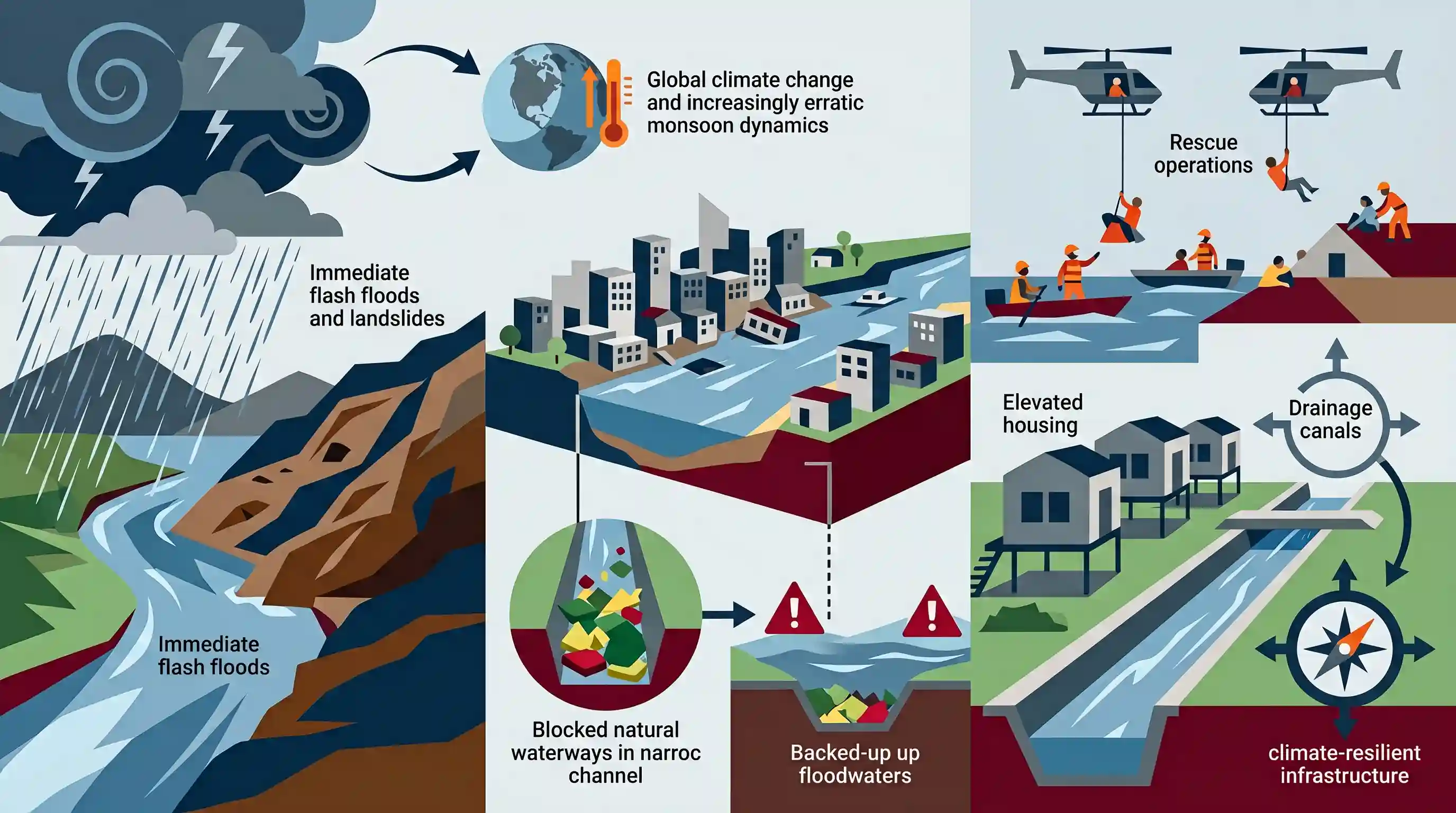
This disaster acts as a vital case study for India on the cascading impacts of climate-induced extreme weather. It demonstrates how erratic monsoon behavior, combined with inadequate infrastructure and poor land-use planning, can lead to devastating flash floods and landslides, emphasizing the critical role of robust disaster management and preparedness.
Summary
The article details a catastrophic flooding event in Pakistan where extreme monsoon rains claimed over 300 lives in just 48 hours. Driven by climate change, these erratic monsoon patterns led to severe flash floods and landslides, particularly in vulnerable provinces like Khyber Pakhtunkhwa. The crisis was severely compounded by human-induced vulnerabilities, such as poor urban planning, the construction of settlements along riverbanks, and the blockage of natural waterways with garbage. This tragedy serves as a critical warning for the broader South Asian region, illustrating the urgent necessity for comprehensive disaster management, climate-resilient infrastructure, and effective mitigation strategies against increasingly unpredictable extreme weather events.
Key Points
- Extreme monsoon rains in Pakistan caused over 300 deaths within 48 hours, highlighting the growing frequency and severity of extreme weather events in South Asia.
- The disaster was characterized by devastating flash floods, raging floodwaters, and massive landslides, severely impacting provinces like Khyber Pakhtunkhwa.
- Human-induced factors significantly worsened the impact, including poor infrastructural planning, construction of homes along vulnerable riverbanks, and waterways choked by garbage and debris.
- The catastrophic event underscores the urgent need for enhanced disaster preparedness, hazard zonation mapping, and climate-resilient urban planning across the subcontinent.
Important Terms
National Disaster Management Authority (NDMA)

The apex statutory body responsible for formulating disaster management policies, approving national plans, and coordinating responses to natural or man-made disasters.
UPSC context
GS Paper 3: Disaster Management. Tests institutional frameworks, the DM Act 2005, and transition from reactive to proactive strategies.
Urban Flooding
The inundation of property or land in a built-up environment caused by rainfall overwhelming the capacity of drainage systems.
UPSC context
GS Paper 1 & 3. Tests geography and disaster management regarding unplanned urbanization and infrastructure failures.
Flash Floods
Sudden, rapid flooding typically occurring within six hours of intense rainfall, characterized by high-velocity water and very little warning.
UPSC context
GS Paper 3: Disaster Management. Focuses on localized extreme weather events and mitigation in vulnerable terrains like the Himalayas.
Climate-Resilient Infrastructure
Infrastructure systems designed to withstand, adapt to, and recover quickly from climate-related shocks and stresses like floods or storms.
UPSC context
GS Paper 3: Environment/Infrastructure. Relevant to global initiatives like the Coalition for Disaster Resilient Infrastructure (CDRI).
Extreme Weather Events
Weather phenomena that are rare at a particular place and time, significantly deviating from historical averages in intensity, timing, or duration.
UPSC context
GS Paper 3: Environment. Tests understanding of climate change impacts, IPCC reports, and socioeconomic vulnerabilities.
Monsoon Dynamics
The seasonal reversal of wind patterns driven by differential heating of land and sea, primarily determining precipitation across South Asia.
UPSC context
GS Paper 1: Physical Geography. Core to understanding Indian agriculture, water security, and atmospheric circulation.
Prelims Trap
"Climate change has increased the overall number of monsoon rainy days in the South Asian subcontinent."
Total rainy days are actually decreasing across South Asia. The hazard stems from a rise in short-duration, high-intensity extreme rainfall events, not an overall increase in wet days.
Static Concepts Connected
What defines a cloudburst under Indian meteorological standards?
- Rainfall criteria: Greater than 100mm of rainfall within one hour over a localized geographical area of approximately 20-30 sq. km.
- Mechanism: Strong upward air drafts prevent rain from falling, causing a sudden, massive water discharge once the drafts weaken.
What distinguishes structural from non-structural flood mitigation measures?
- Structural measures: Physical constructions like dams, embankments, and levees designed to control and alter the flow of floodwaters.
- Non-structural measures: Governance tools like floodplain zoning, hazard zonation mapping, and early warning systems that manage human settlement risks without altering river flow.
Cross-Topic Patterns
Urban Flooding & Solid Waste
Poor solid waste disposal chokes storm drains, directly linking municipal governance and the Solid Waste Management Rules to pluvial flooding vulnerabilities in South Asian cities.
Arabian Sea Warming & Monsoon
A rapidly warming Arabian Sea increases atmospheric moisture capacity, driving localized extreme precipitation bursts over the subcontinent instead of steady, evenly distributed seasonal rain.

Expect a 2026 Mains question linking the increased frequency of South Asian urban floods directly to wetland encroachment and waste management.
Linked PYQs · 4
Linked PYQs · 4
- 2022MainsGS3
Explain the mechanism and occurrence of cloudburst in the context of the Indian subcontinent. Discuss two recent examples.
- 2024MainsGS3
Flooding in urban areas is an emerging climate-induced disaster. Discuss the causes of this disaster. Mention the features of two such major floods in the last two decades in India. Describe the policies and frameworks in India that aim at tackling such floods.
- 2015MainsGS1
How far do you agree that the behaviour of the Indian monsoon has been changing due to humanizing landscapes? Discuss.
- 2019MainsGS3
Disaster preparedness is the first step in any disaster management process. Explain how hazard zonation mapping will help disaster mitigation in the case of landslides.
