Pakistan economic crisis and IMF bailout impact on military conflict
Source:Indian Express ↗
Why It Matters
Understanding the link between a neighbor's economic stability (or instability) and its foreign/military policy is crucial for GS2 International Relations. It highlights how domestic economic constraints, such as balance of payments crises and IMF conditionalities, can inadvertently serve as geopolitical deterrents, shaping India's security environment.
Summary
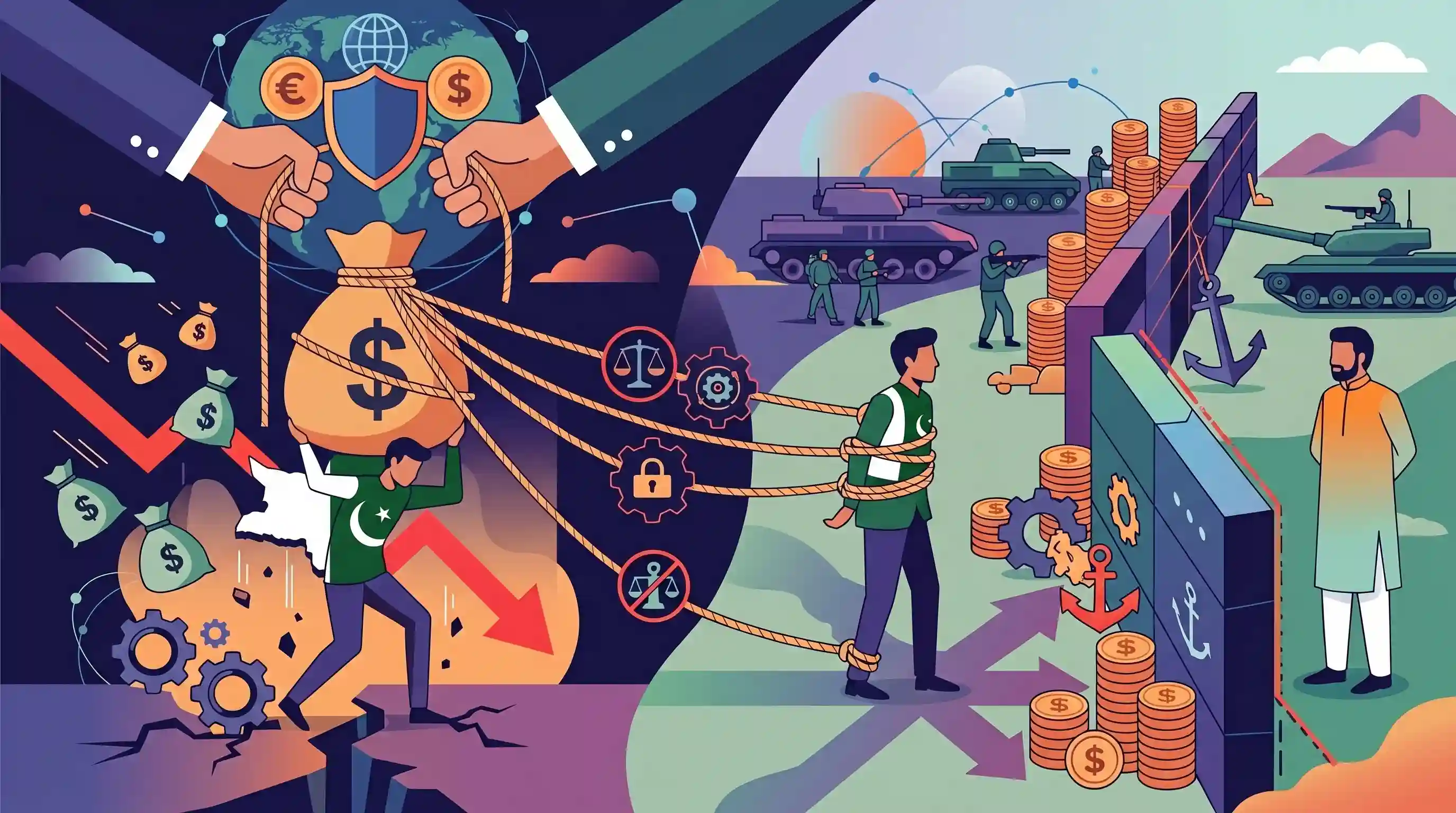
Pakistan's deep-rooted economic crisis and its reliance on International Monetary Fund (IMF) bailouts have severely limited its geopolitical maneuvering capabilities. Because the country faces high debt, low foreign exchange reserves, and stringent IMF conditionalities, it cannot afford the financial burden of a protracted military conflict with India. This intersection of macroeconomic vulnerability and regional security demonstrates how acute domestic economic distress can act as a deterrent to cross-border military escalation, impacting the broader strategic dynamic between India and Pakistan.
Key Points
- Pakistan's economy remains severely overstretched and fundamentally reliant on IMF bailouts to avoid defaulting on its sovereign obligations.
- The precarious macroeconomic situation, characterized by foreign exchange constraints and debt vulnerabilities, acts as a structural deterrent to significant military escalation.
- Pakistan cannot afford to fund a protracted military conflict with India given its current financial distress and the strict fiscal conditionalities imposed by the IMF.
- Economic crises in neighboring states hold significant geopolitical implications for India, shifting the balance of regional security dynamics.
Important Terms
International Monetary Fund (IMF)

A 190-member global organization that fosters international monetary cooperation, secures financial stability, and provides loans to countries experiencing balance of payments difficulties.
UPSC context
GS-II/III: Important International Institutions; tests understanding of global financial governance and stabilizing distressed economies.
Extended Fund Facility (EFF)
An IMF lending program providing medium-term assistance to countries with deep-rooted structural economic problems causing persistent balance of payments deficits.
UPSC context
GS-III: External Sector; tests knowledge of specific international lending instruments for structural economic stabilization.
Balance of Payments (BoP) Crisis
An economic crisis where a nation cannot pay for essential imports or service external debt, marked by dwindling foreign exchange reserves and currency devaluation.
UPSC context
GS-III: External Sector; core concept for understanding macroeconomic stability and India's 1991 reforms.
Sovereign Debt
The total financial obligations incurred by a national government. High sovereign debt can lead to a 'debt trap' where borrowing is required just to pay interest.
UPSC context
GS-III: Fiscal Policy; tests the link between debt sustainability and the ability to fund defense or development.
Conditionalities
The structural and fiscal policy requirements set by the IMF as prerequisites for a country to receive and maintain loan disbursements.
UPSC context
GS-II/III: International Relations; tests the trade-off between international support and domestic policy autonomy.
Foreign Exchange (Forex) Reserves
Foreign currency assets, gold, and SDRs held by a central bank to facilitate trade, service debt, and defend the national currency's value.
UPSC context
GS-III: External Sector; critical for assessing a country’s 'import cover' and resilience to shocks.
Prelims Trap
The IMF's Extended Fund Facility (EFF) provides unconditional financial assistance for short-term balance of payment crises.
The EFF is designed for medium-term structural balance of payments issues and mandates strict fiscal conditionalities, unlike short-term or rapid financing instruments.
Static Concepts Connected
What are the primary IMF lending facilities used for Balance of Payments (BoP) crises?
- Stand-By Arrangement (SBA): Provides short-term financial assistance to countries facing immediate Balance of Payments problems, usually disbursed over 12-24 months.
- Extended Fund Facility (EFF): Provides medium-term support for countries facing protracted BoP issues due to structural economic weaknesses, like Pakistan, tied to deep structural reforms.
- Rapid Financing Instrument (RFI): Offers rapid financial assistance for urgent BoP needs (like natural disasters) without the standard conditionalities of SBA or EFF.
What do IMF conditionalities (structural adjustment programs) typically mandate?
- Fiscal Consolidation: Mandating reductions in fiscal deficits, usually achieved by slashing government subsidies (e.g., fuel/electricity) and increasing tax revenues.
- Monetary Tightening: Raising policy interest rates to curb rampant inflation and stabilize the depreciating domestic currency.
- Market Liberalization: Removing strict price controls, privatizing inefficient state-owned enterprises, and reducing import tariffs to promote free trade.
Cross-Topic Patterns
Sovereign Debt vs. Strategic Autonomy
Pakistan's IMF reliance restricts its military posture, mirroring how Sri Lanka's debt crisis forced foreign policy recalibrations. High sovereign debt structurally limits strategic autonomy across India's neighborhood.
Macroeconomics as National Security deterrence
Modern conventional warfare requires immense forex reserves and fiscal headroom. Pakistan's case proves that macroeconomic stability is the fundamental bedrock of national security and external defense capabilities.

Expect a Prelims question comparing IMF's EFF vs SBA facilities, or a Mains Q on how neighborhood economic crises shape India's security.
Linked PYQs · 4
Linked PYQs · 4
- 2015MainsGS2
Terrorist activities and mutual distrust have clouded India-Pakistan relations. To what extent the use of soft power like sports and cultural exchanges could help generate goodwill between the two countries? Discuss with suitable examples.
- 2022MainsGS2
India is an age-old friend of Sri Lanka.’ Discuss India's role in the recent crisis in Sri Lanka in the light of the preceding statement.
- 2016PrelimsGS1
'Global Financial Stability Report' is prepared by the
- 2013PrelimsGS1
The balance of payments of a country is a systematic record of
