Pakistan geopolitical balancing act between China and US
Source:Indian Express ↗
Why It Matters
Understanding Pakistan's geopolitical maneuvering is crucial for UPSC aspirants, as it directly impacts India's national security, foreign policy calculations, and the broader strategic balance in the Indo-Pacific and South Asian regions.
Summary
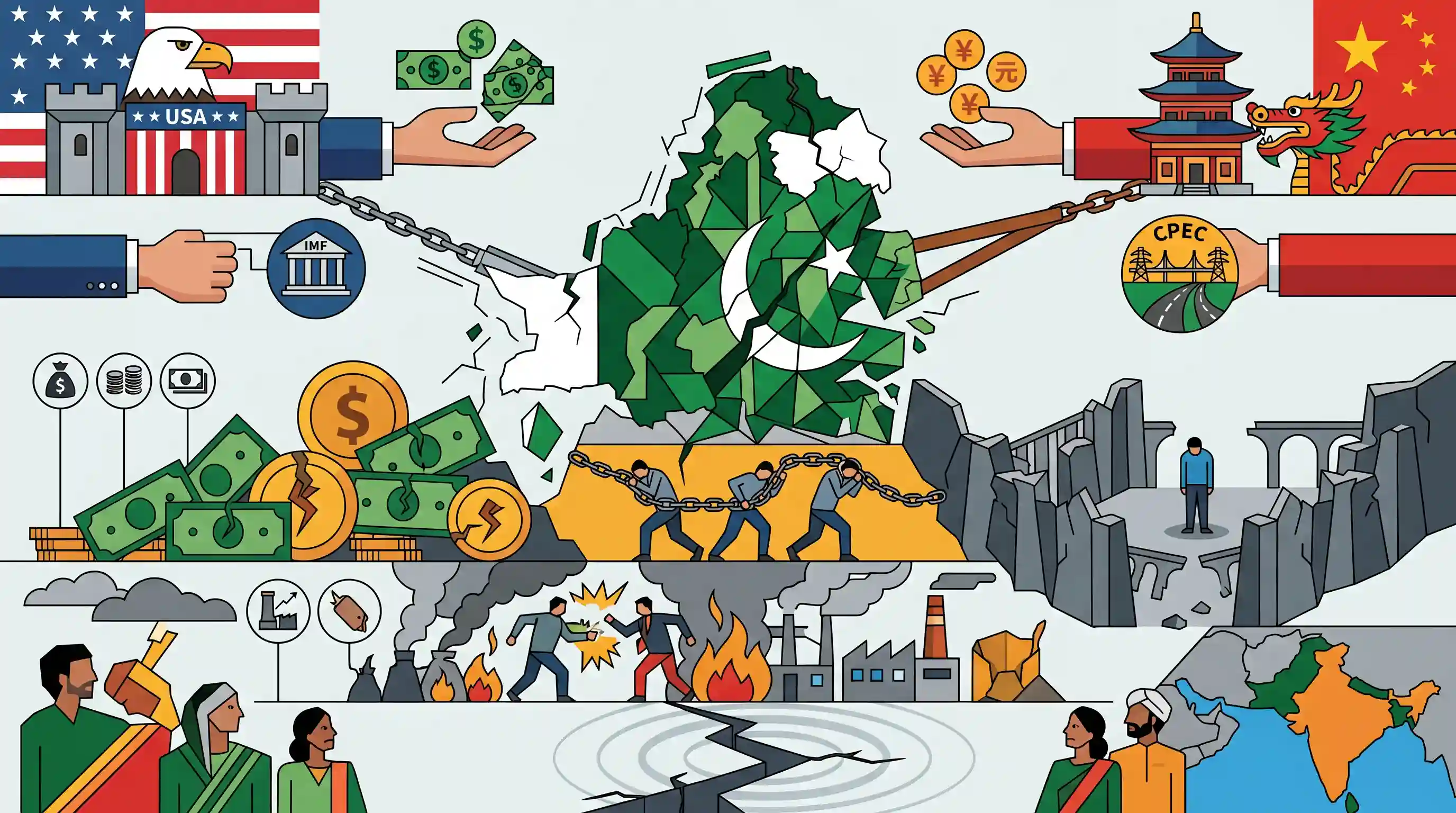
The article critically examines Pakistan's fraught foreign policy strategy of playing the United States and China against each other to extract economic and military concessions. By simultaneously embracing China's Belt and Road Initiative via CPEC and seeking US-backed IMF bailouts, Pakistan is caught in a geopolitical tug-of-war. The author argues that this 'double game' has become a ticket to disaster, eroding trust in Washington and Beijing alike amidst their intensifying global rivalry. Consequently, Pakistan faces mounting debt, international isolation, and exacerbation of its internal economic and security crises, posing significant implications for regional stability in South Asia.
Key Points
- Pakistan is attempting a precarious balancing act between the United States and China to secure economic and strategic assistance from both rival powers.
- While deepening ties with China through the China-Pakistan Economic Corridor (CPEC) for infrastructure, Pakistan risks falling into a severe debt trap and compromising its strategic autonomy.
- Concurrently, Islamabad seeks to maintain relations with the US to secure vital economic lifelines, including IMF bailouts and military aid, often leveraging its geographical position regarding Afghanistan.
- The article argues this 'double game' is unsustainable and leading to disaster, as growing US-China polarization makes both superpowers increasingly distrustful of Pakistan's shifting loyalties.
- Pakistan's resulting diplomatic isolation is compounded by its severe domestic economic crisis, political instability, and the ongoing blowback from its legacy of state-sponsored terrorism.
Important Terms
China-Pakistan Economic Corridor (CPEC)

A 3,000-km connectivity project linking Gwadar Port in Pakistan to Xinjiang, China. As a flagship BRI component, it involves multi-billion dollar investments in energy, transport, and industrial infrastructure.
UPSC context
GS Paper 2: Impact on India's sovereignty (PoK) and territorial integrity; critical for regional security and the "Neighborhood First" policy.
Belt and Road Initiative (BRI)
A global infrastructure development strategy launched by China in 2013 to enhance connectivity between Asia, Africa, and Europe via the "Silk Road Economic Belt" and "21st Century Maritime Silk Road."
UPSC context
GS Paper 2: Tests India's strategic response to Chinese expansionism and multilateral infrastructure diplomacy in the Indian Ocean Region.
International Monetary Fund (IMF)
A major international financial agency that provides "lender of last resort" assistance to countries facing severe balance-of-payments crises, typically requiring structural economic reforms and austerity measures.
UPSC context
GS Paper 2/3: Global economic governance and its role in stabilizing or destabilizing India's neighborhood through stringent financial conditionalities.
Debt-trap Diplomacy
A predatory lending practice where a creditor nation provides excessive credit to a debtor country with the intent of extracting economic or political concessions when the debtor defaults.
UPSC context
GS Paper 2: Key concept for analyzing China's bilateral relations in South Asia and its impact on India's regional leadership.
Strategic Rent-seeking
A foreign policy strategy where a country leverages its geostrategic location or military utility to extract economic and military aid from competing global powers, often without long-term commitment.
UPSC context
GS Paper 2: Evaluates the transactional nature of Pakistan's foreign policy and its effects on regional power dynamics and Indian interests.
Balance of Payments (BoP) Crisis
An economic crisis occurring when a country's total payments to the rest of the world exceed its receipts, leading to a depletion of foreign exchange reserves and inability to pay for imports.
UPSC context
GS Paper 3: Core macroeconomic concept affecting regional stability and spillover effects on India's trade and economic environment.
Prelims Trap
"CPEC connects Xinjiang to Gwadar port entirely through internationally recognized Pakistani territory."
CPEC passes through Gilgit-Baltistan in Pakistan-occupied Kashmir (PoK). India officially opposes the BRI precisely because this violates Indian territorial sovereignty.
Static Concepts Connected
What are the main lending windows of the IMF?
- Stand-By Arrangement (SBA): Addresses short-term balance of payments problems.
- Extended Fund Facility (EFF): Targets medium-term structural economic issues and requires deep economic reforms; frequently utilized by Pakistan.
- Rapid Financing Instrument (RFI): Provides quick assistance for urgent balance of payments needs without full conditionality.
How does CPEC fit into China's broader strategic geography?
- Gwadar Port: Provides China direct access to the Arabian Sea, mitigating the 'Malacca Dilemma' by offering an alternative route for energy imports.
- Karakoram Highway: Upgraded under CPEC, it forms the vital land link between China's Xinjiang region and PoK.
- Sovereignty Violation: The corridor fundamentally violates India's territorial integrity by traversing Gilgit-Baltistan in PoK.
Cross-Topic Patterns
Sri Lanka and Pakistan's parallel debt traps
Both nations leveraged Chinese mega-infrastructure (Hambantota, Gwadar) leading to sovereign debt crises, reinforcing India's long-standing warnings about non-transparent BRI financing.
FATF grey-listing and economic stability
Pakistan's historical FATF grey-listing severely restricted foreign investment and worsened its reliance on IMF bailouts, proving that state-sponsored proxy terrorism has direct macro-economic consequences.

Expect a 2026 GS-2 question on how US-China polarization shrinks the strategic space for "rent-seeking" buffer states like Pakistan.
Linked PYQs · 5
Linked PYQs · 5
- 2021MainsGS2
“The USA is facing an existential threat in the form of a China, that is much more challenging than the erstwhile Soviet Union.” Explain.
- 2024MainsGS2
‘The West is fostering India as an alternative to reduce dependence on China's supply chain and as a strategic ally to counter China's political and economic dominance.’ Explain this statement with examples.
- 2019MainsGS2
‘What introduces friction into the ties between India and the United States is that Washington is still unable to find for India a position in its global strategy, which would satisfy India's national self-esteem and ambitions.’ Explain with suitable examples.
- 2020MainsGS3
Analyze internal security threats and transborder crimes along Myanmar, Bangladesh and Pakistan borders including Line of Control (LoC). Also discuss the role played by various security forces in this regard.
- 2016MainsGS2
Increasing cross-border terrorist attacks in India and growing interference in the internal affairs of several member-states by Pakistan are not conducive for the future of SAARC (South Asian Association for Regional Cooperation)." Explain with suitable examples.
