US Iran Conflict Escalation and Strait of Hormuz Energy Security
Source:The Hindu ↗
Why It Matters
The geopolitical stability of West Asia and the security of maritime chokepoints like the Strait of Hormuz are vital to India's national interests. Disruptions directly threaten India's energy security (oil and LNG imports), maritime trade corridors, and the safety of the massive Indian diaspora in the Gulf region. Understanding third-party mediation (like Pakistan and Qatar) and the multi-front escalation offers critical insight into regional security dynamics.
Summary
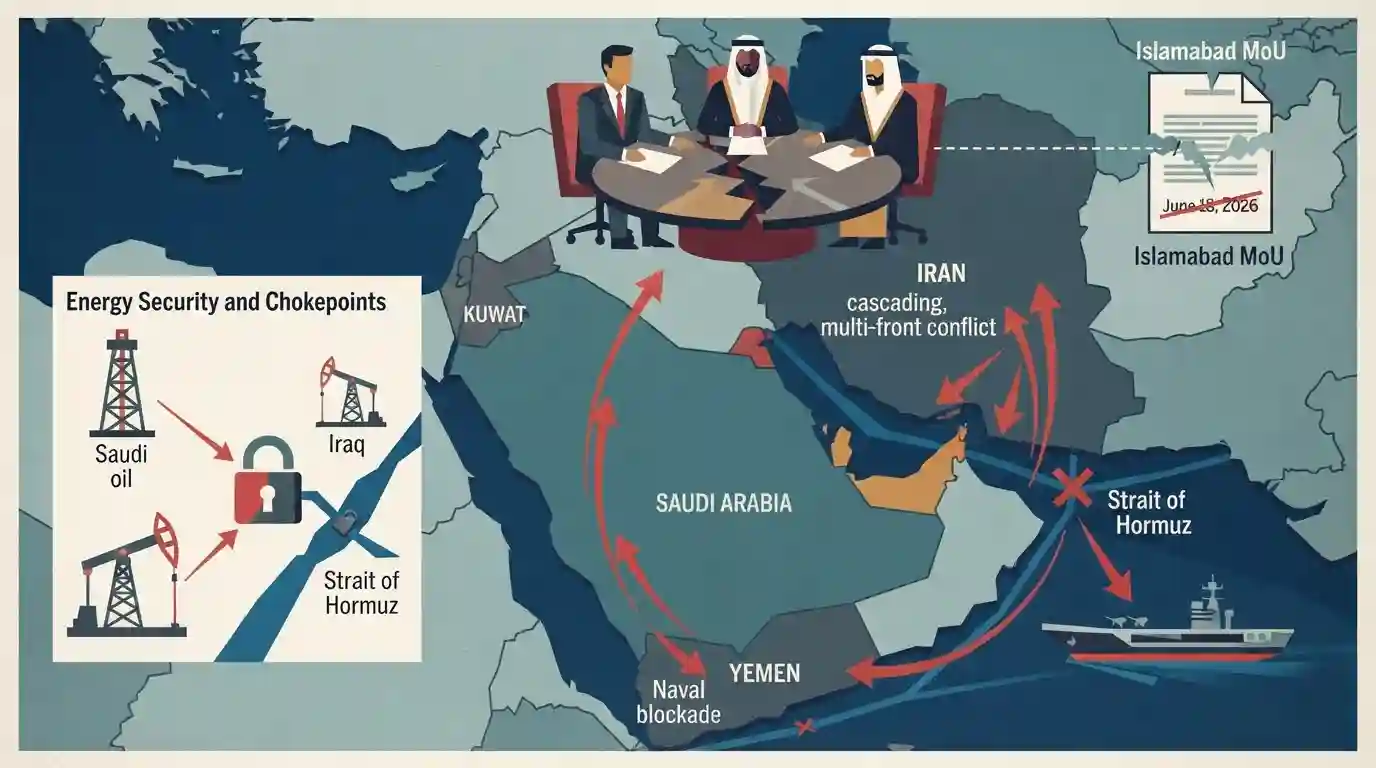
Pakistan, in coordination with Qatar, is attempting to mediate between the United States and Iran to salvage the Islamabad Memorandum of Understanding (MoU) signed on June 18, 2026. The diplomatic framework aimed to secure a ceasefire and reopen the strategic Strait of Hormuz but broke down after Iran attacked commercial shipping on July 7, accusing the U.S. of non-compliance. This has triggered a cascading, multi-front conflict in West Asia involving retaliatory U.S. strikes, a Houthi naval blockade on Saudi Arabia, and strikes reaching as far as Egypt, Jordan, Iraq, and Kuwait, threatening vital global shipping routes and energy infrastructure.
Key Points
- Pakistan is mediating between the U.S. and Iran to resume talks under the Islamabad Memorandum of Understanding (MoU) signed on June 18, 2026, and the Pakistan-Qatar joint statement of June 22, 2026.
- The Islamabad MoU, aimed at reopening the Strait of Hormuz and de-escalating West Asian conflicts, broke down on July 7, 2026, when Iran attacked commercial shipping (including a Qatari LNG tanker), alleging U.S. violations.
- The conflict has expanded across multiple fronts, including a Houthi naval blockade on Saudi Arabia, drone strikes on a U.S.-owned floating storage tanker, and explosions at a natural gas loading port in Egypt.
- Geopolitical escalation has involved joint U.S.-Saudi strikes on Iran-backed paramilitary groups in Iraq, direct U.S. strikes inside Iran retaliating for attacks in Jordan, and an Iranian attack hitting a Chinese-owned facility in Kuwait.
- The disruption of crucial maritime chokepoints like the Strait of Hormuz and the Red Sea/Bab-el-Mandeb poses severe risks to global energy security and maritime trade.
Important Terms
Islamabad Memorandum of Understanding (MoU)

A June 2026 diplomatic framework signed by the US and Iran, brokered by Pakistan, establishing an immediate ceasefire, reopening of the Strait of Hormuz, and a 60-day window for comprehensive peace and nuclear negotiations.
UPSC context
GS Paper II (International Relations): Bilateral agreements, diplomatic mediation, and conflict resolution mechanisms in the strategically vital West Asia region.
Pakistan-Qatar joint statement
A June 22, 2026 bilateral framework establishing an implementation roadmap for the Islamabad MoU, setting up high-level committees and de-confliction cells to secure commercial shipping and monitor the Lebanon ceasefire.
UPSC context
GS Paper II (International Relations): Geopolitics of West Asia, regional diplomatic partnerships, and conflict management frameworks affecting global energy security.
Houthi rebels
An Iranian-backed Zaidi Shia militant and political movement based in Yemen that controls northern Yemen and represents a major non-state actor influencing Red Sea security and the broader West Asian conflict.
UPSC context
GS Paper II & III (International Relations/Security): Role of non-state actors in maritime chokepoints, trade security, and global shipping corridor vulnerabilities.
Foreign Office of Pakistan
The government department administering Pakistan's foreign affairs, which served as a lead mediator alongside Qatar in negotiating the 2026 US-Iran ceasefire and the subsequent Islamabad MoU.
UPSC context
GS Paper II (International Relations): Neighborhood relations and the regional security impact of Pakistan's active diplomatic mediation in West Asian crises.
Prelims Trap
The United Arab Emirates directly borders the Strait of Hormuz, where navigation is governed under the UNCLOS regime of innocent passage.
Only Iran and Oman border the strait. Furthermore, international straits are governed by 'transit passage' (non-suspendable), unlike 'innocent passage' which coastal states can temporarily suspend.
Static Concepts Connected
How do 'Transit Passage' and 'Innocent Passage' differ under UNCLOS?
- Transit Passage: Applies to international straits; guarantees non-suspendable, continuous transit for ships and aircraft, including submerged submarines.
- Innocent Passage: Applies to territorial seas; allows passage that is not prejudicial to peace, but can be suspended by coastal states and requires submarines to surface.
What defines the strategic geography of the Strait of Hormuz and Bab-el-Mandeb?
- Strait of Hormuz: Connects the Persian Gulf to the Gulf of Oman; bordered solely by Iran and Oman's Musandam exclave; handles 20% of global petroleum.
- Bab-el-Mandeb: Connects the Red Sea to the Gulf of Aden; bordered by Yemen, Djibouti, and Eritrea; serves as the southern gateway to the Suez Canal.
Cross-Topic Patterns
Maritime chokepoints and Indian macroeconomic stability
Hormuz disruptions spike global oil prices, directly inflating India's current account deficit and driving imported inflation across domestic supply chains.
Strategic autonomy amid West Asian polarization
Active US-Iran hostilities test India's multi-alignment policy, balancing vital strategic assets like Iran's Chabahar port with Western-led security frameworks like I2U2.

West Asian maritime chokepoints and legal regimes like UNCLOS transit passage are highly likely to feature in 2026 map/concept questions.
Linked PYQs · 3
Linked PYQs · 3
- 2026PrelimsGS1
Ships from which of the following countries have to cross the Strait of Hormuz to reach out to the Indian Ocean ? 1. Bahrain 2. Syria 3. Qatar 4. Egypt Select the answer using the code given below :
- 2025MainsGS2
"Energy security constitutes the dominant kingpin of India's foreign policy, and is linked with India's overarching influence in Middle Eastern countries.” How would you integrate energy security with India's foreign policy trajectories in the coming years?
- 2023MainsGS2
‘Sea is an important Component of the Cosmos’ Discuss in the light of the above statement the role of the IMO (International Maritime Organisation) in protecting environment and enhancing maritime safety and security.
