India Pakistan Military Deterrence and Cross Border Terrorism
Source:The Hindu ↗
Why It Matters
The article underscores India's evolving proactive security doctrine (like Operation Sindoor) in neutralizing cross-border terrorism. It is highly relevant for GS-2 (India and its neighborhood) and GS-3 (Security challenges in border areas), illustrating the dynamic nature of military deterrence, border disputes (Sir Creek), and geopolitical realities in the Indian subcontinent.
Summary
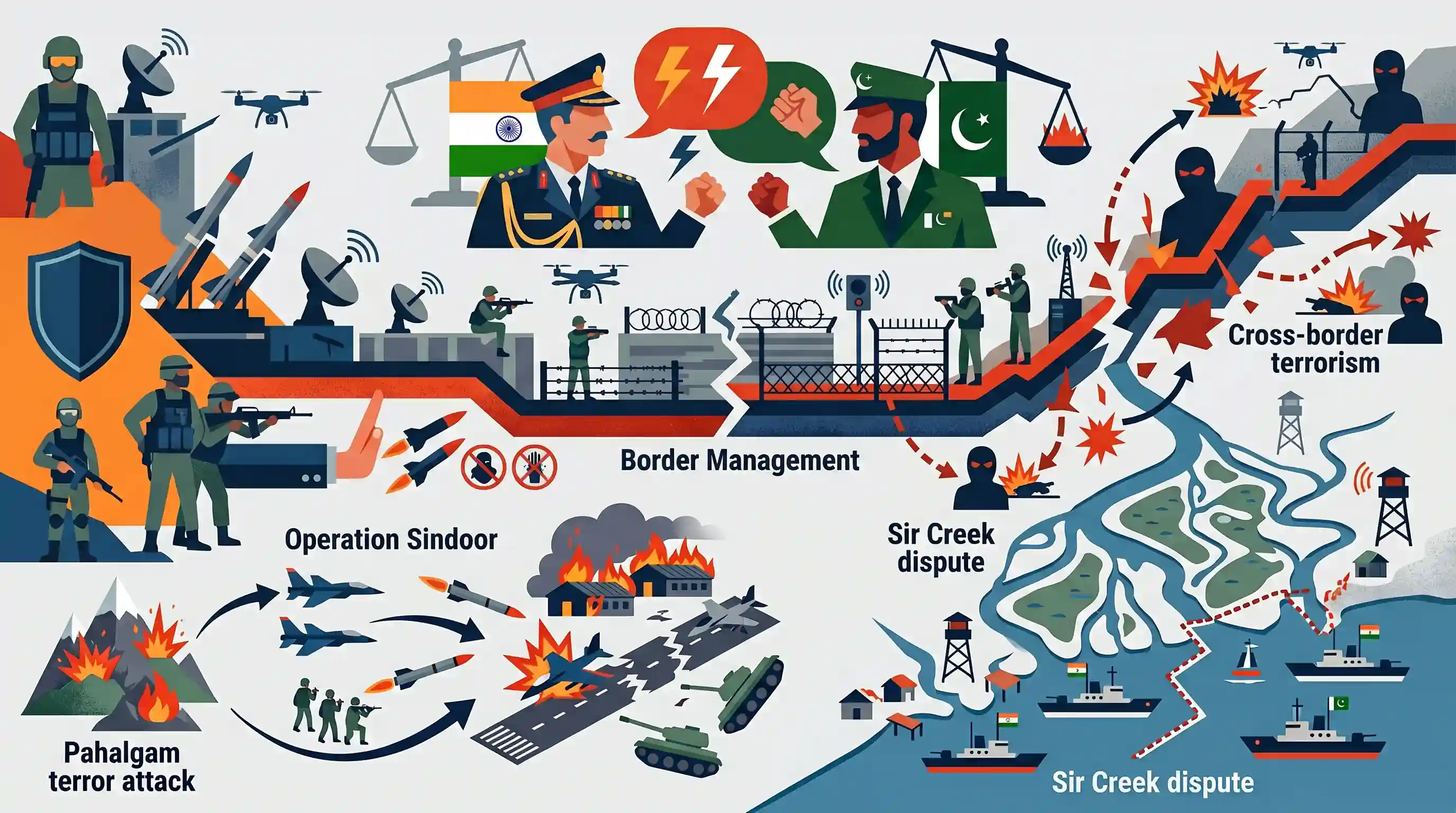
Tensions between India and Pakistan have escalated following mutual warnings from top defence officials of both nations. Pakistan's Defence Minister warned India against future military conflicts in response to assertions by India's Defence Minister Rajnath Singh and Army Chief Gen. Upendra Dwivedi regarding India's readiness to counter state-sponsored terrorism. The rhetoric follows India's 'Operation Sindoor', a military action launched in May 2025 responding to the Pahalgam terror attack, which reportedly resulted in significant destruction of Pakistani military assets. Furthermore, the disputed Sir Creek maritime boundary was highlighted as a critical sector where India maintains a zero-tolerance policy against any misadventure.
Key Points
- Pakistan Defence Minister Khawaja Asif warned India against military escalation in response to assertive statements by India's defence leadership.
- Indian Army Chief Gen. Upendra Dwivedi and Defence Minister Rajnath Singh strongly cautioned Pakistan against cross-border terrorism, warning of severe consequences and a lack of restraint in future conflicts.
- The exchange of warnings stems from 'Operation Sindoor', launched by India on May 7, 2025, to target terror infrastructure following the April 22 Pahalgam terror attack.
- Air Chief Marshal A.P. Singh confirmed significant damage to Pakistan's military infrastructure, including aircraft and radar systems, during Operation Sindoor.
- The Sir Creek estuary, a disputed maritime region between Gujarat's Rann of Kutch and Pakistan, emerged as a potential flashpoint with India warning of a decisive response to any misadventures there.
Important Terms
Operation Sindoor

India's May 2025 military operation involving precision strikes against terror infrastructure in Pakistan (e.g., Bahawalpur, Muridke) following the Pahalgam attack, establishing a new kinetic response doctrine.
UPSC context
GS Paper III (Security) and II (International Relations); tests India's evolving deterrence doctrine and military response to cross-border terrorism.
Sir Creek dispute
A 96-km tidal estuary dispute in the Rann of Kutch between India (Gujarat) and Pakistan (Sindh), impacting maritime boundaries, Exclusive Economic Zone (EEZ) rights, and fishing resources.
UPSC context
GS Paper II (IR) and I (Geography); critical for border management and maritime security discussions between India and Pakistan.
State-sponsored terrorism
The active government support (funding, training, or sanctuary) provided to violent non-state actors to achieve foreign policy goals, often cited in the context of proxy wars.
UPSC context
GS Paper III (Internal Security); essential for understanding asymmetric warfare and security challenges from neighboring states.
Thalweg Principle
International law principle stating that if a waterway defines a boundary, the border follows the mid-channel of the navigable stream, invoked by India in the Sir Creek dispute.
UPSC context
GS Paper II (International Law/IR); tests technical knowledge of maritime boundary demarcation and treaty interpretation.
2019 Balakot airstrike
A significant 2019 Indian Air Force precision strike on a Jaish-e-Mohammed terror camp in Balakot, Pakistan, following the Pulwama attack, serving as a precedent for punitive military action.
UPSC context
GS Paper III (Security); relevant for studying historical precedents of India's "pre-emptive" strike doctrine.
Prelims Trap
"Under the Thalweg principle, estuary boundaries are drawn strictly along the eastern bank of the water body."
The Thalweg principle, invoked by India, dictates that boundaries in navigable water bodies lie in the middle of the main channel, not along either bank.
Static Concepts Connected
What is the core geographical and legal dispute over Sir Creek?
- 96-km Estuary: A 96-km tidal estuary in the Rann of Kutch marshlands, separating Gujarat from Pakistan's Sindh province before emptying into the Arabian Sea.
- Pakistan's claim: Pakistan claims the entire creek based on the 'Green Line' (eastern bank) designated in a 1914 Bombay Government Resolution.
- Thalweg Doctrine: India invokes this international law, arguing the boundary should lie mid-channel since the estuary is navigable during high tide.
How does the Sir Creek demarcation impact Exclusive Economic Zones (EEZ)?
- Maritime baseline: The terminal point of the land boundary in the creek dictates the angle and starting point for projecting maritime boundaries into the Arabian Sea.
- UNCLOS rules: Under the UN Convention on the Law of the Sea (UNCLOS), a slight shift in the land boundary drastically alters the 200-nautical-mile EEZ allocation.
- Resource access: Resolving the boundary determines sovereign access to highly lucrative fishing grounds and unexploited offshore oil and gas reserves.
Cross-Topic Patterns
Active deterrence & Internal Security
India's shift from pre-2016 strategic restraint to active deterrence (surgical strikes, Operation Sindoor) links internal security (counter-terrorism) directly to proactive forward-defence diplomacy.
Water diplomacy as a coercive tool
The suspension of the Indus Waters Treaty amid border escalations shows a growing trend of weaponizing transboundary environmental and water-sharing agreements in geopolitical conflicts.

Expect a Prelims 2026 multi-statement question linking Sir Creek's geography, UNCLOS EEZ limits, and the Thalweg doctrine.
Linked PYQs · 2
Linked PYQs · 2
- 2016MainsGS3
The terms 'Hot Pursuit' and 'Surgical Strikes' are often used in connection with armed action against terrorist attacks. Discuss the strategic impact of such actions.
- 2016MainsGS2
Increasing cross-border terrorist attacks in India and growing interference in the internal affairs of several member-states by Pakistan are not conducive for the future of SAARC (South Asian Association for Regional Cooperation)." Explain with suitable examples.
