Occupational Safety Crisis in Pakistan Coal Mines
Source:The Hindu ↗
Why It Matters
The incident highlights the critical importance of occupational safety and disaster management in extractive industries. It draws direct parallels to challenges in India's own mining sector, testing candidates on issues related to labour protection, environmental hazards of mining, and regulatory enforcement.
Summary
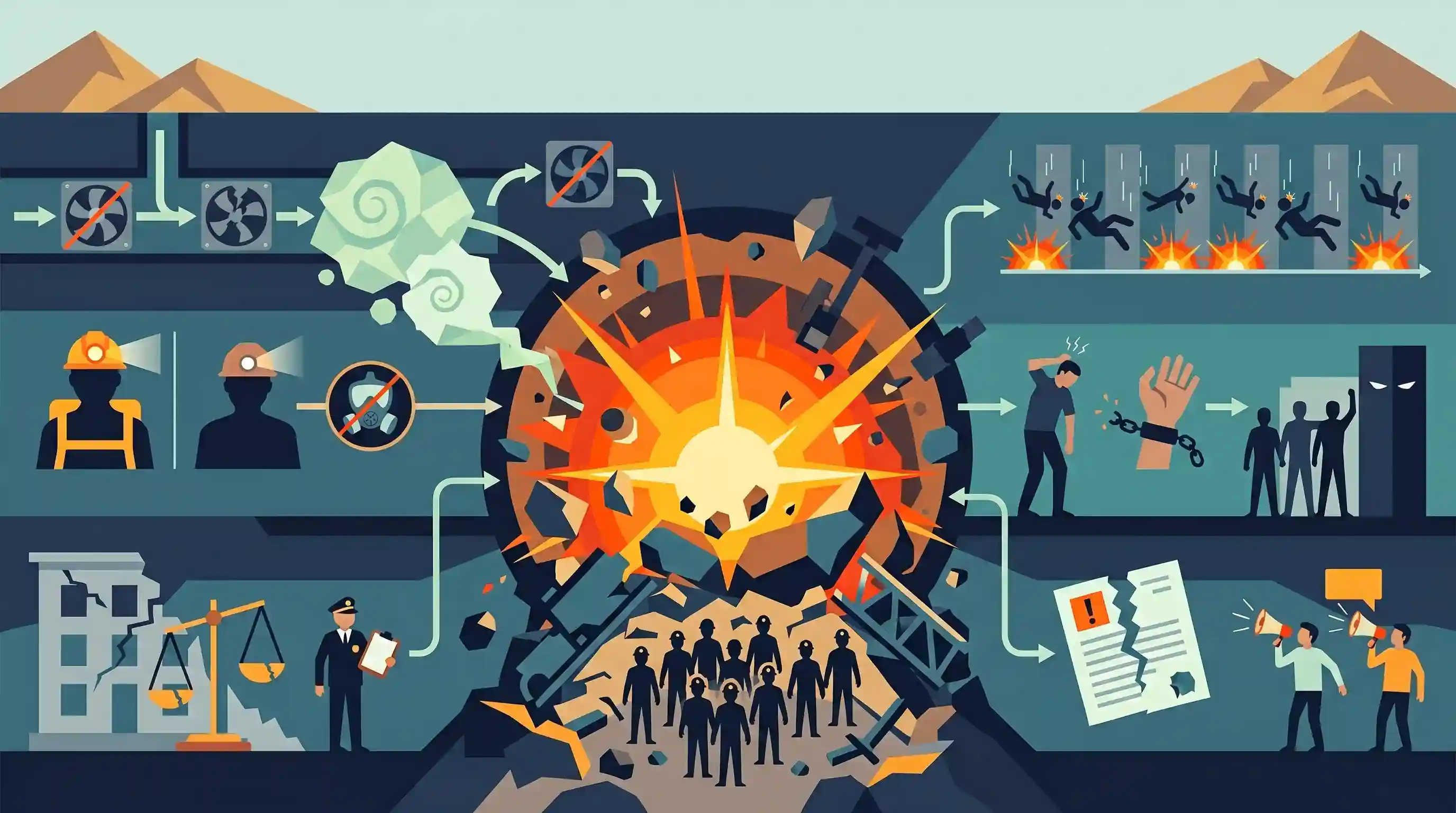
At least 11 workers died following a methane gas explosion and subsequent collapse at a coal mine in the Sanjdi area of Balochistan, Pakistan. The disaster underscores the persistent occupational hazards and poor safety standards plaguing Pakistan's mining sector, where an estimated 100-200 miners die annually according to the Pakistan Central Mines Labour Federation. Frequent accidents are attributed to inadequate safety gear, poor ventilation causing methane build-up, and weak regulatory enforcement, highlighting a severe deficit in labour rights and disaster management protocols in the resource-rich region.
Key Points
- A methane gas explosion triggered a coal mine collapse in Balochistan's Sanjdi area, killing 11 workers including a contractor.
- The Pakistan Central Mines Labour Federation estimates an annual death toll of 100-200 miners in the country due to hazardous conditions.
- Primary causes of mining fatalities in the region include methane explosions, wall collapses, and flooding, exacerbated by poor ventilation and lack of safety equipment.
- The incident highlights the severe lack of occupational safety regulations and labour rights protections in Pakistan's resource-rich but perilous mining industry.
Important Terms
Occupational Safety and Health (OSH)

A multidisciplinary field focused on the safety, health, and welfare of workers. It aims to prevent work-related injuries, diseases, and fatalities through primary prevention and hazard control.
UPSC context
GS II (Governance) & GS III (Labour/Economy); relates to the OSH Code 2020 and welfare in hazardous sectors like mining.
Methane (Firedamp) Explosion
A chemical reaction where methane gas (firedamp) trapped in coal seams accumulates and ignites, causing high-pressure waves and fires. It is a major hazard in underground mining.
UPSC context
GS III (Disaster Management/Environment); tests understanding of anthropogenic disasters, industrial safety, and hazardous gas properties.
ILO Convention No. 176
The ILO 'Safety and Health in Mines Convention, 1995,' which establishes international standards for mine safety, employer responsibilities, and worker rights to be informed and protected.
UPSC context
GS II (Social Justice/IR) & GS III (Labour); tests knowledge of international labour standards and India's status as a non-signatory.
Disaster Management (Mining)
The systematic framework for preparing, mitigating, and responding to mining accidents. In India, it involves the Directorate General of Mines Safety (DGMS) and NDMA guidelines for industrial disasters.
UPSC context
GS III (Disaster Management); crucial for understanding institutional frameworks (NDMA/DGMS) and remedial measures for anthropogenic hazards.
Balochistan (Geostrategic context)
Pakistan's resource-rich province, strategically vital due to its mineral wealth, the Gwadar Port, and its role as the hub of the China-Pakistan Economic Corridor (CPEC).
UPSC context
GS II (International Relations); essential for India-Pakistan relations, regional security, and energy corridor dynamics (CPEC).
Pakistan Central Mines Labour Federation (PCMLF)
A key trade union representing Pakistani miners, affiliated with IndustriALL Global Union. It advocates for OSH standards and labour rights in Pakistan's unregulated mining sector.
UPSC context
GS II (International Relations); case study of labor rights and regulatory challenges in neighborhood policy and regional human rights.
Prelims Trap
"The Directorate General of Mines Safety (DGMS) operates under the administrative control of the Ministry of Mines."
The DGMS functions under the Ministry of Labour & Employment, not the Ministry of Mines. It regulates occupational health and safety, not mining concessions.
Static Concepts Connected
What is Coal Bed Methane (CBM) and how does it relate to mining hazards?
- Formation: It is an unconventional natural gas trapped within coal seams. The methane is adsorbed into the solid matrix of the coal and requires depressurization (usually pumping out groundwater) to extract.
- Dual Nature: If unvented during active mining, it mixes with oxygen to cause fatal explosions. However, if extracted beforehand, it serves as a valuable, clean-burning energy resource.
- Sweet Gas: CBM is often referred to as 'sweet gas' because it typically lacks hydrogen sulphide, eliminating the need for complex desulphurization and reducing environmental pollution.
What is the regulatory framework for mine worker safety in India?
- Statutory Authority: The Directorate General of Mines Safety (DGMS), a statutory body under the Ministry of Labour & Employment, enforces the regulations of the Mines Act, 1952.
- Judicial Intervention: The National Green Tribunal (NGT) actively bans hazardous, unscientific extraction methods like 'rat-hole' mining (banned in Meghalaya in 2014) which cause frequent roof collapses and flooding.
- New Labour Codes: The Occupational Safety, Health and Working Conditions (OSH) Code, 2020 subsumes the Mines Act, updating provisions for safety gear, ventilation, and disaster protocols.
Cross-Topic Patterns
Energy Transition & Labour Rights
As climate commitments force a phase-down of coal, the discourse shifts to a 'Just Transition', emphasizing the rehabilitation, alternative livelihoods, and safety nets for vulnerable mine workers.
Underground Disasters & NDMA SOPs
Frequent underground collapses (like coal mines or the Silkyara tunnel) overlap with NDMA guidelines on industrial and mining disasters, testing institutional capacity for deep-earth rescue operations.

Expect a Prelims question comparing Coal Bed Methane with Shale Gas, focusing on extraction techniques, depth, and groundwater usage.
Linked PYQs · 4
Linked PYQs · 4
- 2008PrelimsGS1
Mixture of which one of the following pairs of gases is the cause of occurrence of most of the explosions in mines?
- 2000PrelimsGS1
Most of the explosions in mines occur due to the mixing of
- 2025MainsGS3
Mineral resources are fundamental to the country's economy and these are exploited by mining. Why is mining considered an environmental hazard? Explain the remedial measures required to reduce the environmental hazard due to mining.
- 2013MainsGS3
What are the consequences of Illegal mining ? Discuss the Ministry of Environment and Forests' concept of GO AND NO GO zones for coal mining sector.
