Ghulam Khan Border Closure and Af Pak Security Threats
Source:The Hindu ↗
Why It Matters
Knowledge of specific border crossings (Ghulam Khan, Torkham, Spin Boldak) is highly relevant for UPSC Prelims map-based questions concerning Afghanistan and Pakistan. Additionally, understanding the security dynamics and cross-border terrorism in this region provides crucial context for Mains GS2 (International Relations) and GS3 (Security).
Summary
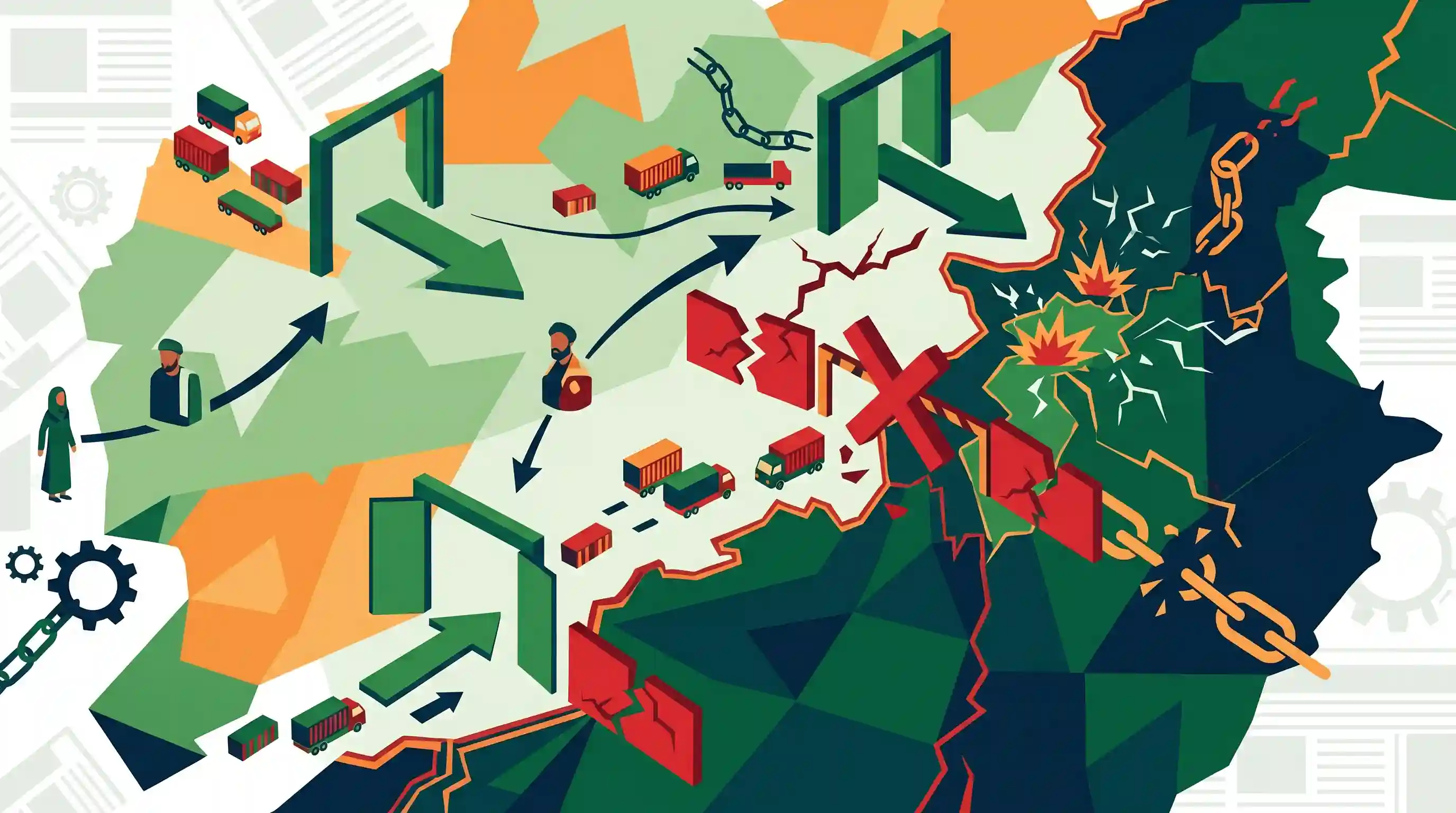
Pakistan has temporarily shut down the Ghulam Khan border crossing, a major trade and transit route connecting its Khyber Pakhtunkhwa province with Afghanistan's Khost province, citing severe security threats after a recent suicide attack in North Waziristan. As a result, Afghan authorities have urged citizens to use alternative crossings like Torkham or Spin Boldak. The closure highlights the ongoing volatility and cross-border security challenges in the Af-Pak region, directly impacting regional trade and connectivity.
Key Points
- Pakistan temporarily closed the Ghulam Khan border crossing with Afghanistan due to elevated security threats following a suicide attack in North Waziristan.
- The Ghulam Khan crossing is a critical trade and transit artery linking Pakistan's Khyber Pakhtunkhwa province with Afghanistan's Khost province.
- Afghan authorities have advised travelers to use alternative border crossings such as Torkham and Spin Boldak during the suspension of operations.
- The incident underscores the persistent cross-border security challenges and terrorism threats that disrupt bilateral trade and civilian movement between the two nations.
Prelims Trap
Spin Boldak and Ghulam Khan are strategic border crossings located in the Wakhan Corridor.
These crossings are on the Durand Line between Pakistan and Afghanistan. The Wakhan Corridor is further northeast, separating Pakistan from Tajikistan and touching PoK.
Static Concepts Connected
What is the Durand Line and why does it remain a contested boundary?
- 1893 Origin: Established in 1893 by British diplomat Mortimer Durand and Afghan Amir Abdur Rahman Khan to demarcate colonial spheres of influence.
- Ethnic Divide: The 2,640 km line arbitrarily bisects ethnic Pashtun and Baloch homelands, causing deep historical resentment.
- Non-recognition: Successive Afghan governments, including the current Taliban regime, refuse to officially recognize it as a formal international border.
How does Af-Pak land transit friction impact India's regional strategy?
- Overland Blockade: Pakistan denies India direct transit rights to Afghanistan. Frequent border closures due to militancy further choke any potential overland trade.
- Chabahar Bypass: This geographic constraint forces India to bypass Pakistan entirely, relying heavily on Iran's Chabahar port and the INSTC to access Central Asia.
Cross-Topic Patterns
Af-Pak crossings as Places in News
UPSC frequently tests Central Asian and Middle Eastern geography. Crossings like Spin Boldak, Torkham, and Ghulam Khan are prime candidates for match-the-following 'Places in News' questions.
Durand Line friction & Chabahar's utility
The unreliability of overland Af-Pak routes contextualizes India’s strategic pivot to alternative maritime-land corridors like Chabahar Port to secure long-term access to Central Asian markets.

A 'Places in News' pairing of Spin Boldak, Torkham, and Ghulam Khan with the Af-Pak border is highly likely in Prelims 2026.
Linked PYQs · 3
Linked PYQs · 3
- 2022PrelimsGS1
Consider the following countries: 1. Azerbaijan 2. Kyrgyzstan 3. Tajikistan 4. Turkmenistan 5. Uzbekistan Which of the above have borders with Afghanistan ?
- 2024MainsGS3
India has a long and troubled border with China and Pakistan fraught with contentious issues. Examine the conflicting issues and security challenges along the border. Also give out the development being undertaken in these areas under the Border Area Development Programme (BADP) and Border Infrastructure and Management (BIM) Scheme.
- 2020MainsGS3
Analyze internal security threats and transborder crimes along Myanmar, Bangladesh and Pakistan borders including Line of Control (LoC). Also discuss the role played by various security forces in this regard.
