Pakistan Airstrikes and Escalating Afghanistan Tensions
Source:The Hindu ↗
Why It Matters
The escalation between Pakistan and Afghanistan into an "open war" drastically alters the geopolitical dynamics of South Asia. For India, instability in its immediate neighborhood poses security risks, particularly concerning state-sponsored terrorism and the regrouping of militant factions like IS-K. It also impacts regional connectivity and trade while presenting new diplomatic challenges for dealing with a volatile Taliban-led Afghanistan and a politically unstable Pakistan. The geography of the conflict zones (like Torkham and Spin Boldak) is highly relevant for Prelims map-based questions.
Summary
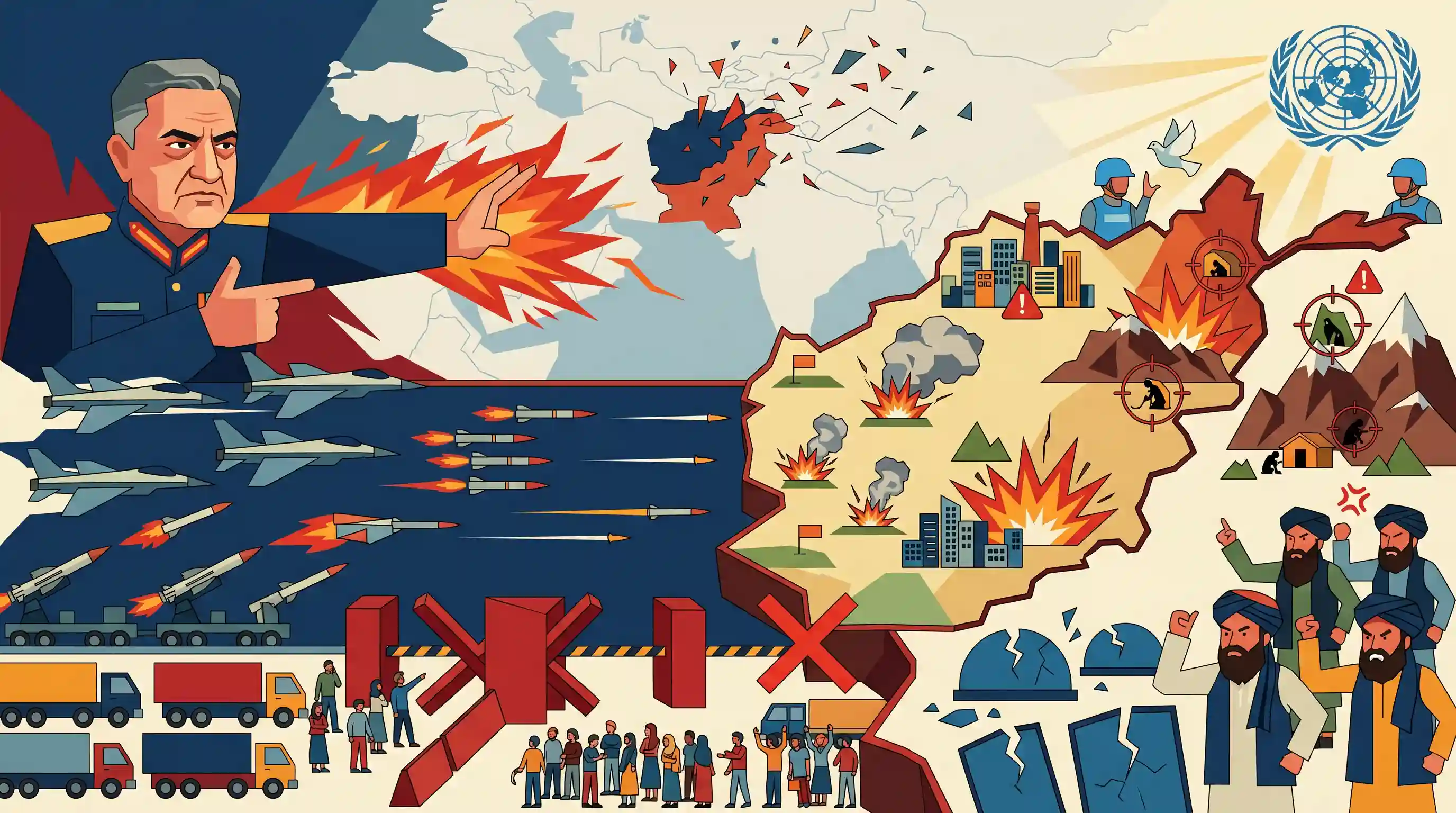
Pakistan has launched widespread airstrikes across multiple Afghan provinces, including Kabul and Kandahar, prompting declarations of an "open war" by the Pakistani Defence Minister against the Taliban government. Islamabad justifies the bombings as counter-terrorism strikes against Islamic State-Khorasan (IS-K) hideouts, a claim the Taliban rejects while condemning the violation of Afghan sovereignty. The escalating military conflict has led to the closure of major border crossings like Torkham and Spin Boldak, severely disrupting trade and civilian movement. The sudden flare-up highlights the deteriorating relations between Pakistan and the Taliban, raising serious concerns for regional security and stability, and drawing calls for restraint from the UN mission in Afghanistan.
Key Points
- Pakistani military jets bombed multiple locations across Afghanistan, including the capital Kabul and the southern stronghold of Kandahar.
- Pakistan justified the airstrikes as necessary operations targeting the hideouts of the Islamic State-Khorasan (IS-K) terror group, a claim rejected by the Taliban.
- Pakistani Defence Minister Khawaja Asif escalated rhetoric by declaring an "open war" against the Taliban administration, indicating a severe breakdown in bilateral relations.
- The escalating violence led to the closure of crucial border crossings such as Torkham and Spin Boldak, severely disrupting cross-border trade and civilian movement.
- The UN mission in Afghanistan appealed for maximum restraint, warning that the conflict threatens to severely destabilize the broader South Asian region.
Important Terms
Taliban

The de-facto governing authority of Afghanistan since August 2021; a Sunni Islamic fundamentalist movement primarily of Pashtun origin.
UPSC context
GS-II: India’s Neighbourhood; critical for understanding regional stability and India's 'wait and watch' policy.
Islamic State-Khorasan (IS-K)
A regional affiliate of ISIS active in the 'Khorasan' region (Afghanistan-Pakistan); it opposes both the Taliban and the Pakistani state.
UPSC context
GS-III: Internal Security; represents the transnational threat of terrorism and radicalization affecting regional peace.
UN mission in Afghanistan (UNAMA)
A UN political mission established to assist the Afghan people, monitor human rights, and facilitate regional cooperation for peace.
UPSC context
GS-II: International Institutions; reflects the global community’s role in conflict resolution and humanitarian oversight.
Tehrik-e-Taliban Pakistan (TTP)
An umbrella organization of various militant groups based along the Afghan-Pakistani border; it aims to overthrow the Pakistani government.
UPSC context
GS-II/III: Security Challenges; the primary friction point between Islamabad and Kabul, driving cross-border tensions.
Durand Line
The 2,640 km international border between Afghanistan and Pakistan, established in 1893, which Afghanistan has historically refused to recognize.
UPSC context
GS-II: International Relations; a legacy of colonialism and a central trigger for territorial disputes in South Asia.
Torkham and Spin Boldak
Major cross-border transit points between Pakistan and Afghanistan; essential for trade, transit, and the movement of refugees.
UPSC context
GS-II: Bilateral Relations; their closure serves as a tool for economic leverage and impacts the regional humanitarian crisis.
Prelims Trap
IS-K and the Afghan Taliban share the same ideological objectives.
Aspirants often group them together. However, they are bitter rivals; the Taliban focuses on a national Deobandi Emirate, while IS-K pursues a global Salafi-Jihadist caliphate.
Static Concepts Connected
What is the historical significance of the Durand Line?
- Colonial Origin: Established in 1893 via an agreement between British India (Mortimer Durand) and Afghan Amir Abdur Rahman Khan.
- Disputed Status: Afghanistan has historically refused to formally recognize the 2,640 km border, as it arbitrarily divides ethnic Pashtun and Baloch populations.
How does border volatility impact India's transit strategy?
- Landlocked Vulnerability: Closures of Torkham and Spin Boldak sever Afghanistan's trade, highlighting its heavy dependence on Pakistani transit routes.
- The Chabahar Alternative: Validates India's investment in Iran's Chabahar Port and the INSTC, providing a strategic bypass around Pakistan to reach Central Asia.
Cross-Topic Patterns
Af-Pak instability + India's INSTC
Closure of land borders like Torkham reinforces the economic rationale for the International North-South Transport Corridor and Chabahar Port, offering India unhindered access to Central Asia.
Ideological fault-lines in terrorism
The operational conflict stems from competing visions: the Taliban's localized, Deobandi-based governance versus IS-K's transnational, Salafist pursuit of a unified global caliphate.

Expect a 2026 mapping question matching crossings (Torkham/Spin Boldak) to countries, or a statement contrasting IS-K vs Taliban ideologies.
Linked PYQs · 4
Linked PYQs · 4
- 2016MainsGS2
Increasing cross-border terrorist attacks in India and growing interference in the internal affairs of several member-states by Pakistan are not conducive for the future of SAARC (South Asian Association for Regional Cooperation)." Explain with suitable examples.
- 2025MainsGS3
Terrorism is a global scourge. How has it manifested in India? Elaborate with contemporary examples. What are the counter measures adopted by the State? Explain.
- 2022PrelimsGS1
Consider the following countries: 1. Azerbaijan 2. Kyrgyzstan 3. Tajikistan 4. Turkmenistan 5. Uzbekistan Which of the above have borders with Afghanistan ?
- 2023PrelimsGS1
Consider the following pairs: Area of conflict mentioned in news Country where it is located 1. Donbas : Syria 2. Kachin : Ethiopia 3. Tigray : North Yemen How many of the above pairs are correctly matched?
