South Asia Geopolitical Shifts and India National Security
Source:Indian Express ↗
Why It Matters
The changing relationship between Pakistan and Bangladesh directly impacts India's regional hegemony and national security. This topic is highly relevant for GS Paper 2 (Neighborhood relations) and GS Paper 3 (Border security), as shifts in South Asian alliances frequently feature in Mains examinations.
Summary
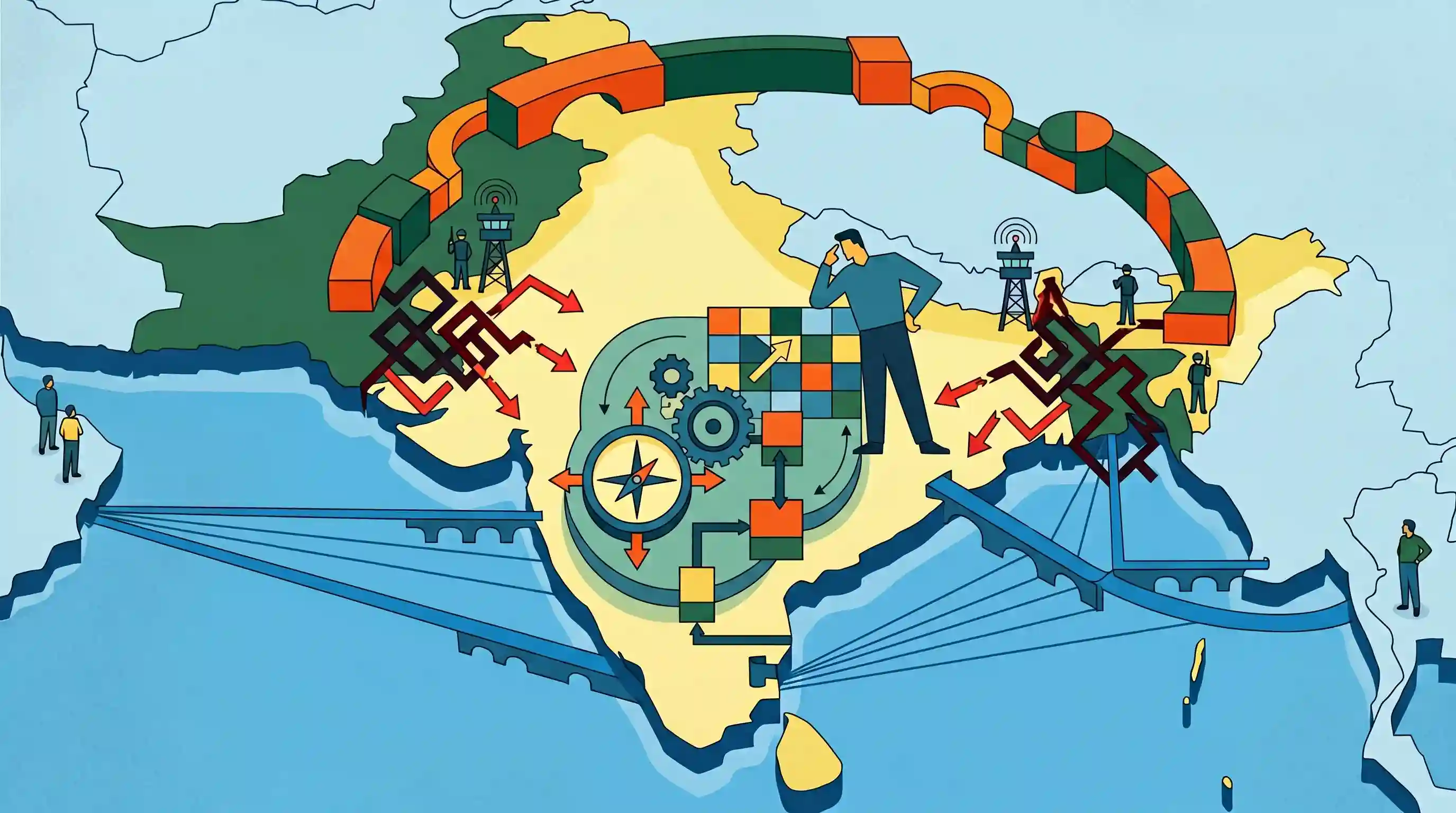
The article analyzes the complex and evolving geopolitical dynamics in South Asia, focusing on the growing diplomatic proximity between Pakistan and Bangladesh following recent political changes in Dhaka. This emerging Islamabad-Dhaka axis presents a significant strategic challenge for India, potentially threatening the security of its eastern borders and complicating its 'Neighbourhood First' policy. The alignment may revive concerns over cross-border terrorism and anti-India activities. Consequently, India must maintain high vigilance and strategically recalibrate its foreign policy to protect its national security and maintain regional stability.
Key Points
- Recent political shifts in Dhaka have led to a warming of ties between Pakistan and Bangladesh, altering traditional geopolitical alignments in South Asia.
- A potential Islamabad-Dhaka axis poses strategic and security challenges for India, particularly concerning the stability of its eastern frontier.
- The growing closeness could undermine India's 'Neighbourhood First' policy and efforts toward regional integration.
- India needs to remain vigilant about the potential revival of anti-India activities, cross-border terror networks, and Chinese influence leveraging this new dynamic.
- New Delhi must proactively recalibrate its diplomatic outreach and border management strategies to safeguard its regional interests and ensure stability.
Important Terms
Neighbourhood First Policy

India's diplomatic strategy giving primacy to its immediate neighbors. It focuses on enhancing connectivity, trade, and security cooperation to ensure regional stability and prosperity through consultative engagement.
UPSC context
GS Paper 2: International Relations. Tests understanding of India's regional leadership, development partnerships, and management of neighborhood challenges.
SAARC (South Asian Association for Regional Cooperation)
An intergovernmental organization established in 1985 to promote regional integration in South Asia. It includes eight members, though it is currently largely dormant due to India-Pakistan tensions.
UPSC context
GS Paper 2: Regional Groupings. Tests analysis of South Asian regionalism, its institutional failures, and bilateral impediments to cooperation.
BIMSTEC
A regional organization connecting seven South and Southeast Asian nations around the Bay of Bengal. It facilitates technical and economic cooperation and acts as a bridge between South and Southeast Asia.
UPSC context
GS Paper 2: Bilateral and Regional Groupings. Tests India's strategic shift toward the Bay of Bengal and synergy with 'Act East' goals.
Act East Policy
India’s foreign policy initiative aimed at strengthening economic, strategic, and cultural ties with the Asia-Pacific region, with a focus on connectivity through its Northeast and neighboring countries.
UPSC context
GS Paper 2: Effect of politics of developed and developing countries. Tests India's maritime and terrestrial outreach to Southeast Asia.
Cross-border Terrorism
Terrorist activities where perpetrators or planners operate from one country to commit acts of violence in another, often supported or tolerated by the host state to achieve strategic goals.
UPSC context
GS Paper 3: Internal Security. Tests challenges to national security, border management, and the role of external state/non-state actors.
Prelims Trap
"CIBMS is deployed exclusively along the India-Pakistan border to counter cross-border terrorism."
UPSC often limits border security tech to the western frontier in trick statements, but CIBMS is heavily deployed on the Bangladesh border too (e.g., BOLD-QIT).
Static Concepts Connected
What is the Comprehensive Integrated Border Management System (CIBMS)?
- Tech-driven security: Replaces physical patrols with technological solutions like thermal imagers, aerostats, and underground sensors.
- Riverine gap management: Crucial for unfenced, difficult terrains like the Brahmaputra riverine patches in Assam (e.g., the BOLD-QIT project).
- Primary objective: Designed to curb illegal migration, smuggling, and the trafficking of Fake Indian Currency Notes (FICN).
Why is the Siliguri Corridor a persistent strategic vulnerability for India?
- Geographic choke point: A narrow strip of land (approx. 20-22 km wide) connecting mainland India to its Northeast.
- Proximity to adversaries: Bordered by Nepal, Bhutan, and Bangladesh, with extreme proximity to the Chumbi Valley (Tibet).
- Strategic severability: Hostile alignments in Dhaka or Beijing could threaten to sever India's land access to the entire Northeastern region during a conflict.
Cross-Topic Patterns
BIMSTEC paralysis via SAARC-like dynamics
India pivoted from SAARC to BIMSTEC to bypass Pakistan's obstructionism. A new Pak-aligned administration in Bangladesh could similarly paralyze India's alternative sub-regional platforms like BIMSTEC and BBIN.
Northeast Insurgency & Dhaka Policy
A hostile regime in Dhaka historically correlates with spikes in Northeast insurgency, as militant groups exploit the porous 4,096 km border to find safe havens and logistical support.
CPEC extension to Bay of Bengal
The conceptual linking of Pakistan-China corridors to Bangladesh's Mongla or Chittagong ports expands China's 'String of Pearls', creating a dual-front maritime challenge in the Bay of Bengal.

Expect a 2026 multi-statement question linking Bangladesh's regime shift to the operational viability of BBIN and Siliguri Corridor.
Linked PYQs · 3
Linked PYQs · 3
- 2015MainsGS2
Terrorist activities and mutual distrust have clouded India-Pakistan relations. To what extent the use of soft power like sports and cultural exchanges could help generate goodwill between the two countries? Discuss with suitable examples.
- 2016MainsGS2
Increasing cross-border terrorist attacks in India and growing interference in the internal affairs of several member-states by Pakistan are not conducive for the future of SAARC (South Asian Association for Regional Cooperation)." Explain with suitable examples.
- 2016MainsGS3
Border management is a complex task due to difficult terrain and hostile relations with some countries. Elucidate the challenges and strategies for effective border management.
